


Interview

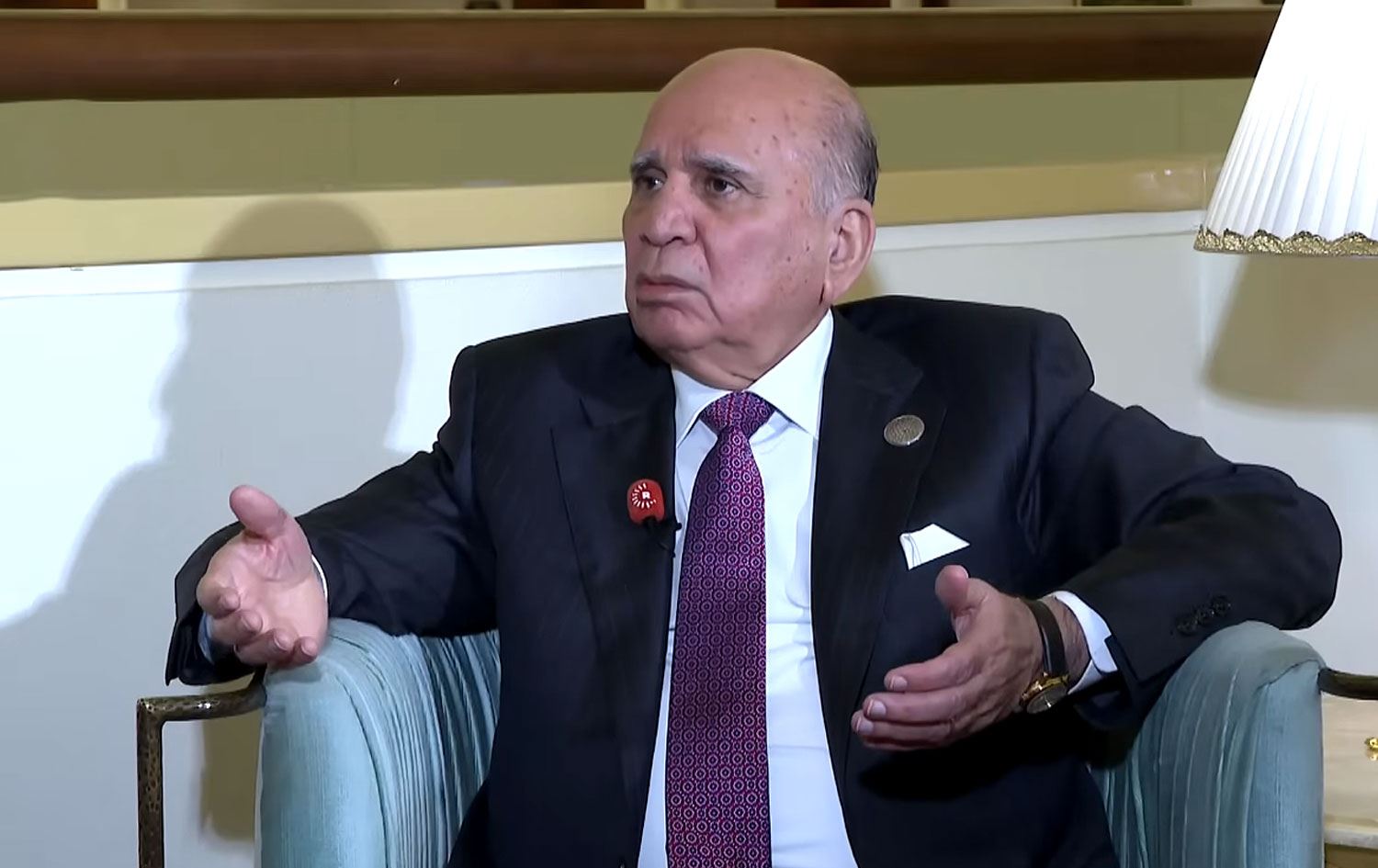
Iraqi Foreign Minister Fuad Hussein speaking to Rudaw in an interview in Doha on December 7, 2025. Photo: Screengrab/Rudaw
ERBIL, Kurdistan Region - Iraqi Foreign Minister Fuad Hussein has warned that the participation of Iran-backed armed groups in Iraq’s next government could complicate relations with the United States.
In an interview with Rudaw's Sangar Abdulrahman in Doha on Sunday, Hussein addressed concerns over armed groups possibly participating in Iraq’s future government. “You know it’s not talk – they [US] published a list. When they publish a list, it means they won’t deal with these groups. Those whose names are on the list, their law doesn't permit them, and their policy doesn't accept this,” Hussein said, noting that the matter directly affects Iraq’s future governance.
"This comes to Iraq's arena. What do we do? Will we form a government, or will Iraq form a government with representatives of those names on the list? Well, how do you deal with America? Should Iraq continue dealing with America? The answer: yes, it should. Can you do without America? Very difficult,” he said.
Iran is believed to have many proxy groups in Iraq, which it has used in the past to target US interests in the region. Washington has taken several measures to ensure that Baghdad is free of Tehran’s influence, including the rescinding of a waiver which had allowed Iraq to buy Iranian electricity for years.
In September, the US designated four Iran-backed Iraqi militia groups as foreign terrorist organizations, saying the decision came as part of President Donald Trump’s order to impose “maximum pressure” on Iran.
The designations came three weeks after the Iraqi government revoked a controversial bill to restructure the Popular Mobilization Forces (PMF, or Hashd al-Shaabi), following intense pressure from the US. Although the PMF is part of Iraq’s official security apparatus, many of its factions still operate independently, with impunity, and reportedly maintain strong ties to Iran.
Reports emerged on Thursday that Iraq’s Committee for Freezing Terrorist Assets had ordered a freeze on movable and immovable property linked to Hezbollah and Yemen’s Ansarullah, widely known as the Houthis. Both groups are believed to be Iran’s proxies. Prime Minister Mohammed Shia’ al-Sudani quickly described the listing as an “error” and ordered an investigation. The Iraqi presidency also distanced itself from the move, saying it played no role in the decision.
A US State Department spokesperson told Rudaw on Friday it was “disappointed” by Iraq’s reversal of the decision.
Asked whether the US would refuse to work with a government that includes such groups, Hussein said, “I don't know if they'll deal or not. We have Syria's experience of how they dealt. But what's being discussed now, according to their law, means creating problems for [the government].”
Hussein stressed that Iraq’s political and economic ties with the US make the question unavoidable. “Iraq's economy and currency are linked to the dollar. Economically linked to America, politically linked to America, and security-wise linked. Well, how do you deal with them?” he added.
Iraq held its parliamentary elections on November 11. Since then, political parties and coalitions have been engaged in complex negotiations to form a new government.
Hussein highlighted the ongoing deadlock over the prime ministership, saying that the Shiites have proposed nine names. "But nine names mean no agreement. It means there is no agreement on a person,” he said, adding that Kurdish and Sunni factions have also yet to finalize their choices.
Hussein also touched on the financial situation in Iraq.
“Some deny it, but there’s a liquidity problem in Iraq. What’s been printed in Iraqi dinars, if I remember correctly, I think 104 trillion Iraqi dinars have been printed in the market. Well, those 104 trillion don’t come back into the economy,” he said.
The following is the full transcript of the interview with Iraqi Foreign Minister Fuad Hussein:
Let me start with the latest development that had political repercussions in Iraq - the terrorist listing of Hezbollah and Yemen's Houthis, which Iraq's government later clarified was an error. Was it really an error or, as some analyses suggest, was it a plot against Iraq's current prime minister?
Fuad Hussein: What I know is that a list came from the Malaysian state. That state prepared a list according to its policy and international decisions and generalized it to other states. This list came to Iraq and was later sent to that committee. I don't know if the committee read it or not, studied it or not, but it was later published. The problem is that it was published in Iraq's Official Gazette, and when published there, it becomes official under the name of the Iraqi state.
When discussing any political or armed force regarding terrorism issues, it should fundamentally be studied in Iraq's Security Council, Ministerial Council for National Security. I'm a member of that council, and this matter was never discussed or reviewed there. This means that when it came to the Central Bank, and they sent it to the committee related to financial sanctions monitoring, it's unclear if they reviewed it or not. They sent it to the Gazette, and it was published. No,w an investigation committee has been formed. Let’s see what the result from the committee will be. But it's clear to me that this matter didn't come to the Security Council and wasn't discussed at the Security Council. Anything that is not discussed at the Security Council and is related to security issues and armed organizations must be decided there, and decisions must be made there. Let's see what the investigation results will be.
Did America contact you about this matter?
No, but the US State Department announced they were displeased that Iraq's government issued a statement saying this wasn't correct. But let’s see [what] the investigation committee [decides]. I don't think there is a political decision in Iraq. There is no political decision in Iraq. Whether it was technical, how it was, done intentionally or by error, I don't know.
Did the Iranians contact you?
No, I've seen the Iranians, and they know, political decisions are not like this.
Elections are over, results are nearly finalized, yet the Coordination Framework hasn't designated a candidate for prime minister. Kurds and Sunnis are waiting for them, or is no side ready yet?
Neither have the Shiites reached an agreement on a person - they've proposed nine names, but nine names mean no agreement. It means there is no agreement on a person - nor have the Sunnis reached agreement, nor Kurds. There's dialogue between Shiite and Shiite, Sunni and Sunni and Among Kurds, the dialogue is through media, which is unfortunate - there's no such meeting to discuss this matter. But there's dialogue between Kurds and Shiite, between Sunnis and Shiite, Sunnis and Kurds. There are these discussions, but they haven't reached any conclusion yet.
Why is there no Kurdish-Kurdish dialogue?
It's unfortunate, I don’t like it. I don't want to say through the media whose fault it is, but when there's no dialogue… We see the Shiites have dialogue among themselves and have a framework. Sunnis, who had major disagreements, created a framework at least for dialogue. But we don't have that framework for dialogue.
Can't the Kurds create that framework?
By God, it can, why not? It existed in the past; why couldn’t it? But the reality is, to answer your question: Does it exist or not? It doesn't exist now.
Mr. Nourli al-Maliki came to President Masoud Barzani, Mr. Sudani met President Barzani, Mr Nechirvan Barzani, and Masrour Barzani in Dohuk. Who has a stronger chance of becoming Iraq's prime minister? Will it be one of them?
I can't discuss that now, but one thing - among those nine people, these two gentlemen's names are on the list. Which one will it be? I don't know. Either both remain as candidates, or one will be chosen. I don’t know. This is the Shiites' decision, but there's still major competition among Shiite political forces to designate someone. I hope they can in the coming period, because that would help Kurds reach a decision and, of course, it will help Sunnis too.
What's the connection to Kurds?
If the Shiites make a decision, it means that the government won't be formed if there's no president, and the government won't be formed if there's no parliament speaker. The steps are: first, there must be a parliament speaker, then a president, then the president designates the prime minister. But the names need to be known. When the Shiites reach a conclusion and designate the name, if Kurds don't designate names, it creates problems for the Iraqi state.
Can Kurds go to parliament with one presidential candidate?
If we reach an agreement, yes. If we don't, we can't.
That possibility, which one is it?
That is what I am saying…
Will a deal be made?
I think it is good for us to reach an understanding on the presidency matter - otherwise we return to the old equation. The old equation that Sunnis used - whoever has the majority among Sunnis designates the person [parliament speaker]. Shiites have decided it [premier selection] should [decided] be by agreement, that is, shouldn’t be by majority and minority. If we can't agree [selection the Iraqi President], we return to the equation where the majority designates, but even if the majority decide among the Kurds, that also requires an alliance.
But will the PUK accept that?
That's what I'm saying - if the majority designates it, meaning KDP. If the KDP designates it [the president], this needs alliances in parliament; Shiites must also accept it. So you ultimately need dialogue and negotiation with the Shiites. It's better if PUK and KDP reach a conclusion beforehand. But if they don't reach a conclusion, honestly, it's not unlikely that both sides will go to parliament with two different candidates, and that's not good.
Will the KDP have a candidate?
What I understand is that the KDP insists on taking the presidency position. It's better to reach an agreement with PUK. If they don't, it means going into competition. Competition requires alliances with both Shiites and Sunnis. Those alliances need to be clear because if you go into competition without alliances, problems arise.
So you want to reach an agreement with PUK that the presidency position goes to KDP?
I'm saying that at this time it is clear, this is the KDP's policy, and Baghdad's reality is that - when I speak to most leaders, they don't object to changing this tradition that [the presidency] has been for the PUK's until now - for it to be KDP's this time. But they say it's better to have understanding between you. If there's no understanding, you'll come to parliament in competition. Then each party decides what to do, and each parliament member from other forces decides for themselves, meaning it becomes intense competition. What the result will be, one does not know what the result will be?
Can KDP create that alliance to create a majority to gain the presidency?
If they reach an understanding with PUK, it becomes a joint alliance. But if not, I think KDP can now play a major role in Baghdad, and Shiites and among the Sunnis they make special calculations for the KDP. But this includes regional calculations too - it's not just Iraq's internal situation.
Regionally, do Iran, Turkey, and the United States want KDP to take the presidency?
America doesn't interfere in these matters, but it's not unlikely that if they know who the person is, they'll give an opinion. But until now, it's unclear who the person is. Also for Shiites and Sunnis - besides the party, discussing the person is important. Of course, which person you designate for which position matters.
You and I were standing together in Dohuk at the Middle East Peace and Security (MEPS) Forum. A dear friend for yours came and said, "Hello, Mr. President" to you. I later mentioned and published that they said that to you.
I said this is a journalist and will publish it. In conclusion, you did publish it.
It was news for me, really. I read it as you being KDP's candidate again for the presidency position. Is that true?
I don't know, honestly, I don't know. But it's discussed in the media and other places. Just as other people's names are discussed, my name has come up for discussion…
Would you like to have the position?
… Who decides in the end is the party leadership, and who decides is President Barzani. What President Barzani decides will be it.
When will they decide on this?
It should be soon. It's not right to delay decisions, because honestly, it requires work. If we reach an understanding with PUK, that's good. If we don't reach an understanding with the PUK, KDP needs to be clear, decide: one, on the position; two, on the candidate, so work can be done for it. What comes at the last moment... KDP's decision is one thing, and people's acceptance is another. You need both - you need the decision, and you need acceptance. Acceptance requires work.
You haven't agreed with PUK on the presidency yet. What have you reached with the PUK regarding the tenth KRG cabinet? Will the tenth cabinet be formed?
One of the problems is this: We have two directions, meaning two paths - Kurdistan's path and Baghdad's path. They are linked together. I see that we should separate this, these two paths, meaning separate Kurdistan's path from Baghdad's path. When you connect them, you won’t reach a conclusion. In Baghdad, if KDP and PUK reach an understanding that one takes the presidency and the other takes which ministry, which place in Baghdad. Meaning, Baghdad's equation is different from Kurdistan's equation. But Kurdistan's equation is important for strengthening Kurds in Baghdad. If you're not united in Kurdistan, it means you won't be united in Baghdad. Fighting each other in Baghdad means weakening each other, ultimately weakening the Kurdish cause in Baghdad. For the sake of the Region, for the sake of Kurdistan, and for the sake of the Kurdish cause, we need to reach a conclusion in the Region too. We have a delegation in the Region, the KDP forms two delegations: one for the region and one for Baghdad. I hope the delegation in the Region, the KDP has begun… There was a special meeting, not political meeting, but they continue meetings to reac a conclusion.
What does the Kurdistan Region delegation want to do? What does KDP's delegation want in the Kurdistan Region?
Naturally, they want to have a dialogue with PUK and reach a conclusion. In Kurdistan, ultimately, it is important to have a coalition government. One party cannot rule. A coalition government with PUK and KDP means it also unites the geography. But if it's a coalition government without PUK, it won't work.
Can't the government be formed without the PUK?
Without the PUK, numerically, you can.
In reality?
Because if it's about numbers in parliament based on election results, you can.
Can the KDP create a parliamentary majority without the PUK? But the problem is the geography.
…what?
Can the KDP create a parliamentary majority without the PUK to reactivate the parliament and government?
But if it reaches an understanding with other parties outside the parliament, it is a matter of numbers. But if you reach that agreement with the other parties, besides the PUK, you solve the matter of numbers, but you do not solve the matter of geography. This is a problem that we must study in reality.
Should PUK show flexibility in this?
I don't want to get ahead of negotiations in the Region since there's a separate delegation in the Kurdistan Region. But there needs to be flexibility and no insistence on certain things. You can change ministries, you can form a government, and after a year, make ministerial changes. So it's not a problem. But to insist now on things the other side won't accept isn't right. What's important is forming a coalition government in Kurdistan, because a coalition government strengthens Kurds in Baghdad, as I said, strengthens the region, and strengthens both parties. If no coalition government is formed and we're busy fighting in Baghdad, it weakens both parties in Baghdad.
This is my point - you have relations with Baghdad. How do you move in Baghdad? It's better to move together in Baghdad.
Is the knot just the Interior Ministry, or are there other issues blocking the formation of the tenth cabinet?
The interior topic will be resolved; how they do it, I don't know. But the issue is trust between both sides. You know this media campaign has recently been, really, an unacceptable and low-level media campaign. When it reaches personal and ethical issues, it's very unpleasant. This isn't accepted in our [culture] dictionary. I hope the first thing in negotiations between both sides is to stop the media campaign against each other and reach political topics and political agreements. Even if political agreements are not reached, political criticism is different from personal media campaigns.
What they're doing now - is it a campaign or criticism?
It's a campaign, it’s a campaign. It’s very unpleasant, very. Honestly, I didn't know it was like this, but when I watched, I was very, very displeased. This media campaign about personal and family matters is unacceptable. Our [culture] dictionary doesn't accept this, apart from a political [philosophy] dictionary. If we take this path, it means we are breaking each other's bones [fighting intensely].
Will we soon see a summit of party leaders in Kurdistan?
I don’t believe so. don't believe a summit meeting is necessary. I believe that both delegations should sit and prepare the ground first to…
I mean for all parties, the first person of all winning parties in the election, not just KDP and PUK.
It's not necessary for his excellency Mr. Masoud himself to participate in the meetings. I suggest that at the political bureau level, both sides sit. Then Mr. Nechirvan, as Kurdistan Region President, invites the political parties - those political parties that have representation in Baghdad, if it's about Baghdad, if it's about Kurdistan, the political parties that have representation in Kurdistan Parliament. He should have a meeting. His excellency President Masoud can supervise the process at a distance. I think that's better. But I see something, a year has passed over the Kurdistan Parliament [elections], and no session has been held. This is a dangerous signal, because it's not unlikely that some people will go to the Federal Court and request that parliament not convening creates problems. It's also not good for us to think about going to [conduct another] the next election, because that creates a crisis.
This is being talked about a lot. Will elections be repeated?
I don't see it as good. I'm giving a personal opinion in this situation. Why to repeat elections? I don't know why. Parliament hasn't convened yet. Let's try to convene parliament [first]. Part of the agreement between KDP and PUK should be that parliament convenes. There was such an agreement a month or two ago. Unfortunately, it wasn't implemented, but time hasn't passed yet. Both parties, along with other parties that have members in Kurdistan Parliament should have a meeting to discuss this matter. We need dialogue. It's not reasonable for dialogue between Kurdistan's political parties to be only through the media. Sunnis sit [together], Shiites sit, but Kurds don't sit?
Why? Are problems so deep that they can't sit together?
I don't see them as deep, but this media campaign against each other is really something rejected and needs to stop as soon as possible, then start dialogue within the framework of meetings.
This media campaign you mention arose from the incidents in Lajan village in Khabat district. According to the Kurdistan Region Security Council's statement, Sayyid al-Shuhada group was involved in those disturbances. Will they be held accountable?
That group, with their leaders, denied it and sent a message saying we have no connection at all to those incidents. Those names mentioned have no connection to us. They have a different interpretation.
So they officially sent a response to Kurdistan [Region], saying they had no hand in it?
Yes.
Still on armed groups in Iraq - has America spoken with you about them not participating in Iraq's future government?
You know it's not talk - they [US] published a list. When they publish a list, it means they won't deal with these groups. Those whose names are on the list, their law doesn't permit them, and their policy doesn't accept this. This comes to Iraq's arena. What do we do? Will we form a government, or will Iraq form a government with representatives of those names on the list? Well, how do you deal with America? Should Iraq continue dealing with America? The answer: yes, it should. Can you do without America? Very difficult. Iraq's economy and currency are linked to the dollar. Economically linked to America, politically linked to America, and security-wise linked. Well, how do you deal with them? This needs to be a question for Iraq's political forces. You should ask them this question in the phase of forming the government.
If they participate, America won't deal with Iraq's government?
I don't know if they'll deal or not. We have Syria's experience of how they dealt. But what's being discussed now, according to their law, means creating problems for [the government].
Kurdistan Region's Prime Minister and Planning Minister sent a letter about census results expressing concerns, especially that the 1957 census, particularly in disputed territories, wasn't calculated and compared, which Iraq's government had previously promised. In the letter, they say that if Iraq doesn't abide by this, we won't be bound by the census results. Have you spoken with Mr. Sudani about this?
The census was conducted. Whether you're bound or not, there's a reality. About the numbers issue, I really didn't know this. I just knew about it. When I return, I want to know what information exists in Kurdistan and will study it in that light. First, I'll speak with my brother, the Planning Minister Mohammed Tamim, to understand what the problem is. If we solve it, good. If we don't solve it, then we'll discuss it in a broader circle.
The problem is that in the census, it was promised that those [Arab settlers] who came [to the disputed areas] after 1957 wouldn't be counted. [But] they were counted in those areas. This is also true for Kurdistan Region cities. Arabs who came from other cities to Kurdistan cities were counted in the Kurdistan Region provinces, not counted in their own provinces. This has created concern for the Kurdistan Region that in the future it will create national problems for the Kurdistan Region.
As I said, when I return, since I just heard about it, I'll study it. In that light, we'll have a dialogue about it in Baghdad. We can also invite a delegation from the region to come to Baghdad for this dialogue. We need to find a solution for this.
You meet foreign ministers and presidents, and leaders of countries. Will there be another war in the region, or is peace on the way?
This is an important but difficult question. You know, the regional atmosphere... First: The negotiations between America and Iran about the nuclear project have stopped. I don't see at this moment any door for continuing negotiations. Why? Because Americans have conditions. Americans don't just want uranium enrichment and enrichment percentage to become zero, which the Iranians didn't accept; the Iranians, for a while, accepted 3.75 percent. Now there's a major difference about this. But Americans tied any negotiations with the Iranians to ballistic missiles. Iranians say we won't discuss this issue on the table; it's impossible to discuss it. This is an internal matter with no connection to the nuclear project. Iranians have this problem - they can't accept this matter internally. Americans have this condition... Now negotiations between America and Iran have reached a deadlock.
So America demands Iran to stop ballistic missile production?
To stop it and treat them differently, because they discuss that these missiles aren't just a threat to Israel but to Europe and other countries too. That's why all negotiations between Iran and America have reached a deadlock. The negotiations between Iran and three European countries - Britain, France, and Germany - also failed. When they failed, these three countries went back to the Security Council - United Nations - and returned to pre-2015 sanctions, bringing them back again. So [negotiations] with Europe have failed, with America too. This is the West's situation toward Iran. Israel's situation is under continuous threats. Netanyahu now threatens Lebanon and Hezbollah, and continues threats toward Iran. So this logic, this existing logic, isn't one of peace but of war. But America also isn't for war. Trump's policy here isn't for war, but we see they're engaged in war elsewhere. So if war breaks out between Israel and Iran, what does America do? Won't participate? Will support? Will back? It's not unlikely initially they won't be with it, but this war logic in the region is honestly dangerous. We can't say the region is heading toward peace. This region is in a state of major conflict, a conflict where war is discussed. I'm not saying there will be war, but war is being discussed.
You've had the Foreign Ministry for several years. Will the Foreign Ministry be given to the Kurds again?
Among Shiites themselves, they've had dialogue. They've discussed that the Foreign Ministry is an important ministry and foreign relations should be in our hands. Not all of them, but one or two people have proposed this. This dialogue was within a group, not between Kurds and Shiites. In any case, Kurds need to decide what they want, because Kurds take any sovereign ministry... When we had Finance, Shiite came and saw it was successful, saw there were no problems in the Finance Ministry, and they wanted the Finance Ministry. Then they rejected the Foreign and gave it to the Kurds. We took Foreign. Now that they see Foreign is successful, they come to take the Foreign Ministry. Fine, but what do Kurds want? Kurds also need to sit [together] and decide. What do Kurds themselves want? Because they need to take a sovereign ministry. I don't predict they'll give the Oil Ministry to the Kurds…
They won't give Defense and Interior [Ministries] to Kurds either.
Only Finance and Foreign [Ministries] remain. Kurds need to decide. In my opinion, for Iraq and for Kurds and for all Iraq's people, it's better if Kurds continue in the Foreign Ministry, whoever it is. Because a financial crisis is coming, a major financial crisis is coming.
Will next year be worse than now?
It depends on oil prices. If oil prices fall, especially if Russia and America reach an agreement on the Ukraine war, take it from me, oil prices will fall. It's not unlikely to fall $10, $15. Oil prices fall, financial crisis occurs. Then what should the Finance Minister do? Iraq's crisis we all need to solve, but it's not good to put the crisis on the Kurds. Honestly, that's not good. Besides that, the Foreign Ministry, by everyone's testimony, has been one of the successful ministries this period. The relations created have been successful in serving Iraq. In reality, the work done in the Foreign Ministry kept Iraq away from war. The Foreign Ministry played a major role, keeping Iraq away from war. If war had happened, it would have been bad for the Kurds too. It's not unlikely that some in Kurdistan say that if war happens, the Kurds' political reality might be different. But that's not true - if war happens, it's bad for all Iraq's people and very bad for Kurdistan too. The Foreign Ministry has played a major role. I don't usually discuss this, but this is the first time, because I'm at the end of my role. Many people have made Foreign Ministry achievements their own, but in reality, the Foreign Ministry did it. Nevertheless, this work the Foreign Ministry did was for Iraq, for Kurdistan, for all sides, not just for Kurds, for all sides. Kurds have played a good role in the Foreign Ministry, both past and present. I'm not saying others who were ministers didn't play such a role, but the objective situation is different and Kurds' relations with the outside world are different. The government has benefited from having a Kurdish minister in the Foreign Ministry. Iraqi society has benefited, and the Iraqi state has benefited with its Kurds, Arabs, and other components.
Does Iraq's government have a plan if there's a financial crisis or if oil prices fall? Has it prepared for that?
I speak from the position of being head of the Ministerial Economic Council. It's difficult because Iraq's government has a major reliance on oil and oil prices. Oil prices aren't in its hands. What do you do if oil prices fall?
Can Iraq pay salaries if oil prices fall?
I don't want to discuss this now... Generally, when I discuss a financial crisis, first, it is a financial crisis for Iraq. It is a crisis for many problems. .
There's a liquidity problem, right?
Some deny it, but there's a liquidity problem in Iraq. What's been printed in Iraqi dinars, if I remember correctly, I think 104 trillion Iraqi dinars have been printed in the market. Well, those 104 trillion don't come back into the economy. Most of it, maybe 80 percent or more, is in homes and basements, doesn't come back into banks, doesn't come back into the economy. This is dinar being printed. Well, what do you do? If you print more, there's monetary inflation, and that's bad. If you increase interest rates in banks so people bring money from home to banks, it's not easy. If you increase interest rates, to what extent and limit would you do so? Besides entering the issue of legitimacy and illegitimacy. Well, if you print new currency, that's also not easy. How do you solve this problem? This is a problem Iraq's society needs to know about, and we need to discuss it now. It wasn't discussed before the elections - they said it would affect the elections. But now a new government is being formed. That new government needs to discuss this: the oil price issue, if it falls, how do we solve the liquidity matter? I'm not saying the money doesn't exist - it exists, but it's not in your hands, not in the economy, not in banks. This is a major problem. Or how do you draw it back from society? There are ways for this, but which path do you take? This needs dialogue.
Will Iraq have a financial crisis in 2026?
I hope we can solve it. Iraq's reserves are honestly large - cash and gold reserves. But this is Central Bank management. We need to protect the Central Bank's policy too, because it sets monetary policy, and government interference shouldn't increase in Central Bank matters.
Is there a problem between the Central Bank and the Finance Ministry?
There's a discussion. I won't say a problem.There's a discussion.
Is there a problem between Mr. Ali al-Alaq [CBI Governor] and Taif Sami [Finance Minister]?
I won't say between whom there's a problem, but between these two institutions, there's discussion, and we're aware of the discussion.
If the Finance Ministry stays with Shiites, will Taif Sami remain as minister?
I can't make that decision. Ms. Taif is my friend, and whoever else comes will become my friend. This is a personal matter related to the Shiites. Who do Shiites appoint and where? It depends on which ministries they take, which ministries Sunnis take, and which ministries Kurds take. Then come the persons.
Tom Barrack, US President's special envoy for Syria, has a press statement about decentralization in the Middle East, especially in Iraq and Syria. He seems to be against it. You met Tom Barrack - did you discuss this matter?
Yes, we discussed at length. He said he has heard my opinion; several people have told me about it. I'd like to hear from you.’ I also discussed it. I said, ‘What you're discussing is like praising dictatorship.’ The alternative to federalism, democracy, and decentralization is dictatorship. Well, what does dictatorship mean? It means civil war and external war, killing and bloodshed. Then you discuss that federalism has failed. That's not true. On the contrary, in Iraq, it's an example moving toward success. But Iraq also had major problems until 2007. There was a war against Iraq, against democracy in Iraq, against federalism. The terrorists waged the war. When you were part of the struggle, the war against terrorists, together we managed to defeat the terrorists. Iraq had various experiences: monarchy experience, unsuccessful; military experience, Abdul Karim Qasim and the military came to power; Baath Party experience, killing and bloodshed; second Baath Party experience, war and killing and bloodshed and Anfal and war with Iran and occupying Kuwait - all this was in it. This is dictatorship. But now, come to Iraq - people participated in the process. People are dissatisfied, we have shortcomings, many shortcomings, but the shortcoming is in not adhering to Iraq's constitution. Iraq's constitution solves problems. Federalism is the solution for unity and unification. Non-federalism becomes the place for civil war. When we discuss this matter with our Syrian friends, we discuss from that experience, because Syrian society is very close to Iraqi society. Syria's history is very close. They also had Baath Party, we had it too. They also had one person ruling; we had one person ruling, too. When they had changed, the change was both an internal struggle and external support. We tell Syrian friends to take experience from us. What was wrong, don't take. What was right, take. Especially the constitution matters, especially the participation of components in the political process. Non-participation of components in the political process causes division of states. He liked the idea, and we decided to meet frequently, either I go to him or he comes to me, to continue our relationship on this matter and continue the dialogue.
After your clarification, did his [Tom Barrack's] opinion change on the matter?
He said ‘When I discussed it, we discussed America's situation. We’ve had the wrong policy, not the system. I don’t talk about the system. We came here, we've been in the region for 20 years, our people were finally killed, we spent money.’ He said, ‘Why should we interfere?’ I said that whether you interfere or not is your policy. That's right. I hope that in the future you won't interfere in war anywhere. But the matter of which system is good for the region, the nation itself decides that. We Iraqis decided ourselves, and that constitution is Iraq's constitution. Our problem is that the constitution hasn't been implemented. The problem isn't that the federal system is wrong, or the decentralized system is wrong, or the democratic system is wrong. The problem is not implementing the constitution. Iraqi society and Syrian society are different from most countries, especially Gulf countries.


Comments
Rudaw moderates all comments submitted on our website. We welcome comments which are relevant to the article and encourage further discussion about the issues that matter to you. We also welcome constructive criticism about Rudaw.
To be approved for publication, however, your comments must meet our community guidelines.
We will not tolerate the following: profanity, threats, personal attacks, vulgarity, abuse (such as sexism, racism, homophobia or xenophobia), or commercial or personal promotion.
Comments that do not meet our guidelines will be rejected. Comments are not edited – they are either approved or rejected.
Post a comment