


Interview

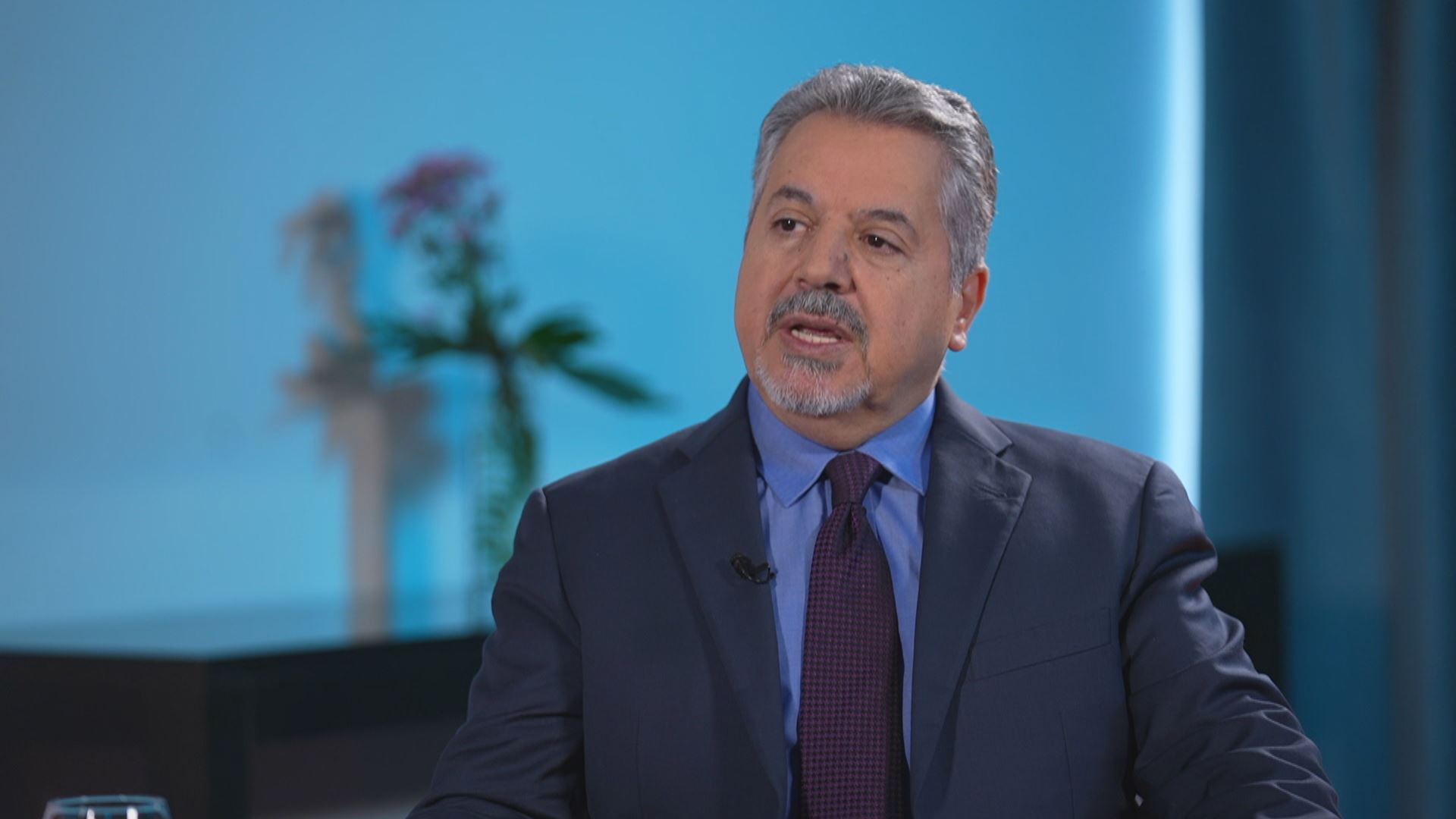
Najeeb Ghadban, Advisor to Syrian Foreign Minister Asaad al-Shaibani, speaks to Rudaw on October 8, 2025. Photo: Screengrab/Rudaw
ERBIL, Kurdistan Region - The Kurds are pushing for decentralization in Syria and there is “openness” in Damascus to that idea, said a senior foreign ministry official to Rudaw on Wednesday. He further praised the Kurdistan Region for playing a “constructive” and “commendable” role in several Syrian dossiers, adding that the potential for “meaningful cooperation” with Erbil is “real.”
Mazloum Abdi, commander of the Kurdish-led Syrian Democratic Forces (SDF) on Tuesday led a high-profile delegation from northeast Syria (Rojava) to hold talks with Syrian interim President Ahmed al-Sharaa in Damascus. The talks followed deadly clashes that erupted in Kurdish areas of Aleppo on Monday night between the Kurdish-led Internal Security Forces (Asayish) - an affiliate of the SDF - and armed militants reportedly linked to Damascus.
Also present at Tuesday’s meeting were US Envoy Barrack and Admiral Brad Cooper, Commander of US Central Command (CENTCOM), according to a senior Kurdish source who spoke to Rudaw on condition of anonymity.
The Rojava delegation included Elham Ahmed, foreign relations co-chair of the Democratic Autonomous Administration of North and East Syria (DAANES), and Rohilat Afrin, commander of the Women’s Protection Units (YPJ), the source added.
Commenting on the high-level meeting, Najeeb Ghadban, Advisor to Syrian Foreign Minister Asaad al-Shaibani, told Rudaw's Shahyan Tahseen on Wednesday: “I heard from the US mediator, Tom Barrack, who described it as fantastic.”
Describing the talks as a “a very important step forward that must be built upon,” Ghadban said “the Kurdish friends” shared that “their impression was positive.” Damascus is “hoping for a detailed, written follow-up to ensure continuity and prevent another breakdown that could lead to complications,” the foreign ministry official added.
On March 10, SDF chief Abdi and Syrian Interim President Sharaa signed a landmark deal aiming to integrate “all civil and military institutions” in Rojava - including the SDF - under the command of the Syrian state, and to enforce a “ceasefire across all Syrian territory.”
While the US-backed accord has been partially implemented, a key sticking point lies in differing interpretations of the term “integration.” The Kurdish-led forces seek to join the Syrian military as a unified bloc, while Damascus prefers to individually absorb and assimilate Kurdish fighters into the national army.
Ghadban told Rudaw that the March 10 agreement “marks a historic starting point,” adding that “some initial steps - such as the SDF withdrawing from certain areas and handing over others to the state - were agreed upon.”
He further noted that “many Kurdish demands were also accepted,” stressing that “mutual concessions are essential for trust-building” at this stage, especially as “there’s a sense that this agreement must be implemented within a limited window of opportunity - which serves the interests of all parties, including neighboring countries like Turkey.”
Ghadban added that Rojava “is pushing for decentralization to be applied across all of Syria,” asserting that “there is openness to that idea.”
Notably, the senior Syrian foreign ministry official lauded the Kurdistan Region for having “played a constructive role on many fronts and adopted a humanitarian approach toward Syrian refugees - which is truly commendable.”
Erbil “also managed to maintain good relations with neighboring countries,” Ghadban noted, adding that “all of this creates space for us to build strong, positive relations” with the Kurdistan Region.
He further said that Kurdistan Region President Nechirvan Barzani had met Sharaa “on the sidelines of several meetings, and we hope those meetings will continue.”
“There is real potential for meaningful cooperation that benefits both sides,” he affirmed.
Below is the full transcript of the interview with Najeeb Ghadban, Advisor to Syrian Foreign Minister Asaad al-Shaibani.
Rudaw: Let’s start with the electoral process that recently took place. How do you evaluate this process and how it unfolded?
Najeeb Ghadban: Truthfully, it was part of a series of steps. It began with a national dialogue that led to a constitutional declaration. As part of this declaration, a legislative authority was established for the transitional phase.
The major challenge in Syria is that half of the population is displaced - around 6.5 million refugees and approximately 7 million internally displaced persons - making it difficult to hold direct elections under such conditions. Therefore, an indirect selection process was proposed.
Roughly 17,000 individuals - including local dignitaries, activists, and notable figures - were selected at the regional level. They, in turn, formed an electoral body that chose 140 representatives, making up two-thirds of the legislative council. The remaining third would be appointed by the President to ensure the representation of components that might otherwise be excluded. This, in short, was the process.
We noticed that women and minorities were underrepresented in the elected assembly. Can we say that Syrian interim President Ahmed al-Sharaa will make up for this through the appointments he is authorized to make?
That’s what we hope and expect. Of course, after 15 years of war that claimed over a million lives and displaced half of the population, we need to build a culture that encourages the selection of qualified women. Interestingly, during the revolution and within opposition institutions, there was notable female representation - some entities even adopted a minimum 30 percent quota for women. However, this stage requires a formal quota system, because, as we’ve seen, the electoral method didn’t naturally produce that outcome.
Syria is not unique in this regard; many Arab countries have implemented quotas because, unfortunately, even women voters have at times refrained from voting for female candidates. So yes, introducing a women’s quota is essential during this transitional phase.
Have you determined a percentage or number of seats for the quota?
A minimum of 20 percent was mentioned.
For women or for minorities?
Just for women. Minority representation was expected to be reflected geographically. But again, due to internal displacement, many segments are not in their areas of origin, so the process wasn’t perfect. Still, it’s very encouraging to see a legislative authority emerge with responsibilities that include drafting a permanent constitution.
When you say “in the next phase,” do you mean this will be implemented now or in the next election? Will Mr. al-Sharaa appoint the quota as part of his allocated third?
Yes, the quota will be part of his allocated third. He is the one responsible for making those appointments.
So, 20 percent of his appointees will be women?
That’s what has been suggested. I’ve heard from friends involved in the council that they expect 20 percent, so I believe that number will be achieved through the appointments.
So the number of women will increase beyond the six who won through elections?
That’s what we hope and expect.
Three provinces were excluded from voting due to [what the Damascus leadership said was] security reasons. What’s the solution for these regions? Will elections be held in Suwayda, Hasaka and the other provinces?
Absolutely. We had hoped they could participate this time. There were attempts in Raqqa and Hasaka, but that depends on the progress of negotiations with the [Kurdish-led Syrian Democratic Forces] SDF. From our perspective, the legislative council won’t be complete until those provinces are represented.
What happened in Suwayda is unfortunate - violations and tensions led the Druze community to raise their demands, even calling for independence [encouraged by Israel], which we believe is not a realistic or viable option. We hope that, once tensions ease, we can return to dialogue.
In fact, a roadmap supported by Jordan and the United States has been proposed to resolve the situation in Suwayda. It includes accountability, humanitarian aid and the restructuring of local institutions, followed by elections to ensure proper representation. The same applies to Hasaka and Raqqa - once conditions permit, representatives from these areas will be selected.
So after the 30-month period, elections will be held? Or could they be held earlier?
Elections can be held at any time once the security situation allows. The 30-month period is renewable until we reach a permanent constitution, after which real elections can be held. This is also tied to the return of many displaced Syrians and the need to conduct a proper census. The current allocation of seats is still based on the last census from 2011. There are many steps ahead, but there is a clear will and intention to move forward.
Regarding the Kurds and the talks between the government and the SDF, let’s begin with the recent security incidents in Kurdish neighborhoods in Aleppo. What caused these events?
I don’t have all the details, but as long as there is no comprehensive agreement between the SDF and the government, tensions in areas like Sheikh Maqsood and Ashrafieh in Aleppo can escalate. That’s something we absolutely want to avoid.
In fact, the incident motivated both sides [the SDF and Damascus] to continue dialogue. A meeting was held yesterday between [SDF chief] Mr. Mazloum Abdi and the President [Sharaa], with US mediation. This is a positive step. We hope the agreement signed on March 10 of this year will be implemented.
The core elements of that agreement include the integration of the SDF into the Syrian state and a joint administration of [northeast Syria (Rojava)] regions’ affairs and resources. The Kurdish component is pushing for decentralization to be applied across all of Syria, and there is openness to that idea. Of course, technical committees and time are needed, but the encouraging thing is that both sides are committed to dialogue as the only path forward.
What were the results of the recent meeting in Damascus between Mazloum Abdi, Mr. Sharaa, and the Kurdish delegation [from Rojava]?
I don’t have the full details yet, but I did hear from the US mediator, Tom Barrack, who described it as “fantastic.”
What about the Syrian government’s impression? Was it also “fantastic” in their eyes, as Mr. Barrack said?
I heard from Kurdish friends that their impression was positive. We’re hoping for a detailed, written follow-up to ensure continuity and prevent another breakdown that could lead to complications. There’s a sense that this agreement must be implemented within a limited window of opportunity - which serves the interests of all parties, including neighboring countries like Turkey.
Did Turkey have a role in this agreement?
Turkey provided the space for the agreement to happen. I believe Turkey played a positive role by reaching an understanding with [the leader of the Kurdistan Workers’ Party (PKK)] Mr. [Abdullah] Ocalan regarding disarmament, which could open the door to a political process within Turkey itself.
How would this affect the situation?
Very positively. There is a PKK presence within the SDF, and if that presence can be neutralized. Mr. Mazloum Abdi is one of the people who genuinely wants a solution. With the broader regional trend moving away from violence and toward political solutions, I believe this development is quite promising.
What were the Syrian government’s conditions, and how did Mr. Mazloum Abdi respond to them? For example, was there any discussion about amnesty?
The Syrian government's main condition is that no weapons exist outside state control. Therefore, the SDF must integrate into the Syrian army and security forces.
The previous debate centered around whether the SDF would integrate as a unit or as individuals. The government’s position is that we are now building a national army based on a new doctrine - not the one inherited from the previous regime. So, the SDF is being asked to join as individuals, to undergo training and adopt this new doctrine, which is focused on protecting the homeland.
The same applies to administrative decentralization - it still requires detailed discussion.
Another important point to mention is that northeast Syria [Rojava] is not only the SDF. There are other Kurdish factions, as well as Arab, Christian, and other communities. The SDF may be the de facto authority on the ground, but all components must be included and acknowledged. The agreement signed in March between Mr. Mazloum Abdi and Mr. Sharaa marks a historic starting point.
Why hasn’t the agreement been implemented yet?
These processes take time and require building trust. Some initial steps - such as the SDF withdrawing from certain areas and handing over others to the state - were agreed upon. In one meeting I’m familiar with, many Kurdish demands were accepted, while the state had its own, including joint administration in some areas of Deir ez-Zor and control over specific border crossings. Mutual concessions are essential for trust-building. What happened yesterday was a very important step forward that must be built upon.
Is there a fear that recent incidents may reoccur?
I hope not. I believe all parties in Syria are exhausted from war and are eager to avoid renewed violence. After what happened in the [Alawite-majority] coastal regions and in [the Druze-majority] Suwayda province, the government certainly has no interest in further conflict.
Regarding Suwayda, unfortunately, we cannot overlook the role of Israel. Some factions there have taken extreme positions, encouraged by Israel.
Are there ongoing talks with Israel? What are they about?
Yes, clearly. This is one of the changes in Syria - we’re speaking transparently. The talks revolve around a potential security agreement: Israel would return to the positions it held before December 8 and cease its violations inside Syria, including its support for factions in Suwayda. In return, Israel has raised concerns - primarily the fear that armed factions could return to its border. Their main concern is a repeat of October 7 events [when the Palestinian movement Hamas led a deadly incursion into southern Israel]. They’ve also expressed doubts about Mr. Sharaa’s background and his alleged links to [the now-dissolved] Hay’at Tahrir al-Sham (HTS), claiming such figures cannot be trusted.
But the reality is that we didn’t initiate anything against Israel. Israel has carried out over 1,400 attacks on Syria, targeting any site with weapons - even unused ones. It has violated our airspace and attacked farmers and civilians in the demilitarized zones established by the 1974 [US-brokered Disengagement] Agreement [that established a UN-monitored buffer zone on the Golan Heights.]
We want a return to that status quo, while also addressing Israel’s concerns. Some progress has been made, but we are dealing with an extremist government in Israel, which makes reaching an agreement difficult. Nonetheless, we are pursuing dialogue - both directly and through US mediation.
The responsibilities are massive - Suwayda, the events in Aleppo, so on. Regarding the Kurds, do the Kurds seek political or administrative decentralization? Where exactly does the disagreement lie?
From what I understand, the Kurdish side wants the highest possible level of decentralization - potentially federalism. That idea was initially proposed by the Kurdish National Council (KNC/ENKS) [an umbrella group of Kurdish opposition parties in Rojava], which was our ally during our opposition [to the Assad regime]. Decentralization covers a broad spectrum, from limited powers to full confederation.
Federalism worked in Iraq because there’s a historically Kurdish-majority region, with longstanding promises of autonomy dating back to the 1970s. In Syria, however, we believe administrative decentralization is a more viable model.
The Kurdish community wants recognition as a fundamental part of the Syrian people. They seek cultural and linguistic rights, political representation, equal citizenship, and the rule of law. If those rights are secured, then we can have a meaningful discussion on the level of autonomy appropriate for different regions - whether in education, health, local security, and so forth.
During the war, Syria was de facto divided, and various local governance models were tried. Those experiences can be useful as we move forward.
Was the Democratic Autonomous Administration of North and East Syria (DAANES) a successful model?
It had some positive elements, but it wasn’t without its flaws. Certain Kurdish factions expressed frustration over limited political space, and many Arab communities were also dissatisfied. What gave the SDF real legitimacy was their role in the fight against [the Islamic State] ISIS and the significant support they received from the US.
Do you recognize the DAANES at this stage?
Demographically, northern and eastern Syria are highly diverse. In areas with a Kurdish majority, it’s natural for decentralization to allow for local education systems and the use of the Kurdish language. But the strong Arab presence and community intermixing make full autonomy infeasible.
Additionally, the region controls a significant share of Syria’s oil and farmland - resources that belong to the entire country. Wealth distribution also remains a major challenge, and even Iraq is still struggling with this issue. But progress is being made.
Is this your first visit to the Kurdistan Region? What are your impressions?
Yes, although I’ve long had strong relations with colleagues in the Kurdish National Council (KNC/ENKS). I’d been invited several times before, but the timing wasn’t right. I’m impressed by the development I’ve seen here. The Kurdistan Region has played a constructive role on many fronts and adopted a humanitarian approach toward Syrian refugees - which is truly commendable. It has also managed to maintain good relations with neighboring countries.
All of this creates space for us to build strong, positive relations. I know the President of the Kurdistan Region [Nechirvan Barzani] met with our President [Sharaa] on the sidelines of several meetings and we hope those meetings will continue. There is real potential for meaningful cooperation that benefits both sides.


Comments
Rudaw moderates all comments submitted on our website. We welcome comments which are relevant to the article and encourage further discussion about the issues that matter to you. We also welcome constructive criticism about Rudaw.
To be approved for publication, however, your comments must meet our community guidelines.
We will not tolerate the following: profanity, threats, personal attacks, vulgarity, abuse (such as sexism, racism, homophobia or xenophobia), or commercial or personal promotion.
Comments that do not meet our guidelines will be rejected. Comments are not edited – they are either approved or rejected.
Post a comment