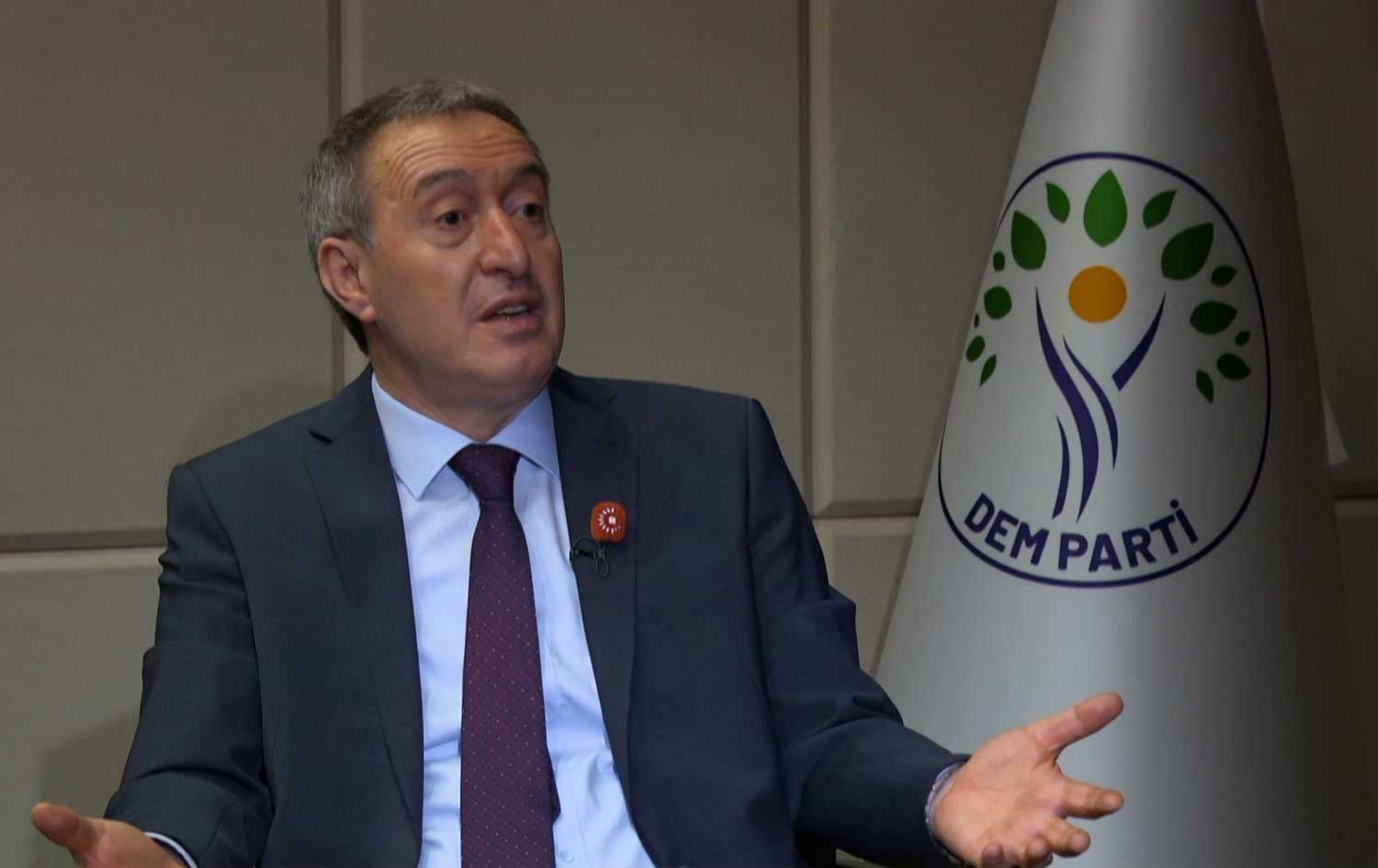
ERBIL, Kurdistan Region - Turkey’s main pro-Kurdish Peoples’ Equality and Democracy Party (DEM Party) Co-Chair Tuncer Bakirhan said that the recent agreement between Syrian authorities and Kurdish forces in northeast Syria (Rojava) has eliminated Ankara’s long-standing justification for delaying steps toward resolving Turkey’s Kurdish issue, stressing that the government must now act without further postponement.
“After this Syrian agreement, in reality, no excuse remained for the Turkish authorities who kept saying ‘Syria, Syria,’” Bakirhan said in an interview with Rudaw's Rawin Sterk on Wednesday. “They sat down and reached an agreement among themselves. Now we must return to Turkey.”
After weeks of clashes between the Syrian Arab Army along with the allied armed groups and the Kurdish-led Syrian Democratic Forces (SDF), the SDF and Damascus announced on January 29 that they had reached an internationally brokered agreement to end hostilities and integrate Rojava’s civil and military institutions, including the Kurdish-led forces, into state institutions.
Bakirhan said that "both the Kurds and the Syrian authorities were successful," in reaching the agreement, adding that "however, the correct implementation of this agreement is vital."
“Sometimes the best things are written on paper but implemented differently in reality,” he warned, while noting that the deal could make Rojava “a democratic part of Syria, allowing it to have influence and a voice across the whole of Syria.”
His remarks come amid an ongoing new peace process in Turkey that began after jailed Kurdistan Workers' Party (PKK) leader Abdullah Ocalan’s historic call in February last year for the group to disarm, followed by a unilateral PKK ceasefire.
In mid-July, 30 PKK fighters held a symbolic disarmament ceremony in the Kurdistan Region as a gesture of goodwill and commitment to peace. PKK has also taken other steps to serve the process but it has blamed Ankara for failing to take any concrete steps.
On Wednesday, a delegation from the DEM Party visited Turkish President Recep Tayyip Erdogan to discuss the peace process. The delegation said on Thursday that the meeting was “important”.
The delegation, which consisted of Pervin Buldan and Mithat Sancar, were received by Erdogan. This came nearly a month after the same delegation, which acts as the main mediators of the peace process between Ankara and the now-dissolved PKK, also visited Ocalan in prison.
The delegation said in a statement that the meeting was “important,” adding that they “consulted” with Erdogan on the developments in the region and their impact on the peace process.
“During the meeting, the shared will to continue the process with determination was reaffirmed. It was stated that the Turkish parliament, the relevant ministries, and public institutions need to intensify their efforts to take concrete and reassuring steps regarding the ongoing process,” read the statement.
Bakirhan described the DEM Party as the third-largest political force in Turkey and said recent regional developments - from Rojava to Kurdish protests worldwide - have strengthened Kurdish political consciousness rather than weakened it. “Kurdish unity is not a threat to anyone, and for our party, it is something very positive and important,” he said, adding that Kurds seek equality and democratic citizenship rather than territorial separation.
He also called for concrete steps in Turkey, including the release of political prisoners and constitutional recognition of Kurdish rights. “A Kurd is a Kurd and wants to be an equal and free citizen of this country. The matter is as simple as this,” he said, adding that continued inaction risks deepening what he described as an “emotional detachment” between Kurds and the state.
The following is the full transcript of the interview with DEM Party Co-Chair Tuncer Bakirhan:
Rudaw: Rojava has become an influential experience for every Kurd and for everyone. Considering this experience and the ongoing political process in Turkey, what is the current state of the Kurdish political movement in general in North [Kurdistan] [southeastern Turkey], and your work specifically? Also, as Co-Chair, how are you psychologically sustaining your work?
Tuncer Bakirhan: Currently, the DEM Party is the third-largest force in Turkey and the third-largest party in parliament. The majority of our voters are Kurds, alongside workers and the oppressed. Therefore, our struggle is not only for Turkey but also for the rights of Kurds in other countries in the region. The crises, conflicts, or positive developments in those areas affect us as well, because we are talking about the same nation, people who speak the same language, share the same identity, and remain behind artificial borders drawn 100 years ago.
In Turkey, there was a process that began on February 27 [2025], followed by the PKK's decision to end armed conflict and other subsequent steps. The process continued with different stages, and a committee was formed in parliament. The committee listened to various parties, and a group of MPs, on behalf of the committee, met with Mr. [Abdullah] Ocalan on Imrali Island. Even if it was difficult and slow, a process was underway.
Of course, in Syria, there was a civil war for 14 to 15 years involving regional interference and hegemony. Following that, the creation of a new system in Syria emerged. We all saw that both processes were moving together because Turkish authorities always prioritized the Syrian process over the local solution process, waiting for developments in Syria. They would ask: ‘What do the Kurds in Syria want? What will they achieve? How will they solve the problem?’ They made all of these conditions for the solution process here. We criticized this, saying that there is a process underway in Turkey and we should focus on that. We told them that if the process here proceeds positively, it will have a positive impact on Syria and Rojava as well.
We have reached today's stage. In Syria, an offensive and war that started in Aleppo spread to Rojava. It was clear that this offensive had the approval of international hegemonic powers. Despite this, the reaction from Syrian Kurds, the diaspora, those in Europe and their friends, as well as the world's democratic public opinion, led to protests and mass demonstrations against these attacks. In my opinion, this had an impact to some extent and forced them to seek another path. From here, we saw that the Syrian regime, the leaders of the SDF, and Turkey were also thinking about seeking a solution, because the largest reactions emerged from Kurdish regions in Turkey, such as Nusaybin and Suruc. I stayed in the region for a week and observed many places.
The situation in Syria reached a point where an agreement was reached on January 30, and a memorandum of understanding was prepared. Of course, the document does not fully satisfy both sides. Syria harbored the fantasy of establishing a power without Kurds - from the cabinet to the interim constitution - in a way where Kurds and their rights were not considered. For 14 years, Kurds have lived there with other peoples on a very democratic basis that could serve as a model for the world, but sometimes the realities on the ground present different things to people.
An agreement was made there in which we can say both the Kurds and the Syrian authorities were successful; however, the correct implementation of this agreement is vital. Sometimes the best things are written on paper but implemented differently in reality. Conversely, even points we dislike or find insufficient can yield positive results if the governing mindset acts with greater understanding and a democratic, broad logic.
It is true that this is still the beginning, but there is a reality: the security of the Kurds there [Syria] will be provided, and they will be organized in the form of brigades, which will certainly integrate within the framework of the Syrian army, because there cannot be two separate and independent armies within one state. If there are two armies, one cannot talk about unity. We have a principle before us like the protection of language, culture, and local democracy, where the administration of the region will be by their elected representatives. On the other hand, this makes Rojava a democratic part of Syria, allowing it to have influence and a voice across the whole of Syria. In my opinion, if this agreement is implemented well, it will be important for the future of Syria.
Kurds are an undeniable part of Syria and have lived there for hundreds of years. Rest assured, a Syria without Kurds would be like the regime that has persisted there for centuries. If Syria is to be rebuilt, become democratic, and become a strong country in the region, Kurds must participate in all stages.
I am not only talking about Rojava; today, nearly one-third of Kurds live in Damascus, Aleppo, and outside the Rojava regions. Therefore, Kurds should not be limited only to their own regions but should have a say in the administration of Syria and fulfill all their duties and responsibilities for the development, progress, and democratization of Syria.
As the DEM Party, we support this process and will monitor it. If positive and good work is done, we will defend it here, but if a negative stance arises against those Kurdish rights defined in the agreement, we will express our views on a democratic basis.
After this Syrian agreement, in reality, no excuse remained for the Turkish authorities who kept saying ‘Syria, Syria.’ They sat down and reached an agreement among themselves. Now we must return to Turkey. Of course, Damascus, Qamishli, Kobane, and Rojava are on the Kurdish agenda, but they are also on Turkey's agenda. A solution must begin as soon as possible by gathering the work of the commission formed in the Ankara parliament and preparing a report for legalization.
Throughout this process, you were on the streets, you were outside, you were on your feet; in fact, Kurds were on their feet all over the world. Especially in the international arena and in the field of diplomacy, some important steps were taken, but there is a criticism of your party that people say it has been weak in the international arena and has not done something great through mediation [lobbying] and diplomacy. Could you not have conducted better diplomacy?
There is criticism of our party. In reality, we may have shortcomings in all matters, and one can criticize oneself, but in this matter, an injustice is being done. From the moment the attacks on Rojava began, we were in the region and on the streets. Our foreign relations commission conducted very strong diplomacy in Europe and many parts of the world. Sometimes the issue is not just about you and your work. An agreement had been signed in Paris; an agreement that included the US and Israel, and Turkey was there too, and a decision had been made. The decision was very clear: a unified Syria, a Syria without Kurds, without Druze and Alawites. I say it very clearly: if it were left to the conscience of the Paris agreement, something else would be there today.
In my opinion, Kurds in every country where they live showed their democratic stance, and that led officials to seek another way - those forces that made the Paris agreement as well as the Syrian government. For the first time in my life, I saw all Kurds united on an issue. I have been in politics for 35 years; we had reactions regarding Kirkuk and the referendum, but nothing like this happened in the world, and it never reached that level. Or during the attack on Shingal, of course, something happened, and during the previous siege of Kobane similarly, but I was never a witness to something like this at that time.
That is to say, from Duhok to Zakho, from Sulaimani to Erbil, from Amed [Diyarbakir] to Kars, from Suruc to every village in Nusaybin, in the entire world, wherever there was a Kurd or a friend of the Kurds, they showed their stance. This is a very good thing. This stance had an impact on the attacks carried out against Rojava, and this was very valuable.
Of course, Kurds have been very oppressed, and we cannot talk about it at length here - the things that happened in the Kurdistan Region in Iraq. In Iran, there are still executions. Here, nearly 4,000 of our officials and people who have not picked up weapons are in prisons. There are more than a million cases, and Kurds are being tried in more than a million cases.
This people, wherever they are and in whichever country, standing up against oppression and moving together is a sign of the democratic unity that exists, and this is very valuable. This is more valuable than creating a state. This is a situation that is far above great situations. When one's brother has fallen into hardship, showing a democratic and diplomatic stance for him is, in my opinion, the greatest stance, and the Kurds did this and were successful.
On this occasion and through you, I, on behalf of myself and my party, thank all Kurds and their friends in Zakho, Duhok, Mahabad, Sulaimani, Amed, Dersim, Siirt, Qamishli, and Kobane, who do not accept injustice and the violation of rights and are alert 24 hours a day, standing on their feet and showing their democratic reaction.
Amid this process, a national protest among the Kurds emerged. We saw that a national consciousness was revived. What problem does this create for your party's ideological stance?
It doesn't create a problem for us. Some parties in Turkey talk about this issue. The unification of Kurds against oppression and raising their voices harms no one. We are trying to make the systems of the countries we live in democratic. Kurdish demands are very clear and obvious. If Kurds in Turkey demanded a system based on land [territory], perhaps there would be concern on this issue. The Kurds living in Turkey and the Kurdish movement struggling here want to become equal citizens on a democratic ground.
If Kurds in Iraq and Iran also play a constructive role in confronting the oppression against Kurds, it harms no one. Kurdish unity is not a threat to anyone, and for our party, it is something very positive and important. Our party has shown its stance and reaction in the same framework against oppression of Kurds, Alawites, and Druze, as well as against the oppression inflicted on Palestinians in Gaza. We are a party that struggles for the democratic rights and freedoms of Kurds, workers, the oppressed, and for the rights of the environment, nature, and women. Therefore, this image that has emerged is not harmful or negative for us; on the contrary, this stance is a primary force that leads Iran, Iraq, Syria, and Turkey toward democratization, changes them, and it must be seen in that way.
I have been closely monitoring your politics for over 20 years and am somewhat aware of your policies from the inside. Recently, especially with the situation that arose, we saw that Kurdish national demands increased. It was as if all these events were done under the flag of Kurdistan. Among your own public base, we see a strong reaction against the slogan ‘Brotherhood of Peoples.’ How do you view this? Especially since this topic has spread to a wider arena, what do you think about it?
Our idea is correct. The imposition of the system in this matter has led to a fracture and collapse of feelings among Kurds and, to some extent, a rise in nationalistic reaction. This is not a negative point for us. If there is a national consciousness among Kurds, we cannot evaluate this as a negative point or a shortcoming. Kurds are a nation, but they want to live with the peoples they live with in equality, coexistence, and partnership. This is what is misunderstood in Turkey.
There is a process; why does a Kurd say ‘I am Kurdish?’ Why does a Kurd say ‘[ am against executions in Iran?’ Why does a Kurd raise their voice against the attack on Aleppo? This is natural. When Turks were fighting in Cyprus, a relative of mine went - and I can even say his name, he still receives a pension and lives in Kars. It was the same in the War of Independence. In the matter of the siege and attacks on Gaza similarly, the party that has the most members arrested is our party. We are like this, and no one can show us as anything else.
Therefore, yes, it's true, among our public there is a psychological collapse and a reaction stemming from the imposition of the system. They ask: ‘Where is the solution process, where are its steps?’. Instead of criticizing us, this government should see that feeling of the Kurds that you mentioned a moment ago and take steps for it. For a year and a half, we have been coming and going and we have nothing in hand. People ask: ‘Why isn't my child released? He laid down his weapons, why doesn't he participate in social-political life? Why was my spouse unjustly punished and lives in exile? Why isn't he with us and his children?’ The DEM Party is the truth and reality of Turkey. It asks why this racist language, this discriminatory language, and that which creates marginalization exists, and it shows a reaction.
The psychological collapse among your public and also the change in the Kurds' stance regarding the ‘Brotherhood of Peoples’ - in reality, the criticism comes from the fact that hostility against the Kurds or nationalism within the state and also among people, the Turkish people, is highly increasing. After Arab factions abandoned the SDF and redirected their weapons against them, hostility against ‘Brotherhood of Peoples’ slogan increased. Could a change occur regarding the slogan ‘Brotherhood of Peoples?’
No, we are on a very right path. We don't say ‘let people fight and come to war, let people be enemies of other people.’ We are not like that; we are a party of values. How much does the opposite side understand us? As a Rojava official said yesterday, ‘We didn't understand [the situation in] Raqqa, but we didn't want to understand.’ This is a very important thing and the matter is related to us. Now, what are you doing in Istanbul? When you declare another people as an enemy, how do Kurds live there or in the big cities? We must not misunderstand this. This democratic consciousness that exists among Kurds, the national consciousness, the reaction against evils, and those reactions they show should not be analyzed as a negative aspect.
Is it not better to say ‘Neighborhood of Peoples’ instead of ‘Brotherhood of Peoples?’
Throughout the world, peoples live together. If a nation is created for every people, you say ‘everyone has something of their own, let them be a good neighbor.’ We are together, so nothing comes out of this for those who think differently. I'll tell you something: before this topic, similar questions were asked. They said, ‘America will create a Kurdish state, but the Kurdish movement doesn't want it; is Israel actually ready to create a Kurdish state?’ Does this happen? Everywhere, in all four corners of Turkey and the world, people were walking with the flag of Kurdistan along with the flag of Israel and we saw that, but when Kurds faced attacks with cannons, guns, and bombs, those states that were said to be creating a state were not in the arena. In fact, their approval of the attack, even if indirectly, was shown in Paris. One must not make a mistake; Kurdish national consciousness is valuable, but we must protect a life of brotherhood and equality with the peoples we live with. Otherwise, it might lead to a massacre or a war and conflict that cannot be solved and will not end.
The reaction among Kurds is related to the fact that the system and the government are not taking steps despite this process. It is related to the fact that they do not raise their voices against racism against Kurds and fascist pressures. Amedspor, which is only a football club, is nearly unable to play. The people's reaction is here; when it goes to a city - like the previous match where 500 people were present - Amed enters the stadium and faces racist, takfiri, and marginalizing slogans. Later, Amed returns and another club goes to the same city and again plays with 500 people.
True, you as the third party possess power and a public base, but when a Qayyum [state-appointed trustee] comes and puts everything under their own control, no power remains in your hands; the reaction is for this too. On the other hand, recently, due to the gathering of all Kurds around Kurdishness, a global resonance was created. Isn't it better for Kurds to prioritize Kurdishness among themselves?
It is so; in fact, being Kurdish is not in the background. Among us, there are left and socialist components too, as you know; being Kurdish among us has never remained in the background because the oppression of Kurds is very fast, daily, and always at the forefront. The current situation must place positive duties and responsibilities on our shoulders.
For example, we must say: ‘Look, because you didn't take steps, Kurds stood on their own feet everywhere. Your policy of assimilation and monism, your pressures, and that harsh policy you imposed on Kurds in every geography no longer have results.’ We understood in Duhok and Sulaimani; God bless them, from the age of seven to 70 years of age, they headed toward Rojava. Look at Duhok, Kirkuk, Khanaqin, and Akre - this is a very good thing. How beautiful! Let the authorities look at it. Just as we learn lessons from it, the authorities and administrators of those countries where Kurds live must learn lessons from here. Neglect, blacklisting under the name of ‘terrorist,’ and starting a process with lies and not taking steps no longer satisfy society. If we are truly democratic, we understand how valuable the brotherhood of peoples is.
I ask you: with what conscience...? In the first siege of Kobane 15 years ago, believe me, thousands of Turkish, Arab, Circassian, left-socialist, and democratic youth who were studying in universities here lost their lives. In Suruc, 35 Turkish citizens lost their lives. Now in this universal world where advanced technology has removed borders, the truth consists of brotherhood, common struggle, and protecting values. For values to be put into practice, it doesn't matter who it is or which people or nation it is; the world has grown large. No one can limit themselves only to one people or one border.
Everyone must have a relationship with each other. My message through you is this: First, administrators of the countries where Kurds live must learn lessons from these recent developments. Second, Kurds too must struggle to create a ground where they can obtain their democratic rights. We must not be satisfied only with our own regions in the countries where we live; we must become partners in power, partners in administration, and participate in shaping the future of those places. Democracy should not be only for Kurds, but let every side benefit from it. When we say mother tongue in Turkey, we are not only talking about Kurds; there are Circassians, Laz, and other peoples and communities too. Kurds, like the snow-clearing equipment, have put themselves at the front and are clearing the stones in front of democracy and the roads. This is very valuable and they pay the price for it.
But I'll tell you something: 20 years ago it wasn't like this. In the last 10 to 15 years, I have gone to 22 to 23 countries. I swear, when one says ‘Kurd’ or ‘Rojava,’ they are looked at with admiration in the world.
True, at that time the leaders of the Kurdistan Region took on a great role. We saw what freedom is; even if it's semi-free and not a state, we saw what it means to be free.
Yes, it is so. Take this word from me: the Kurd is free. We cannot say that according to the rights the systems have given us, we are half or a quarter free. Kurds are inherently free, but the current authorities and system do not recognize Kurdish rights. That is, we do not measure our freedom by their standard. This is their shame. In the 21st century in Turkey there are nearly 25 million Kurds - maybe more or a bit less - but when one says this number, nationalists and racists get angry, but this is a reality and what can we do? Their main shame is why Kurds do not see those countries and regions they live in as their home and are always in fear and concern? Let them ask this question of the system.
Both Mr. Mithat Sancar [DEM Party lawmaker] and your other officials have said that in this recent matter of Rojava, Ocalan played a key role. During the days of the attacks and sieges, you had a meeting with Ocalan. Was there any pressure from Imrali Island?
In fact, when we went to Imrali Island, Mr. Ocalan said something I will never forget. I myself asked him this question and said: ‘How will this process affect Rojava and Syria?’ he set a very broad framework and said: ‘Why should Kurds be satisfied only with their own regions? Why shouldn't they manage Syria and become partners in the administration?’ now, after several months have passed, when I look at today, I understand what was said. Society has a tendency toward such things. Sometimes in a calm atmosphere and by taking some high things without considering international and regional conflicts, they might fall into that system, but reality is something else.
The reality is that Syria is not only the property of Damascus, but it includes Britain's plan, America's leadership, Israel's security, and the interests of other regional and hegemonic powers. Therefore, what Damascus alone talks about might sometimes not receive its full answer. Look, Turkey is also there; those forces belonging to Turkey and those forces Ankara supports are also there, in Sari Kani [Ras al-Ain], Afrin, and Gire Spi [Tal Abyad].
In short, Ocalan viewed the matter with a broad logic. He wanted Kurds to protect their own security in their regions and also become part of the whole. That democratic unity is something that originated from Imrali Island and today we are committed to it because, with that demographic structure, half of the Kurds live in Aleppo, Damascus, and other places outside of Rojava. One must seek a general solution. For this reason, Ocalan's role there was decisive. As I said, in the Paris agreement they had thought of something else, but that will Ocalan put forward in Imrali, in my opinion, forced the state as well as regional powers and hegemonic powers to seek a new formula.
In this current agreement - meaning the January 30th agreement - I see a great value because, as you know, on the 18th of the month, a surrender was being imposed and they were saying ‘extirpate them and clear them out.’ In my opinion, Ocalan's influence is clearly evident. We haven't gone back again yet, but certainly delegations come and go and there has been traffic and there are meetings with the state. I don't believe that traffic and those meetings have been cut. In the end, we are talking about an effective actor who shows the way. In my opinion, he has had a positive impact and there is a great effort of his in that agreement.
Well, let's come to the solution process. It has been one and a half years since that process began, but still no steps have been taken. Devlet Bahceli [MHP leader], in his last speech, spoke similarly to you. It seems that there are no longer any obstacles; what is the state waiting for and what steps do you expect the state to take in a short time?
Until now, no one has said anything before us. Bahceli sometimes surprises society with his words and makes statements outside the role and duty he performs. From the beginning, we have talked about freedom, life, and conditions related to Mr. Ocalan. People marched for his freedom. For years, we have struggled for the release of President [Selahattin] Demirtas, President [Figen] Yuksekdag, and other political prisoner friends. That is valuable, but Mr. Rawin, look; in reality, Bahceli has been saying a series of things for a year that break down the current situation, but until today not one of them has been implemented. He speaks like the leader of the opposition. A while ago he had a meeting with the President, Mr. Erdogan; that is, he could have said what he said from that seat directly to the President in the meeting, because he is a partner in power.
Do you tell them this?
Certainly, we say this in all our meetings. Therefore, the word spoken is valuable and it is a correct thing; according to his duty, he breaks down the current situation and this is a very good thing. Against this racist and nationalist language and practice that keeps people outside of itself, in my opinion, his statements become a shield and a good pressure. One must give credit for this, but in no way are his words put into practice. We are not very hopeless either, because Syria was always placed before everything else. After this, Syria continues to some extent on its own path and with its own dynamics. I hope some of those things Bahceli has been saying for nearly a year - especially those that are very important, very valuable, and in which we also participate - will lead to a development within life.
Look, the reaction of the region is also tied to concrete steps. You shake hands with Ahmed Turk [veteran Kurdish politician], you take a photo with Ahmet Ozer [former Kurdish mayor of Istanbul district]. One of the most important political parties that keeps the government on its feet is the MHP. Yes, it doesn't undertake something tangible; that is, when a partner of the government and a partner in power says something, does one not listen to it?
Who or where is the obstacle?
I say that and I said it yesterday: Mr. Bahceli, you speak well, but the relevant party for this issue is not us, but the government. You are also their partner - tell them to do it and they must implement that. Therefore, perhaps this will be done later. Certainly these are important things, but Turkey really needs them; political prisoners should no longer remain in prisons. Please look, in the whole world is the side for dialogue in prison or somewhere else? The example of Mandela and other similar examples - after the developments or before, Mandela was moved to a house and obtained his freedom. Let this no longer be seen as an obstacle. That is, the time has come in Turkey to take steps for democratization and bring this process to success.
Now is the time to create the product of those good words that were said until yesterday on a practical ground. We see this and again play our constructive role. For the government to take steps as soon as possible in the matter of democratization, solving the Kurdish issue, and issuing special laws, we carry out our struggle. The DEM Party plays a constructive role here.
Mehmet Ucum, the President's advisor, said a few things in his last speech. We see Kurds are still considered a part of the Turks and the process is conducted based on this understanding. Is the state's view still in this way?
It is in that way; we cannot determine our stance according to the words of those bureaucrats. That is, what a bureaucrat says is not very important and our relevant party is the government itself. Mr. Ocalan's relevant party is also the state, which includes the government. From time to time, some representatives and members of political parties also speak harshly. We cannot say, ‘Which bureaucrat said what, let us change our politics and language based on that.’ These bureaucrats are of the new generation; they are not aware of the historical relationship between Turks and Kurds. Because they have been educated with a narrow understanding and within the framework of denial, rejection, and Turkifying the Kurds, they do not know these realities. Brother, a Kurd is a Kurd and you must accept it as such. What are their rights due to being Kurdish? You must give them those rights.
The matter is like this and there's no need to prolong it much. They always tell us Turkish is the official language. Brother, we also say the official language is Turkish. Good morning! By God, bureaucrat, what an important thing you said! As if we just heard that! Therefore, let no one reveal new things to us or threaten us. A Kurd is a Kurd and wants to be an equal and free citizen of this country. The matter is as simple as this.
The Turkish state has several red lines that it always talks about. Well, what are your red lines that if not implemented, the process will not be successful? We know Ocalan's freedom and the release of political detainees are your red lines; besides those, what else is there that you think is a primary condition?
True, those points you mentioned bring along several other topics that must be implemented. There must be a broad definition of citizenship in Turkey. As I said, we are not all Turks. If the Republic of Turkey were only the republic of Turks, they would say ‘Republic of Turks.’ For this reason, there must be a treatment that includes this mosaic. This is connected not only to the definition of citizenship and history but also to literature and culture. Why shouldn't our children know the prominent figures of Kurdish history and its literature and culture?
That is wealth. It is said there is no emotional fracture among Kurds; how is there not? When you impose a Qayyum on the will of the people of Siirt for the third time and plunder it, do you think Kurds will clap for you? No, rather a great emotional fracture occurs, the consequences of which have reached here. I am talking about that; Kurds want to elect their own administrators in their own cities. Have we committed corruption, have we stolen, or have we stepped outside legal boundaries? No. Therefore, when you appoint a Qayyum at your own whim, you wound the feelings of those people and increase their hatred and grudge against you.
As I said: freedom of language, democracy, a new definition of citizenship, and the release of political prisoners will bring Turkey to a calm and peaceful atmosphere that no one would have believed; a country where all its citizens struggle for progress and democracy. Even the cause of Turkey's economic crisis is related to these very issues.
You mentioned an emotional detachment. As Kurds, we all see and feel that detachment. True, there is a detachment. In the face of this emotional detachment among your public base, what difficulty do you see? Because the duty of repairing that detachment also falls on your shoulders. In the face of this situation, what risks and problems do you see?
Currently, it is like this; the principles we advocate for are correct, but due to those policies the system has imposed, our public base also shows its reaction against us and says: ‘For a year, steps have been taken unilaterally, why doesn't the government take steps?’ This is the problem of the system and the government itself. That is, if you create pressure on the DEM Party, the public will detach and distance themselves in that way. For this reason I say this: there is an emotional detachment, but as I said before, this can be repaired.
If you are broad-minded and democratic, if you correct those imposed policies in practice as soon as possible, if you embed Kurdish rights and law within constitutional rules, why should that emotional detachment occur? We say Turkey is our home, let it truly be our home. We want to have security. Is there a more innocent and more legitimate demand than this? Therefore, if there is a detachment, the cause is not us and our policies, but the policies of the government, which are anti-Kurdish. Let them look at themselves a little. We look at ourselves at every stage, we criticize ourselves, and we re-evaluate the process.
The easiest thing is to tell you, I was an athlete in my youth and played on the basketball team. I have a connection with sports, like table tennis and several others. Because Kars was a city of snow and cold, I had a connection with sports. At the same time, I am a football fan. When I have the opportunity, I watch world and Turkish football matches. When I watch Amedspor matches, I see a great detachment within myself, because it is treated as if an enemy force has come.
Let me say something; I have been monitoring your work since your presidency in DEHAP. You have been professionally in politics for 35 years; you were a mayor, an MP, and a Co-Chair, but in those 35 years you repeat the same thing? Wouldn’t this make you upset?
Very true. You said something that is very appropriate. I have indeed been in politics for 35 years. Yes, from the youth of the HDP [DEM Party] until today I have headed the city organizations of my party—that is, there is no work I haven't done. When I was in the youth organizations, this place [the headquarters] was a basement; it was a place without air and without windows. We slept here because of few opportunities. In this basement, many of those friends with whom we stayed together are no longer here. Many of our administrators became victims of ‘unknown perpetrator’ crimes. Believe me, from the first day we emerged from these basements until now, we are in fact saying the same thing. You are right; those things we say are not a collection of old and rotten ideas. Democracy, brotherhood, and an equal and human life for citizens on a democratic ground are necessary for everyone.
Sometimes, as I said and to answer your question, when I watch Amedspor matches, I too become very uncomfortable, my morale drops, and I get angry. Not only because of losing or winning, but isn't this the duty of this government? Can the Football Federation not make a decision against this racist stance taken toward Amedspor? The government in this field doesn't say: ‘My dear brother, these are children of this country; their fathers pay taxes, their children study and go to the military. Tomorrow if a bad situation occurs, we are together and one.’ Despite all this, as someone who emerged from these basements, by God's help we will bring this process to success. Everyone saw that denying and rejecting Kurds has no meaning.
Now is the time for Kurds in Turkey to obtain their democratic rights and place their rights under legal and constitutional protection. By God's help, our children will not live in that situation in which we lived. I say let no one's child live like that. We are hopeful and we struggle. True, there are difficulties, but we try to overcome the difficulties. I have stayed in prison three times for a long period; don't look at it like that, we have seen many things. Exile - yes, I have stayed in 10 different prisons and been tortured. If we talk about those things, a day is not enough. With all that, look, you said it and I understand very well what you mean; we are still persistent in demanding a common life, togetherness, a democratic republic, and equal citizenship within the framework of a common democratic republic. Let there be some respect for this feeling and let it be understood.
At the time Rojava faced siege and attacks, officials, media, and the people of the Kurdistan Region showed a great stance. Especially the officials of the Kurdistan Region played an important role and its impact was evident on a global level. What is your message regarding this topic?
In Amed too, in one of our activities, where I believe you were present, I answered that question in my speech. I have thanked every single Kurdish leader for that support and help they provided from all cities of Kurdistan. I also thanked my people. This is very important and positive and one must continue in it. What message does this convey? For example, when an injustice is done to Kurds in Kirkuk, one must say, ‘this is an injustice and it must stop.’ If one has power, one must also use it in the field of diplomacy. These stances are important and a source of happiness. This recent unity of Kurds and their common stances and reactions are very valuable and no state should fear them.
I, before everyone else, thank Mr. Masoud Barzani and Nechirvan Barzani. I thank Bafel Talabani who was with us from the beginning. Also, I thank the Kurdish presidents, pioneers, and leaders in Iran and those Kurdish intellectuals, businesspeople, and workers in Europe who have lived there for years and whom we may know or not.
From here, I send my greetings, love, and respect to all those brothers and sisters of mine who are in any part of the world and are viewers of Rudaw. That which keeps us on our feet and guarantees our rights is that common feeling we have shown. This common thought must continue because it is very valuable. Once again, I send my greetings, respect, and love to everyone.