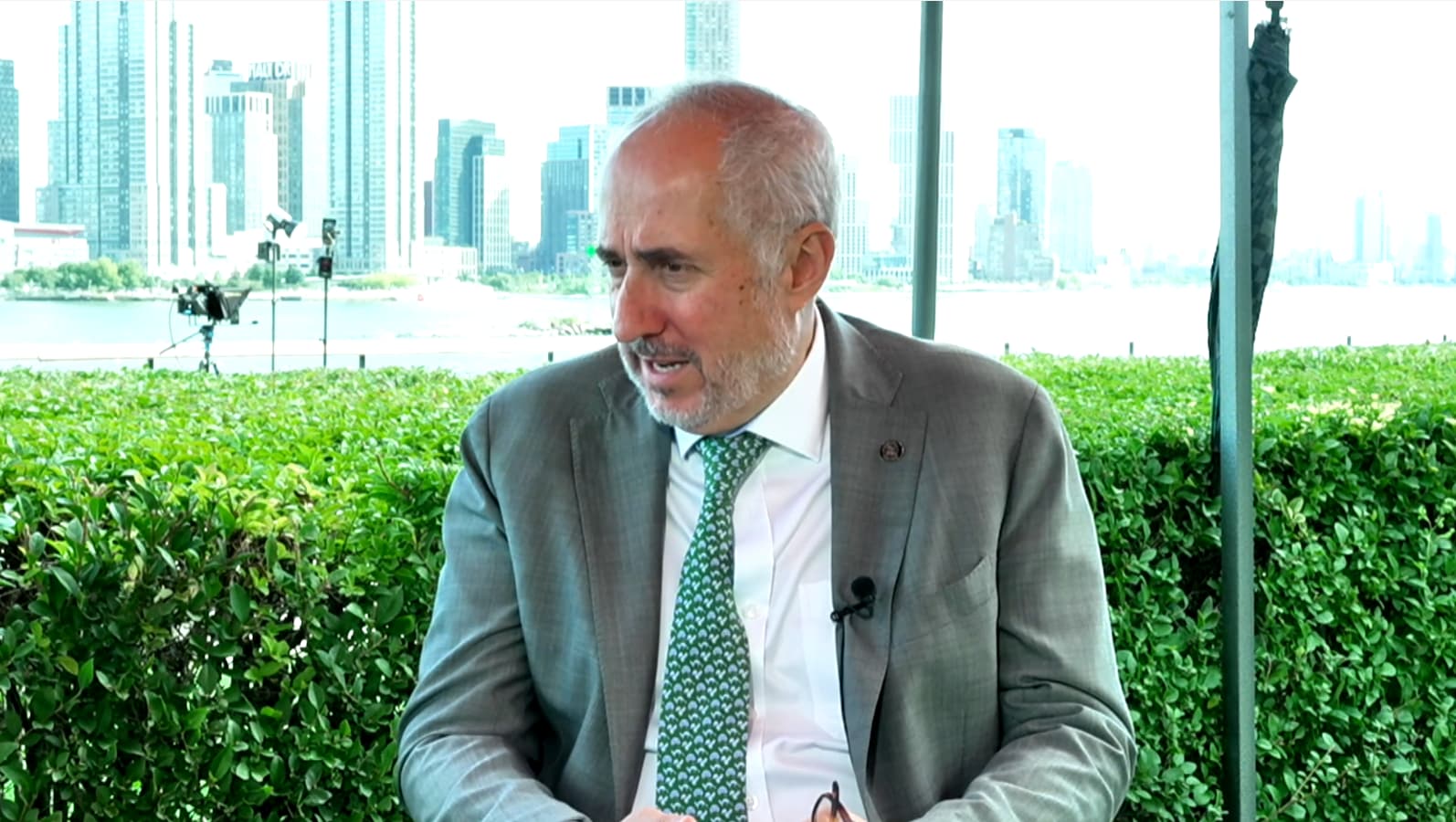
WASHINGTON, D.C. - US Congressman Marlin Stutzman has warned that renewed attacks on minorities and internal divisions in Damascus could squander what he described as a narrow window for stability, economic growth and opportunity in Syria.
In an interview with Rudaw this week, Stutzman, a Republican member of Congress, described Syria as being at a pivotal point in history, with its future decided by President Ahmed al-Sharaa, an increasingly close US ally. While Washington is supporting foreign investments for Syria and deeper diplomacy, Stutzman said Congress is also watching the situation closely.
“The burden is on President al-Sharaa to bring people together and stop any attacks,” he said.
Stutzman pointed to graphic video evidence and testimony during a House Foreign Affairs Committee hearing on Syria this week that detailed recent violence against Kurdish, Druze, Christian and Alawite communities.
“Actions speak louder than words,” he said, arguing that al-Sharaa must ensure minorities are not attacked and act with transparency if Syria hopes to maintain Western support.
The congressman, who has met al-Sharaa three times, said he wants the new Syrian leadership to succeed but stressed Damascus must unify the country and prevent abuses.
“If he’s successful, Syria will be successful,” Stutzman said. “But if the fighting continues, it won’t work.”
Recent attacks by the Syrian army and allied armed groups on Kurdish-majority areas and longtime US ally the Syrian Democratic Forces (SDF) have shaken Washington, with some lawmakers threatening to reimpose sanctions if abuses continue. Stutzman cited reports that senior Kurdish and Damascus officials were jointly attending this weekend’s Munich Security Conference as an indication of progress toward unification in Syria.
Stutzman said Washington is willing to partner with Syria, particularly in the fight against the Islamic State (ISIS) while maintaining strong ties with the SDF. He signalled openness to the bipartisan Save the Kurds Act but agreed that protections should be extended to all Syrian minority groups.
Stutzman also raised concerns about foreign interference, citing Turkey and Russia as destabilizing forces. He argued that the US should maintain a base in Syria, reopen its embassy and appoint an ambassador dedicated solely to Syria. US Ambassador to Turkey Tom Barrack currently also serves as Special Envoy to Syria, which enjoys strong ties with Turkey.
While he expressed confidence in President Donald Trump’s position to deepen engagement with Syria, which has strong ties to US Gulf allies such as Saudi Arabia, Stutzman indicated Congress will continue pressing for accountability and monitoring developments closely.
“This is a window of time,” he said. “If al-Sharaa becomes a dictator, we'll probably lose this opportunity for several decades.”
The following is a transcript of the full interview with Marlin Stutzman:
Rudaw: Can you tell me, after this week's hearing, what has changed in your view about Syria and minorities?
US Congressional Representative Marlin Stutzman: Well, first of all, thanks for having me. It's great to see you. I think that the hearing that we had this week was really excellent. We had great witnesses. There was a lot of good information that was shared with the committee - and of course members of Congress - but there's a lot of work to do. We've seen a lot of ups and downs, as I shared in my testimony.
In the past year, a lot has happened - the Alawite [community] has been attacked. The Druze have been attacked. The Kurds have now been attacked, and Christians have been attacked. And so there are other minorities who are caught up in all of this. I am wanting the very best for the Syrian people. I want the very best for the region, but there has to be cooperation between Damascus and the minorities around the country. Really, the burden is on President al-Sharaa.
I've met him three times. I'm rooting for him. I want him to be successful. Because if he's successful, Syria will be successful. But as long as there's fighting, as long as there are killings, as long as there's disagreements, it just won't work.
[SDF] General Mazloum and Shaibani [Syria’s interim Foreign Minister] are going to be traveling together to the [Munich security] summit, is what we're being told. So we're hopeful that’s the start of something very positive. I'm still a little baffled by what happened over the past 45 days - why the attack on the Kurds - but now all of a sudden, we're back to making sure that General Mazloum has a visa or a passport and is traveling with the foreign minister.
So I think those are all positive signs, but we're just taking it a day at a time. My hope is that we can get the Syrian Embassy to open back up - that the United States can really lean in - because this window of time is still very short. And from an economic standpoint, we need to help the Syrian people get back on their feet economically.
You mentioned a lot of things. First, will you attend the Munich conference?
I'm not, no.
The [congressional] witness [cited] horrific crimes against minorities in their testimony. After this week’s House hearing, will the US change its policy toward Syria, or continue the same approach toward Syria?
I think we have already shown that we're willing to go after ISIS. Whether it's the attacks that happened over the past couple of months by our own military, after some of our national guardsmen were shot and killed in Syria, France, and, I believe, Italy also helped facilitate some attacks on ISIS. So the anti-ISIS coalition is strong, but I don't believe that we're at where we want to be at this point. We need to continue to push Russia out. I think they continue to create conflicts. We need to continue to build.
The relationship with the Kurds is vital for this to work. The Kurds have always been great friends and supporters and allies in the region with America, and I want to continue to see that stay strong. I know that Senator [Lindsey] Graham wants to maintain that relationship on the Senate side, and so that relationship is important. The relationship with the Druze is important, the relationship with the Alawites - but also the relationships with Damascus. I mean, we want to see a peaceful, prosperous Syria. And I know al-Sharaa has a tough job, but he really needs to keep any further attacks and killings from happening going forward. Because every time that happens, it’s a step back.
After the recent fighting, there was an agreement between the SDF and Damascus. Do you think the United States will ensure both sides honor this deal, given past violations? What are your thoughts on that? Because we had prior agreements, but they were violated.
Well, first of all, President Trump is the strongest diplomat and the strongest negotiator that America has had since [US President] Ronald Reagan. And I know how much President Trump admires the Kurdish people and wants to continue that relationship. Because of how much work has been done in the past in his previous administration, I know that matters to him greatly.
I think he's also watching President al-Sharaa and the Damascus government very closely. What direction are they going? We're hoping for the best, but actions speak louder than words - the attacks with the Kurds in January really set our confidence back. If it is true that General Mazloum and Shaibani are traveling together, that's a good sign, but what changed? I think that's the question that I have, is why the fighting and now the traveling together in such a short amount of time. This next month is really critical.
One of the things that's also important is the economy and finding a financial system that works in Syria, because just using a cash system - corruption can happen so easily. Qatar and the Saudis and the European Union, they've all committed to helping, but we need to make sure that the money actually gets to those infrastructure projects that are going to truly benefit the Syrian people.
You mentioned that actions are more important to you - that action is louder than words. If some elements are committing crimes and not responding to Damascus, how should the US deal with them?
I suspect that I don't have concrete evidence from Damascus that that is the case. If it is the case, I would ask President al-Sharaa for help. I believe that there is a coalition, a Western coalition, that would help support Damascus against ISIS. I mean, we're already doing that, but against these foreign fighters and maybe even those inside the Damascus government that are acting on their own. I hope they're not acting out from any orders from the President's palace. But at the same time, President al-Sharaa needs to be transparent and open and honest and say, “Look, we're getting this under control,” or “Hey, we need your help.”
So has he asked you for any help in this regard?
Not me personally, but he may have with President Trump. I've heard several times that they've had conversations, and there is a lot of dialogue, of course, with Ambassador Barrack and President al-Sharaa. Ambassador Barrack is working very hard to try to keep these things aligned - he's got a tough job.
As you brought up Ambassador Barrack, I will ask a question: There is a lot of criticism of him - among the Kurds, among the Druze, among the minorities in Syria - that he is not meddling, but he is dictating. So what's the overall assessment from the US Congress of his role? Do you think that he is purely doing what he is expected to do? Or do you have some concerns?
I know that President Trump and Ambassador Barrack are very close. And I believe that we all want the same objective. We want a peaceful and prosperous Syria, which is good for the whole region, but obviously it's complicated, and there's a lot of different dynamics. From what I see, there seems to be internal disagreements within President al-Sharaa’s government. I think that President al-Sharaa is more pragmatic and wants to bring the sides together, but inside it seems like there's a tug and pulling in different directions.
That's why, at some point, President al-Sharaa, if he needs the help: ask. Because President Trump wants to see success in Syria for the Syrian people, and we don't want to go from one dictator, Assad, to a dictator named al-Sharaa. And so that's why I say it's really vital for President al-Sharaa to be transparent and to work with the West and the coalition that is willing to work with him when we lifted the sanctions [in November]. That's a huge signal to the Damascus government that we're wanting to work together - to find a way to come up with a defense agreement with the Kurds; find some sort of peace agreement with the Druze - to ensure that the attacks on minorities are not any responsibility of Damascus.
You mentioned that Senator Lindsey Graham was voicing concerns about what's going on there. Senator Lindsey Graham, with Senator [Richard] Blumenthal, introduced a bipartisan bill Save the Kurdish Act, which now other minorities are calling to be included [in the bill.] After what we saw over the last few months, does that push Congress - including the House - to fast-track and support this act so that it’s not [just] from the Senate side, but from the House side too?
Well, that's the information we're trying to get from Ambassador Barrack, of course, from the State Department. I support Senator Lindsey Graham's effort - not only to protect the Kurds, but we do have to protect all the minorities - Christians, Alawites, Druze. But my fear is that Turkey is still dabbling and disrupting inside Syria. That's a big concern of mine, and so my message to Turkey - and to anyone who's trying to disrupt a peaceful process within Syria - is [they] should be very careful. Because this is an opportunity for humanity in the Middle East to find a better path forward than what we've experienced under the Assad regime over the past 50 years.
The next 50 years could be about building Syria, about prosperity, about unifying and supporting a Syria that has so much potential. But my fear is that the Turks are disrupting [this.] I would just again emphasize that President al-Sharaa has friends here wanting to help, but he has to help make that happen.
So does that mean you're supporting the Save the Kurds Act?
Yes, if that's what it takes. I mean, I was hopeful that we were already past the point that we were going to find peace. Because even in December, there were conversations - even General Mazloum was going to go to Damascus and sign a peace agreement or defense agreement, and that never took place. And so I'm hopeful now, with the new information that he and al-Shaibani are together, that maybe they can start this new path forward, that there is an agreement there - that President al-Sharaa makes that happen, focuses on Syria, and doesn't let Turkey or Russia disrupt any of those efforts.
Representative, experts say US policy towards Syria has been as a good cop, by lifting sanctions and giving them an opportunity. But it's been a year since you’ve given this opportunity to the new Syrian government. Do you think, after this week's hearing, will there be a shift from the House side toward this approach?
I hope so. In fact, as I mentioned earlier, I think it's really important that we open the embassy. [We’re] looking at opening the embassy in Syria to have an ambassador that is strictly focused on Syria. Again, nothing against Ambassador Barrack, because this is a tough job and he has worked tirelessly to find a path forward. But I think if we have more focus just on Syria, then that would benefit the situation. That way, the government in Damascus also knows that we'll be there.
I mean, we're watching, and if there are any bad actions taking place, we're paying attention. I don't want the message to be to Russia - or anyone else - that Syria is open for them. I think that this window of time for Syria to be a Western-leaning nation - it's now. And that's why it’s important to open up an embassy with a special ambassador to Syria, only working in Syria.
President Sharaa has a strong connection with Russia. I've seen videos of him visiting Moscow, where he praises Putin and his troops. Do you have any concerns about these connections?
Yeah, sure, absolutely. That's why I think it's important that we try to find a way to help - if it's economically, the banking system is something that has to be figured out. I know that American banks have been approached, but there are security concerns. There's mining opportunities, energy opportunities, agricultural opportunities. We've even heard of vaccines that have been trying to get into Syria, but there are blocks [on] vaccines. So somebody has to be focusing on this on a daily basis.
We've got to walk and chew gum at the same time, making sure that the Syrian people have economic opportunities, and that the economic system is being built, while at the same time making sure that the security agreements are in place and that there are conversations between all of the minority groups in Damascus. It's a big job. It's easier said than done, but it needs to be done, and with President Trump's leadership, now is the time to do it.
Do you have any specific deadline for the Syrian Government to take action on the ground?
Again, that will be President Trump's decision. And Secretary of State Marco Rubio, who is very concerned about the situation in the Middle East.
Have you spoken with him on this?
No, I've not - not particularly on this. It's been some time since I've talked to him about Syria, but I've talked to his staff and have talked to Ambassador Barrack frequently, and recently, about the situation there. Again, I trust President Trump - that he is doing what needs to be done. But whenever we take a step back and there are attacks on the Kurds or the attacks on the Druze or anything, then we have to put that responsibility back on President al-Sharaa and say: “Look, you've got to get this under control. You can't allow these attacks to happen. If you need the help, please ask.”
Speaking of crimes in Syria: Have you seen all the videos of the crimes that are committed by the Syrian elements within the Syrian government, like cutting the Kurdish fighter’s braid and massacring civilians? Have you seen those videos?
I have.
I believe a member of Congress showed some of these videos during the hearing. So will that change anything here in Washington?
It will. I mean - it has to. The video of the soldier that saw the lady laying on the ground, and she wasn't dead, and he just shot her three times. And she's now dead. Anyone who sees that, that values life should be moved by that. I know that that does affect all of us. We don't want to see that happening. We know there's been killing going on in Syria for a long time. There has to be not only a change in the minds of the people - that's why we want to see a government that values life as well, and that is willing to sit down at the table and sort out disagreements.
And you know what? Listen, America had a civil war at one point, and it was brutal. I mean, thousands and thousands of people were killed, family against family. But we've moved past that, and we found a way to be united. Do we have disagreements in the United States? Sure, but that's why Syria reminds me so much of America. Yes, with its diversity, but there's more commonality in Syria than even in America. Now, maybe there's past sins and offenses that are still remembered, but at some point, there has to be forgiveness. But you can't say, “One side forgives and another side doesn't.” Both sides have to forgive and then protect the lives of both sides.
Now the Druze are asking for autonomy for their region, and the Kurds have the same desire. Christians also want to live in these autonomous regions. Do you think there is still a chance of having an autonomous administration in northern Syria, and a region for Druze in the south? I mean, having a federal system for Syria, will that help Syria to be a successful country? As you mentioned, the United States had its own civil war. We now have a federal system: each state governs itself, the federal government does its job, and individual states govern themselves. Do you support this idea? Do you think it's an ideal solution for the current situation in Syria?
I know a lot of people say, “Well, the Middle East is different than the United States,” and that it couldn't look like the United States. There might be some points to that, but I do think the Kurds should have the ability to govern themselves like a state here in the United States. Like Indiana, we govern ourselves at the state level, but then we look to the federal government here in Washington for national security and for our borders and protecting the country, and there's a unified agreement around the United States. Maybe I'm naive and wishing for something that will never happen. But why can't Syria look something like that, where the Kurds can govern themselves in their state, the Druze can govern themselves in their state, but then there's an agreement with Damascus as the federal government over Syria?
I think a unified Syria is a better solution, and we need to find leaders that can bring people together. I hope that's al-Sharaa. We're watching closely. If it ends up looking more like the Assad regime, then it's not going to work. The Assad regime… I mean, he protected minorities if they agreed with him. Politically, he still killed many people, but it wasn't necessarily directed at the Druze or the Kurds independently, if they disagreed. But that's why President al-Sharaa needs to bring people together, sit down, and talk. He could be an incredible legend for Syria if he could unify Syria, and there would be peace and prosperity there.
At the hearing, Chairman Mast asked the [expert] witnesses a question, and I will ask it here: What do you see - and how do you see - Syria in one year? In two years, do you think there will be only two solutions? Either there will be a good Syria or a bad Syria, or there is a middle ground [that] Syria, the US, and other countries can work on and build?
Yeah, I hope the middle ground is chosen.
Is the middle ground a feasible solution, or just hope?
From the people I've spoken with - the Kurds, the Druze, the Alawites, the Christians and even Damascus - everybody says they want a unified [Syria.] Well maybe not the Druze necessarily right now because of the attacks back in June, and the Kurds are going to be more hesitant right now as well. That's why the burden is on President al-Sharaa to bring people together and stop any attacks, to look to the West for assistance. The United States, we've already shown that we've been willing to help, especially fighting ISIS and to be part of the anti-terrorism efforts there.
But beyond that, I would support a military base in Syria. I think that would be important for Syria, but also between Turkey and Israel, to have a base there, to have a presence there. I think America is the country that can truly negotiate agreements there and then help keep peace as well. But Turkey has to keep their fingers out of it. Israel needs to protect their borders. I understand the border situation on both sides - but a good, strong, stable Syria could be good for the whole region.
Is that only Turkey or Israel, or are there other countries that are interfering with the Syrian affairs, I mean, for example, countries in the Gulf?
From what we’ve - from what I've - been told and hear from Qatar, is [they are] willing to help invest in Syria. I'm sure they're always going to be asking for something in return. Saudi Arabia has said the same. Israel is willing to be there; they're going to defend the Druze. One thing we know: Israel is always going to be there. The Druze relationship with Israel is strong, and it goes back a long way, so they're going to always defend each other. Lebanon is going to be a big part of that.
Defeating Hezbollah, defeating ISIS, defeating the Houthis, all these terrorist groups - the more we defeat them, the better our opportunity is to rebuild that whole region. Just imagine, if it's from India all the way to Europe through the Middle East, that the old Silk Road could be an incredible place where people would want to travel and visit. As I've said before, Christians would love to go to Jerusalem and Damascus, and then, of course, travel throughout the rest of Syria, because of the history there by the Christians. The history that Syria has is remarkable, and my hope is that people come together and support the Syrian people, because they've put up with so much pain and suffering for the last 50 years.
With the recent events, I've heard a lot from minorities, especially the Kurds. They said the United States is betraying us. They are abandoning us, and we were fighting with them against ISIS. Later, Ambassador Barrack said the mission of the SDF has ended or expired. ISIS is still a big threat in that region, and tried regrouping. Adding to that, there are still even some elements with extremist mindsets within the Syrian government.
What's your message as a member of Congress to these communities - not only the Kurds, but to the Christians in Syria, the Syrian Christians in the United States, the Kurdish Americans here in the United States, the Druze, and everyone? Are you abandoning them?
No, absolutely not. And I hate to hear that, and I feel bad that they feel that way. But I've talked to people in Syria, and I understand why they're feeling that way after the attacks on the Druze and then the attacks on the Kurds. But I can speak for myself that I'm not abandoning the minority groups. That's what I'm fighting for here in Washington. And I know that President Trump wants to see peace in Syria as well. I mean, this is an important piece of the puzzle in the Middle East for there to be peace.
It's hard to turn the ship around overnight, but I think, a year from now, I hope that we are not seeing any of the attacks, and that we're actually starting to see infrastructure being rebuilt - whether it's at the airport or whether it's agricultural facilities that are being built. Hospitals, rebuilding of communities like Jobar that was just decimated, and hopefully a financial system that is safe and secure for people to buy and sell goods.
That's my hope that we'll see that in a year. There's a lot of work to get to that. Again, that's why I go back to supporting opening the embassy in Syria. I think we just need more help. If anything, Ambassador Barrack needs assistance and help that could be more permanent in Syria, and once we have the security in place to do that, I'm hopeful that the president goes ahead and assigns an ambassador strictly to Syria.
You mentioned US troops. I will ask my last two questions, but for this one, many people are sending me a lot of texts and messages. They're asking about what Congress can do. These meetings have no impact on US policy, US foreign policy, or the administration. Only a few people are dictating what's happening in that region.
Can you explain what Congress can realistically do to influence US policy toward Syria and the Middle East, and why these meetings matter?
Well, first of all, by lifting the sanctions. The reason I supported lifting the sanctions is because as I traveled the streets in Syria, I saw the poverty, and the families are just trying to survive. So by lifting the sanctions, this is going to start allowing for investments in Syria. But what can members of Congress do? We can continue to speak out just like this. And I know that there are many. I have many friends in Congress that are wanting to see the Syrian people be successful.
And of course, the government in Damascus helping to unify the country.
If there's going to be attacks, we're going to support President Trump and our military to counter those attacks on minorities. And especially, if there's going to be attacks on a minority community, then whether it's ISIS or whoever is behind the attack should be considered terrorists. This is just unacceptable, to allow for killings of any human being in Syria. And so we can continue to speak out on that. I think the more voices there are, the more ears listening and participating, we can then help drive the narrative on what's truly happening in Syria and what needs to be done.
Last question: I will ask about the US interests in Syria you mentioned; ISIS and attacks on minorities, and even attacks on the US interests in that region. We are hearing that the administration is preparing to fully withdraw its forces in Syria and in Rojava, northeast Syria. Does Congress support a full withdrawal, or do you believe some presence is still necessary in that region?
I think actually we should be leaning in rather than withdrawing. I think that we should keep the presence there again, because this is a window of time where the old leader [Assad] is out and a new leader is coming in. We have a huge presence in Europe. We don't need the huge presence in Europe like we used to. Now I think we have to transition and say: Look, there's an opportunity here to bring peace to this region, and if we would take over the military base, rather than the Russians, that's going to help stabilize the region. Russia doesn't stabilize. Russia only manipulates and takes advantage of situations. If you look at our military base in Qatar, that helps stabilize that region, especially in relation to Iran, with the Qataris and the Saudis as well in the UAE.
That military base in the south helps protect Israel by giving up that military base in Afghanistan. That was a huge mistake, because that gives us a presence there in relation to China. So I think that having a military base in Syria is a smart thing to do to help bring stability and support - Kurdish support and anti-terrorism efforts we have in the Middle East. It also keeps Russia at bay.
Those are all reasons why I would support the president if he chose to put a base in Syria and keep troops there. You could bring those in from a variety of other places around the world to help stabilize that region, because it’s an opportunity right now. And if al-Sharaa becomes a dictator, we'll probably lose this opportunity for several decades.