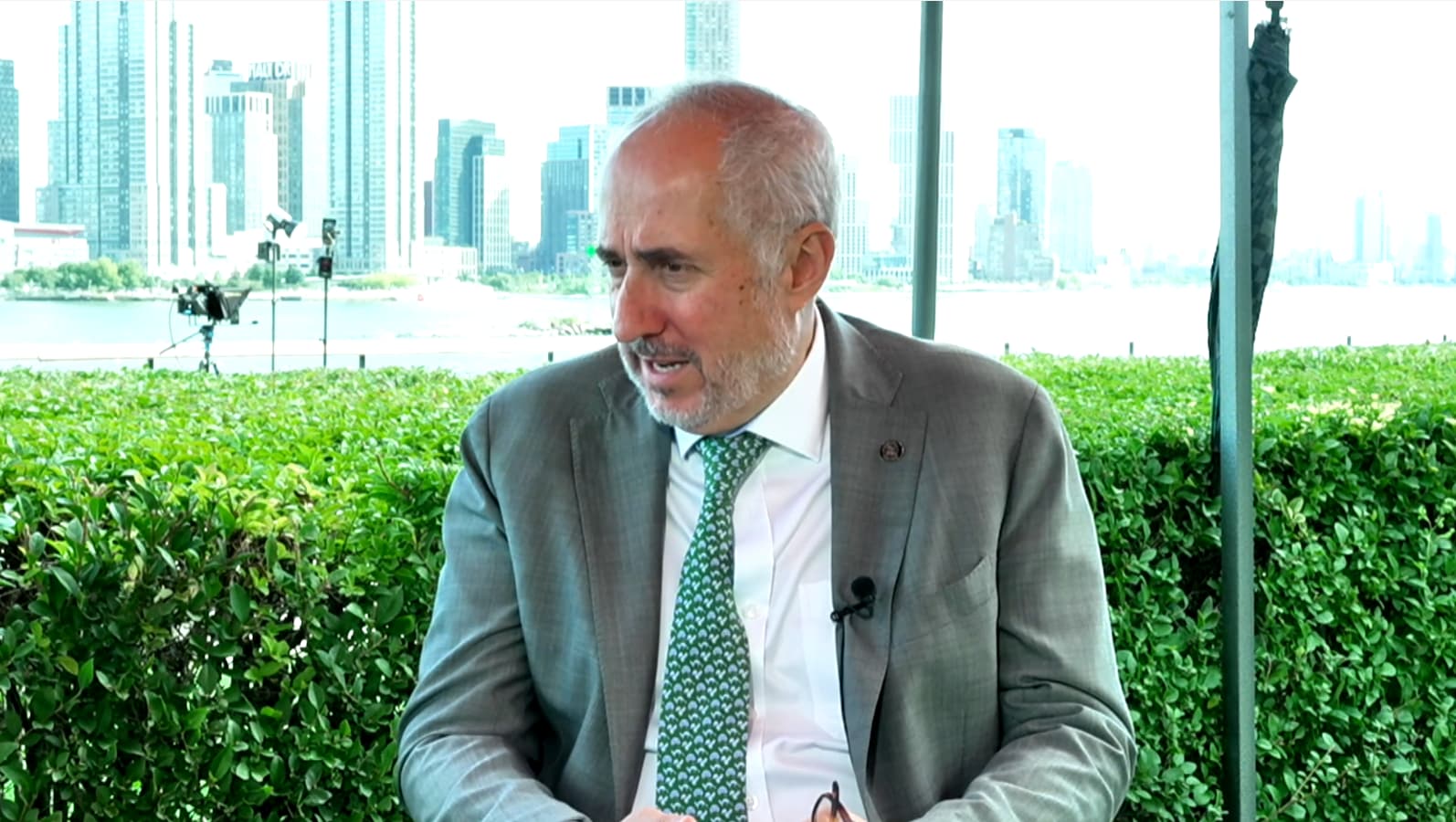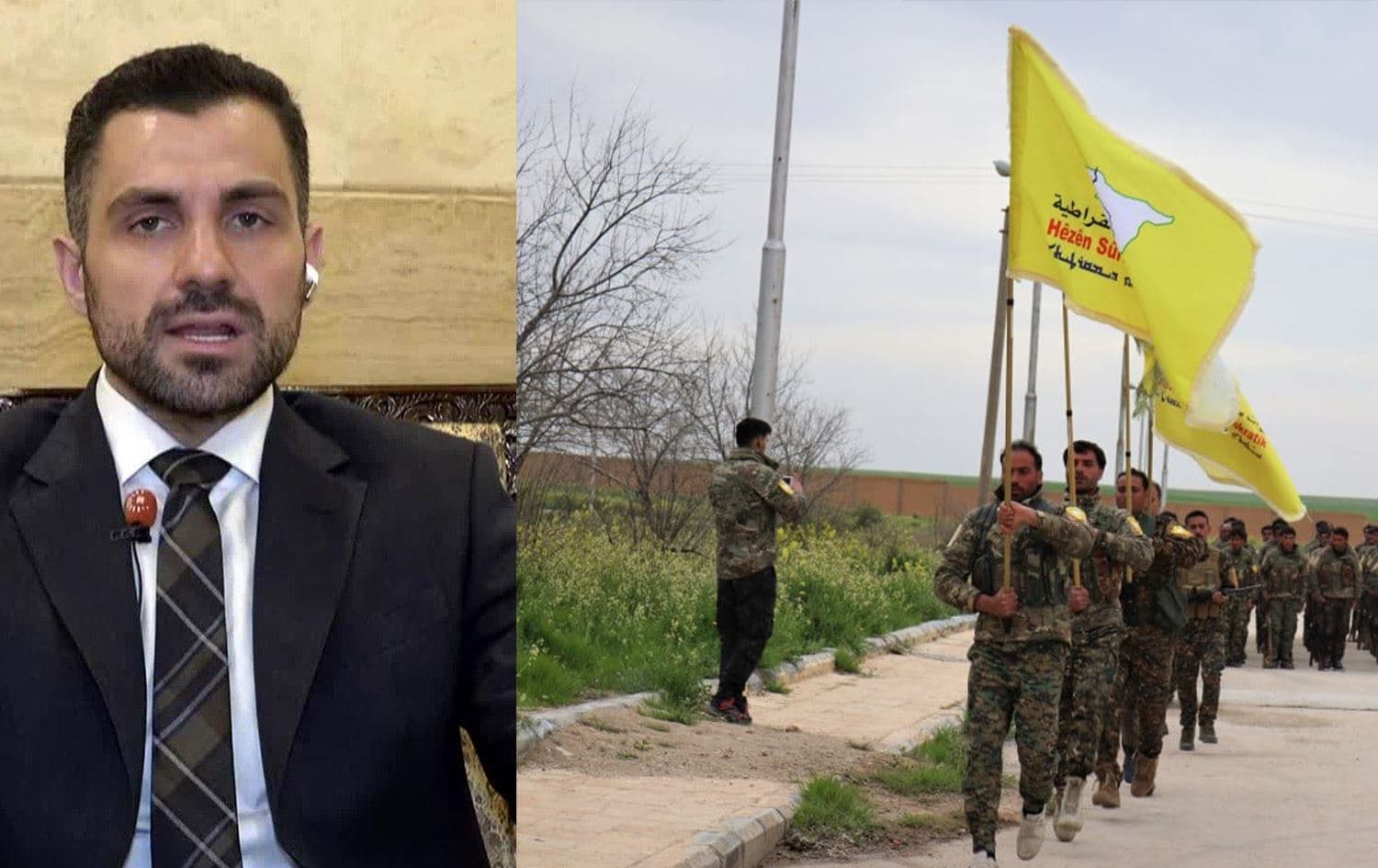

ERBIL, Kurdistan Region - The interim government in Damascus wants to learn from the experience of the Kurdish-led Syrian Democratic Forces (SDF) amid ongoing talks regarding the SDF’s integration into the new army, a senior Syrian official told Rudaw on Sunday.
“It would be very good for the experiences gained by the Syrian Democratic Forces and the fighters in the Syrian Democratic Forces to be shared so that all units of the Syrian army and other fighters who perhaps did not have the same experience that the Syrian Democratic Forces had can benefit from them,” Qutaiba Idlbi, director of American affairs at Syria's foreign ministry, told Rudaw during an exclusive interview.
The US-backed and trained SDF has played a key role in the fight against the Islamic State (ISIS) since 2014 and has resisted numerous attacks from Syrian militia groups and Ankara since 2016. Acting as the de facto army of the Kurdish autonomous administration in northeast Syria (Rojava), the SDF is made up of various units, including an all-woman one.
Syrian interim President Ahmed al-Sharaa and SDF chief Mazloum Abdi signed a landmark agreement in March to integrate the SDF and Rojava’s institutions into the state institutions.
The talks have been stalled recently as the SDF wants to join the new Syrian army as an independent unit rather than individual fighters.
Regarding the collapse of the Paris talks between Rojava and Damascus, Idlbi stated that direct dialogue between Sharaa and Abdi opened up better avenues for cooperation without international interference. He confirmed that meetings are now “taking place in Damascus and northeastern Syria” to implement the March 10 agreement.
The senior foreign ministry official further dismissed the possibility of a federal system based on ethnic or religious lines, arguing that Syria’s demographic landscape makes it unfeasible.
Idlbi acknowledged the historical grievances of Kurds under the Ba’athist regime, calling the displacement and denial of citizenship "a political plan."
On the issue of a new constitution, Idlbi confirmed that “a comprehensive committee will be formed to draft it,” following the formation of Syria’s upcoming parliament. He noted that the process will allow for debate on all issues, including the name of the republic stating that "there will be opportunities to raise all these matters... that represents all Syrians."
Below is the full transcript of the interview with Qutaiba Idlbi:
Let's start with a point that may attract the attention of many of your people, especially since you mentioned in a previous interview with Rudaw that you are of Kurdish origin. I would like to know, which Kurdish family are you from? Are you originally from the city of Idlib, or were you displaced from Kurdish areas in Syria’s Kurdistan?
Qutaiba Idlbi: That's right. I am originally from the Bakir Agha family. Our tribe came from Kermanshah in northern Iran in early 1804. It was part of the Ottoman Empire's confrontation with the army of Muhammad Ali at that time. As you know, the Ottoman Empire dealt with many Kurdish tribes to defend the southern borders of the empire. At that time, our people came to settle in Syria in early 1804.
This was new information for you, Mr. Qutaiba. During your meetings with the foreign minister of Syria [Asaad al-Shaibani], do you demand national rights for Kurds?
As I mentioned earlier, the Kurds in Syria have a historical experience. It is an integral part of the experience of the Syrian people, an integral part of their existence and culture. The question today is how to fix what the regime of [toppled Syrian dictator Bashar] al-Assad has ruined - particularly in relation to Kurdish communities in Syria from 1963 until today - what the Ba’athists have ruined in practice. Of course, there are many things to work on in this field. Some are specific to the Kurdish community, and others relate to what the Assad regime has taken from all Syrians.
What concerns us is how to fix these issues - whether relating to the Kurdish communities specifically or the general rights taken from all Syrians. Of course, this is part of the Syrian [interim] government's agenda: how we can, logically and rationally, within the context of my time and practices, fix what can be fixed and mitigate the harm in the areas where time has passed and it may be difficult to fix.
As you know, the Assad regime has left a heavy legacy of problems among Syrians - not just between Arabs and Kurds in northeast Syria [Rojava] but among all Syrian communities. The intention and will are there to complete this work. The real question is how we can do that within the context of my time and my practices.
This is my question, Mr. Qutaiba, especially since you know that the Kurds demand official constitutional recognition of their national identity, geography, and cultural rights in Syria. They also demand federalism, or at least self-governance, and it should be enshrined in the constitution. Is this possible in light of the current rule in Syria?
There is a constitutional declaration that was issued in March that clearly grants equal citizenship rights to all Syrians. The practical question, I think, is how we can fix political issues. The problems of the Kurdish communities with the Assad regime started with political decisions and did not originate from legal or constitutional changes. For example, when the Assad regime banned Kurds from obtaining Syrian citizenship and placed many of them in the “foreigners” category, they did not rely on the constitution. In fact, it was a political plan, and they created a legal framework to pass it through.
When the Assad regime and the Ba’ath Party worked on the ‘Tenth Line and the Flooding’ [Ba’athist policy that relocated Arabs to Kurdish-majority areas], again, they did not rely on the constitution. There was a political decision, and they then created the legal framework accordingly. I understand the need - because of the injustice the Assad regime and the Ba’ath Party created - to have additional guarantees, and special guarantees, for the Kurds in Syria.
But I think there is a lot of room today to interact with the new Syrian administration. This new administration doesn’t begin from an Arab nationalist perspective, but from the broader Syrian national interest that unites all Syrians. There is a need for many positive steps today to create a positive atmosphere.
Many people have reservations about the name of the Syrian Republic. They say the constitutional declaration is a temporary constitution that refers only to the Arab community, and this is not accepted by some communities and components. What is the current direction of the government in drafting a comprehensive constitution for all Syrians?
If I may continue with the previous point. I think there is a need today to create a positive atmosphere between the Kurdish community and other communities in Syria. The conditions are suitable for this. It will help build a sense of common trust and begin to repair past harms. That could even eliminate the perceived need for additional frameworks or guarantees demanded by some due to a lack of trust.
Regarding the name ‘Syrian Arab Republic,’ as I mentioned, the constitutional declaration clearly states an equal framework for all Syrians.
Of course, I understand that this concern is not limited to Kurdish political parties or groups. Many others in the Syrian context also raise it. What the Syrian administration is saying is that, first, a comprehensive committee will be formed to draft the Syrian constitution, and this matter will be fully debated by the Syrian people. I think there is an opportunity during that drafting period to propose changes. As soon as the transitional period ends and a Syrian parliament is elected, and there are clear electoral mechanisms in place, there will be opportunities to raise all these matters - whether it’s the name of the republic or anything else that represents all Syrians.
I believe that commitment to these inclusive methods is the best way - as I mentioned - to honor the historical Kurdish experience in Syria, which was based on cooperation, solidarity, and mutual agreement with all members of Syrian society.
When will the permanent constitution of Syria be drafted?
As announced at the beginning of the year and after the formation of parliament, a committee will be formed to draft the constitution. The draft constitution will be presented to Syrians before the end of the transitional period.
Let’s move on to the Paris meeting. Why did the government refuse to participate in the Paris meeting after the Hasaka conference?
I think there are two main reasons. The first is the Hasaka conference itself. I believe there was a mistake in how that conference was prepared and held - particularly in how it gave a platform to many parties associated with the Assad regime. It reintroduced these figures in a sectarian, religious, or ethnic context.
That was a mistake. The way it was presented created a framework where some participants tried to impose certain things on the Syrian people, under the banner of international will. The Syrian government’s message was that these matters should be decided between Syrians.
In fact, through direct communication between the Syrian government and the self-administration - especially between the [interim] President [Ahmed] al-Sharaa and [Syrian Democratic Forces (SDF) chief] General [Mazloum] Abdi - we saw that direct dialogue opened much better horizons to implement the agreement without external influence. The message was clear: as Syrians, we can sit at the table and solve our problems ourselves without any international interference. And we will actually get much better results by sitting directly, better than those sessions that are held or held internationally.
I understand from your statement that there’s no longer a ‘Paris talks.’ Do you mean the meetings will now take place in Damascus?
Do you mean that there will not be a meeting in Paris about the agreement?
No, no. I mean, I understood from your speech that the talks will take place in Damascus. I mean, there is nothing left in the name of the Paris conference?
Correct. Yes, exactly. We will continue the meetings in Damascus and in northeast Syria [Rojava]. We are currently taking practical steps on the ground, working with technical committees in Damascus, Hasaka, and other parts of northeast Syria to study the details of implementing the agreement and begin practical steps for the ten-year agreement’s implementation.
Mr. Qutaiba, the SDF does not want to disarm or disband. Why does Damascus not accept the SDF as a special unit of the Syrian army and gather its forces into a special structure?
First, I must correct something: other factions are not present as units within the Syrian army. Those factions agreed to join the Syrian army, and the integration process is ongoing - it has not ended yet. So, it is premature to judge the current status of those factions or to alter the basic form of integration.
The fundamental idea is that these experiences should be distributed based on the Syrian army’s needs - across its divisions and teams - and that this should be studied and placed accordingly, based on Syria’s national needs.
Of course, this matter regarding the Syrian Democratic Forces has a greater need for it. It would be very good for the experiences gained by the Syrian Democratic Forces and the fighters in the Syrian Democratic Forces to be shared so that all units of the Syrian army and other fighters who perhaps did not have the same experience that the Syrian Democratic Forces had can benefit from them. That’s one aspect.
Another key point: as I mentioned, the general framework is the framework of integration. The factions will not remain as groups as they are. As I mentioned, the path of integration will certainly take time. This applies to the factions, and it will apply to the Syrian Democratic Forces. But on the other hand, and this is the most important thing, we’ve seen in other countries what happens when non-state factions are not integrated into the framework of the state. We do not want to repeat models like [the Iran-aligned] Hezbollah [movement] in Lebanon or similar structures elsewhere. Syria cannot grow, flourish or stabilize without one army, one government, and one state. Participation in this unified structure is the real guarantee for everyone - not just Kurds, but all communities.
If we use the framework of the state completely, it can serve as a guarantee for us and our societies - rather than using a narrow framework that would only instigate sectarian and ethnic enmities.
Mr. Qutaiba, you mentioned the experiences of other countries. Many people ask this question: Why does the Syrian government not benefit from the Iraqi experience? The [Kurdish] Peshmerga is part of the Iraqi defense system, but not part of the Iraqi army.
Of course, each country has its own conditions and standards. What applies to Iraq does not apply to Syria, and what applies to Syria does not apply to Iraq, nor to other countries. We tend to start from the awareness of the Syrian experience - its conditions and aspects.
The question today is, of course, that other countries and all other models have their pros and cons. We tend to start from the awareness of the Syrian experience - its conditions and the reality of Syrian society. Not only from the point of view of geographical diversity, ethnic and religious diversity, but we also start from our experience during 14 years, in which we really need to heal the wounds we sustained during the decades of the Assad regime, the Ba’ath Party, and the decades of war. We learn from these experiences so that we do not reopen these wounds again, or create new ones or new gaps between Syrian communities.
Mr. Qutaiba, a member of the US House of Representatives, Congressman Abe Hamadeh, also has relations with the SDF and has recently visited Damascus. How was his meeting with you in Damascus?
Of course, Congressman Hamadeh's visit was in the context of communication between members of Congress and the Syrian [interim] government. The visit was positive, and I think the main purpose of it was to convey a clear picture of the situation in Washington and how Congress can continue to implement President [Donald] Trump's policy, which he defined during the Riyadh conference.
Of course, Congressman Hamadeh suggested that there should be a clear communication channel between President Sharaa, the Syrian [interim] government, and Congress through him, to ensure that all the messages and ideas of the Syrian government are conveyed to the decision-makers in Washington. In general, it was a positive visit, and we look forward to cooperation with members of the US Congress. There will be many visits from Congress to Syria in the coming period, and of course, we look forward to strengthening cooperation - not only between the Syrian government and the US government but also between the Syrian people and the American people.
I have a question about the two dossiers: the events in the Alawite-majority coastal regions in Syria in March and the events that unfolded in the predominantly Druze Suwayda province in southern Syria in July. Has the current government succeeded in dealing with these two dossiers? And don’t you believe there should be a federal system in Syria to solve all these issues?
First of all, I think that when it comes to success or failure, of course, there is no single measure. I think we should look at the details of each of these dossiers. Of course, there are many mistakes that we can learn from, and I think there were also successes achieved by the Syrian government that we can build on. As for each experience - it has its own characteristics. I think that what happened in Syria’s coastal regions, for example, does not apply to what happened in Suwayda, and vice versa.
I think that, in principle, we should first distinguish a basic matter: the political framework of what happened in the coastal regions and in Suwayda. The political framework here is that there are remnants of the Assad regime - military or political groups that follow the Assad regime. The problem is not that they used to follow the Assad regime. I think that as Syrians, we all agreed to leave the past behind us, look ahead, and try to build this country together. The real problem is that there are remnants of the Assad regime that still reject what happened on the eighth of December [when a coalition of opposition groups - led by the now-dissolved Hay’at Tahrir al-Sham - ousted Assad] and are trying to turn back time. Whether it was one of the groups of the Fourth Battalion or the intelligence services, which started the armed rebellion in the coastal regions in March, or whether it was groups like Louay al-Ali, Hossam Louqa, and others in the air and military intelligence services that follow the Assad regime - these groups practically rejected what happened on the eighth of December, rejected accountability to the Syrian [interim] government, and are still engaged in kidnapping, killing, and the trade of captagon not only in Syrian markets but also in neighboring countries.
This is the main framework of what happened. These groups, of course, took advantage of sectarian cover, and caused this unfortunate sectarian conflict in both cases. I think the main lesson we should all learn is that we must isolate political problems as much as possible from the sectarian frameworks that try to hide behind them, in order to prevent the Syrians from falling into the traps of these political clashes.
Regarding the federal system - as I mentioned - the Syrian experience has its own characteristics. And I think one of its most important characteristics is that we cannot talk about any region in Syria that is purely ethnic or religious. The experiences of the Syrian people over hundreds - if not thousands - of years, and their interconnected presence in every region of Syria, indicate first their ability to coexist with one another. But on the other hand, it also shows that the ideas presented about federalism based on ethnic boundaries cannot be applied. There is no Syrian province that is purely institutionalized today - whether religiously or ethnically. There is not even the notion of complete intersection that is purely institutionalized.
Therefore, it is not possible to establish federalist boundaries based on ethnic or religious bases.
On the other hand, the Syrian experience we are calling to embrace is one lived by Syrians together for hundreds of years. And I think the success of this experience over that time is a lighthouse for us to guide the way forward.
The tyranny of the Assad regime is what planted the seeds of sectarian and ethnic conflict in Syria. And as soon as we remove those seeds and fix what has been destroyed, I think the scope for reconciliation is very large.
And this is my question to you, Mr. Qutaiba. You said in a previous interview with Rudaw that you support an administrative decentralization regime. But this was part of the previous constitution, in the era of the next regime, and it did not succeed. The result was the destruction of Syria. What is the solution, in your opinion - which system should be adopted?
Absolutely. And this is what I mentioned at the beginning. The problem in Syria was not a problem with the legal framework. The problem was the political application. The Assad regime - through the Syrian constitution - prohibited torture, for example, and even called for accountability, talked about freedom, and talked about the dignity of the Syrian people. But the Syrian people - or rather the Assad regime - did not respect the dignity of the Syrian people for 60 years.
So the problem is not with the text. The problem is with the application.
That is why what we are saying today is: leave the text aside - regardless of what it says - and focus on the implementation.
What we want to focus on is how we can apply the existing frameworks in the best possible way, respecting local frameworks and respecting local culture, so that members of each society feel represented among their communities. And at the same time, after trying this - if we see that there is a need to change the legal framework - then I think the door is open to do so. But the problem, as I mentioned, is that the Assad regime had the best laws and the best constitutions in the world - but its application on the ground was the worst imaginable. Because there was a political framework operating behind the regime.
So let's put that experience aside, and see how we can apply a new experience within the existing frameworks. And I think that this application will be the guide to determine - within a year or two or three during this transitional period - what we need to establish permanently for the long-term future of the Syrian Republic.