
ERBIL, Kurdistan Region - The largest Iranian Kurdish opposition group said on Friday that its bases have endured more than 114 drone and missile attacks since the start of the Iran war in late April, despite not being a party to the conflict. The Kurdistan Democratic Party of Iran (KDPI) added that the attacks on its positions and those of other dissident groups have killed at least 10 people and are continuing despite the early April ceasefire.
“Since the start of the joint Israel-U.S. operation against Iran on February 28, 2026, more than 114 drone and missile attacks have been recorded against the positions of the Kurdistan Democratic Party of Iran, as well as residential areas housing its members and their families in the Kurdistan Region,” the KDPI said in a statement on X.
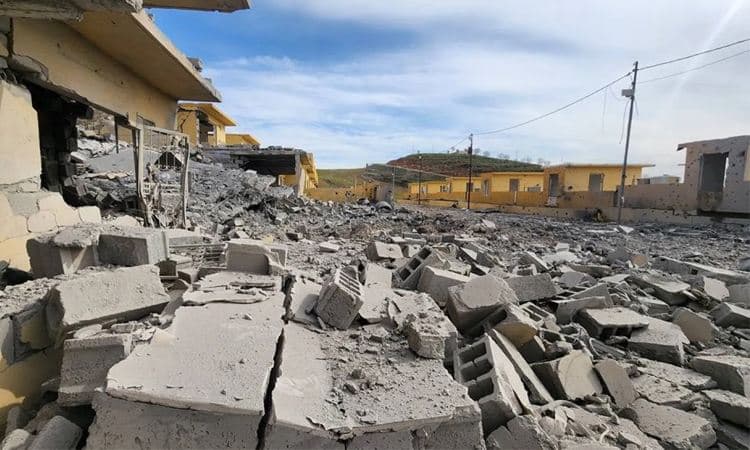
The KDPI added that “the Islamic Republic’s attacks on the headquarters and camps of Iranian Kurdish political parties based in the Kurdistan Region have so far resulted in the deaths of 10 people, injuries to several civilians, and extensive material damage.”
It further warned that the ongoing strikes on its bases have put “the lives and security of refugees and residents in the region at serious risk.”
The latest attack was recorded late at night on Thursday, when the Azadi camp, affiliated with the KDPI, was targeted by five drone strikes in the eastern Koya district of Erbil province.
In its Friday statement, the KDPI detailed that the “Islamic Republic used five suicide drones” to target the camp, which marked the second attack on Azadi within a week, after two missiles hit the site on Monday.
The US and Israel launched a large-scale aerial campaign against Iran in late February, during which more than 17,000 sites were reportedly targeted over six weeks of hostilities.
In response, Iran carried out thousands of drone and missile strikes across the Middle East, targeting alleged US assets - particularly in Gulf Arab states - as well as launching retaliatory attacks against Israel.
The Iranian response also involved Iraqi armed groups aligned with the Tehran-led ‘Axis of Resistance,’ with several factions claiming responsibility for attacks on purported US targets in the region, including in Iraq and the Kurdistan Region.
The US and Iran later agreed to a Pakistan-mediated ceasefire on April 8, halting fighting to allow space for talks. While the first round of discussions concluded without a final agreement on April 11, a second round has yet to take place, as the war has yet to fully conclude.
Despite the truce, the Kurdistan Regional Government’s (KRG) Department of Media and Information reported on Saturday that since the outbreak of the war through April 20, the Region endured over 809 attacks, which “resulted in 20 martyrs and 123 wounded.”
Kurdish leaders have repeatedly censured Tehran over the attacks, which continue despite the ceasefire and despite the Kurdistan Region not being a party to the conflict, nor allowing its territory to be used as a launchpad for attacks against Iran.
For its part, Tehran claims that Iranian Kurdish opposition groups pose a threat to its national security - a concern that intensified following the 2022 and early 2026 nationwide anti-establishment protests, which Iranian authorities allege were fueled in part by Kurdish opposition groups.
In a Tuesday interview with Rudaw, Hamid Reza Gholamzadeh, director of Iran’s Diplomatic House and former editor-in-chief of the semi-official Mehr News Agency, stated that Iran views the attacks on Kurdish opposition groups as part of “efforts to secure its border that began even before the [six-week] war.”
He hinted that Tehran would continue to “defend its own security” against them, adding that this issue “is not connected to war. It is more about the security of the borders,” he said.