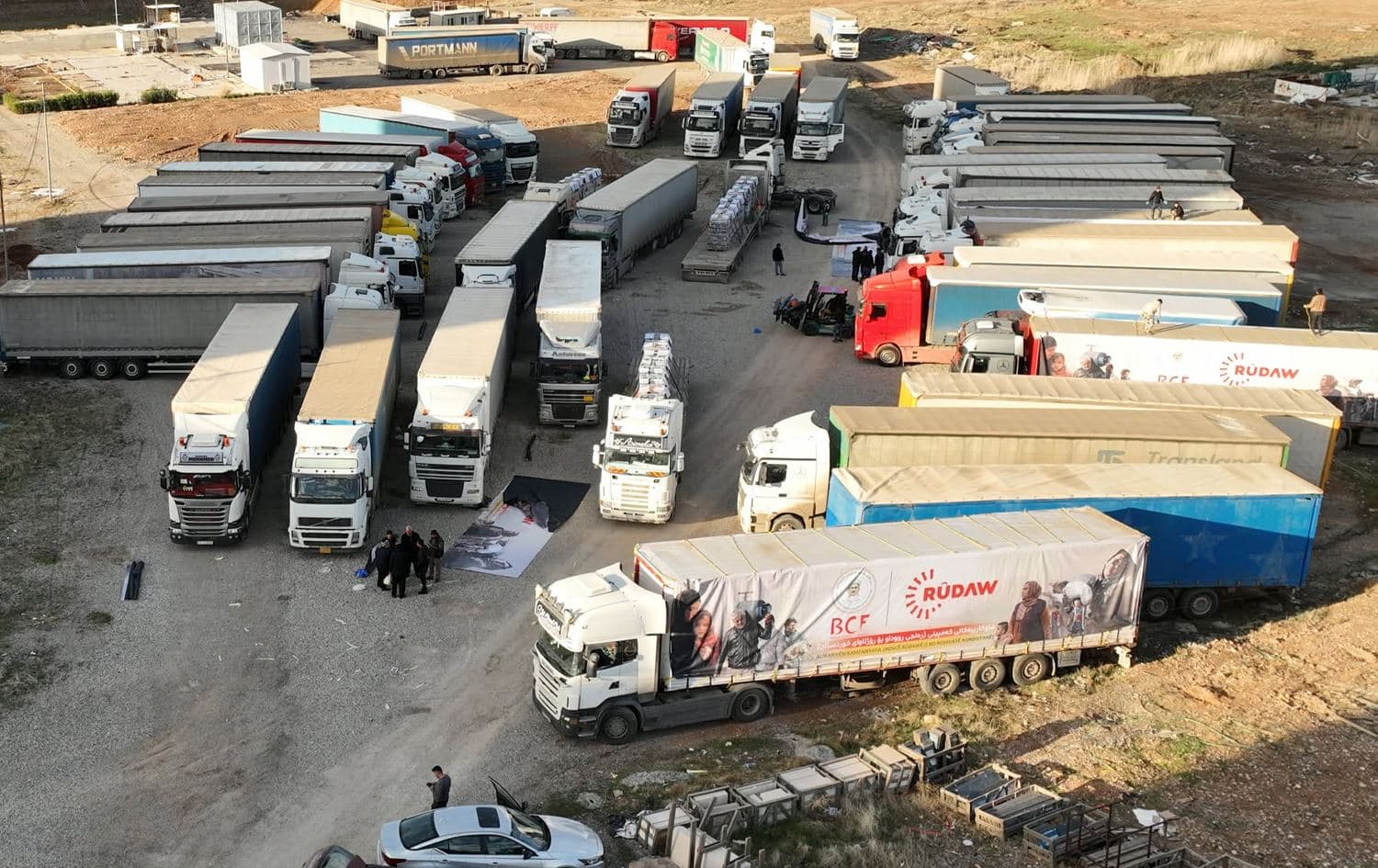

ERBIL, Kurdistan Region - Eighty trucks carrying humanitarian aid worth more than 1.3 billion Iraqi dinars (about $932,000), collected through a Rudaw-organized fundraising campaign, were dispatched on Tuesday to Kurdish-led northeast Syria (Rojava).
The convoy marks the first delivery under Rudaw’s Ranj campaign - Kurdish for “struggle” - spearheaded by prominent Kurdish media personality and Rudaw lead anchor Ranj Sangawi.
“Today, 80 trucks of aid will cross into Rojava, and we are preparing to send another 40 trucks,” Sangawi said.
Each truck is carrying 10 tons of aid and is expected to complete delivery in the coming days. In total, more than 1,000 tons of assistance has been accumulated, including food, medicine, daily necessities, blankets, heaters, clothing, and more.
The aid comes as a tightening military siege and ongoing clashes have left families across northern and northeastern Syria struggling without electricity, clean water, or life-saving medicine amid freezing winter temperatures.
In Kobane city - a symbol of Kurdish resistance against the Islamic State (ISIS) that marked the 11th anniversary of the group’s defeat on Monday - six children have died in recent days due to a lack of basic necessities, including medicine. One of the victims was an infant who died after a hospital ran out of oxygen, according to local reports.
Sangawi praised public participation in the fundraising drive. “The people of Kurdistan, companies, and even those children who brought their savings, participated very bravely.”
Mahjub Haso, head of the Kurdish Red Crescent office in Hasaka, told Rudaw that deteriorating security conditions have forced residents to flee the city toward Qamishli, Amuda, and al-Malikiyah (Derik) in Rojava’s eastern Hasaka province.
“Around Hasaka, there are two refugee camps, Washokan and Serekaniye. Unfortunately, due to the war, organizations have left them, and they only get bread and water,” Haso said.
He added that about 1,500 families from Afrin, who had been living in school buildings, have mostly relocated to Qamishli as displacement continues.
Haso said the needs of displaced families remain overwhelming and thanked the people of the Kurdistan Region and Rudaw for mobilizing aid.
Addressing conditions in Kobane, Haso said only one United Nations aid convoy has entered the city so far. “We are trying to get aid there too, but until now, official approval has not been communicated by the government [the interim government in Damascus],” he said.
Meanwhile, the Syrian Arab Red Crescent told Rudaw on Tuesday that it has delivered the first humanitarian aid convoy to Kobane, noting that there is “ongoing coordination with public authorities and actors on the ground.”
Omar al-Malki, director of the Media and Communication Unit at the Crescent, said the organization “successfully delivered today the first humanitarian aid convoy” to the Kurdish city, confirming that “specialized teams immediately began assessing the population’s urgent humanitarian needs upon arrival.”
Malki added that aid will not be limited to Kobane but will extend “to any other location that requires humanitarian intervention,” including Hasaka. He noted that the humanitarian response is underway in cooperation with “actors on the ground, as well as partners in the International Red Cross and Red Crescent Movement and UN organizations.”
For her part, Rula Amin, spokesperson for the United Nations High Commissioner for Refugees (UNHCR) for the Middle East and North Africa, told Rudaw on Monday that estimates suggest more than 100,000 people have been displaced across Rojava.
The latest displacement wave has unfolded despite a fragile US-brokered ceasefire that took effect on Tuesday. The 15-day truce was intended to facilitate the transfer of ISIS detainees from prisons run by the Kurdish-led Syrian Democratic Forces (SDF) to Iraq.
.jpg&w=3840&q=75)