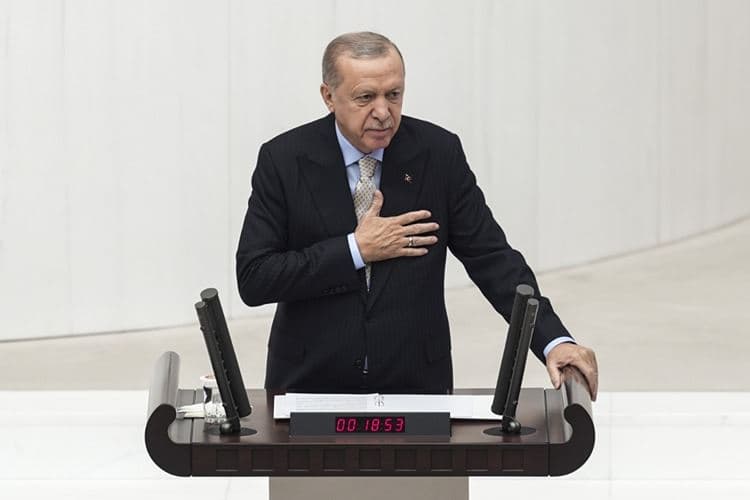

ERBIL, Kurdistan Region - Turkish President Recep Tayyip Erdogan said Wednesday that they were "strongly" supporting Syria's territorial integrity, while warning they would not accept any attempt to "divide" the country, amid rising escalations between Damascus and Kurdish-led Syrian Democratic Forces (SDF), which Ankara has repeatedly considered a threat to its national security.
"From the very beginning, we have strongly supported Syria's territorial integrity. Today, we remain strongly opposed to any plans to divide Syria," Erdogan said. "We have activated all channels of diplomacy to ensure Syria's territorial integrity and to prevent any terrorist activity beyond our borders."
Erdogan went on to claim that Ankara continues to "use these channels with patience, sincerity, and common sense."
"If diplomatic initiatives remain unanswered, Turkey's position and policy are clear. Turkey will not allow a 'déjà vu' in Syria," the Turkish president threatened. Déjà vu is a French word, which means the feeling that you have already experienced something that is happening for the first time. It has remained unclear what Erdogan was actually referring to.
Turkey is one of the key supporters of the new administration in Syria, and strongly opposed to the semi-autonomous Kurdish enclave established in the northeastern region of the country known as Rojava.
The SDF, the de facto army in northeastern Syria, has been the main ally of the US-led global coalition against ISIS. During Syria’s civil war, Kurdish forces established an autonomous administration across large parts of the country’s northeast after government troops withdrew.
Erdogan's remarks came weeks after Syria’s interim president Ahmed al-Sharaa criticized delays in implementing a landmark deal to integrate the SDF into state institutions, suggesting the hold-up stems from separatist ambitions presented as decentralization. He also claimed that Kurds make up only a quarter of the population in Rojava.
Sharaa said that Turkey was also involved in the implementation of the agreement and acknowledged that the process is moving forward slowly.
While the US-backed March 10 agreement has been partially implemented, serious disagreements between Damascus and the SDF remain. The key sticking point is the two sides’ interpretation of the word “integration.” While the Kurdish-led forces seek to join the Syrian forces as a unified bloc, Damascus prefers to individually absorb and assimilate Kurdish fighters into the national army.
Turkey has repeatedly warned that despite its reservations concerning the deal itself, it will give them a chance to implement it.
There are concerns that tensions between the SDF and Damascus could impact peace talks between the Turkish state and the Kurdistan Workers’ Party (PKK).
Ankara is in talks with the Turkey-based PKK about ending nearly half a century of a deadly war that has claimed the lives of over 40,000 people. Acting on a call from its jailed leader Abdullah Ocalan, the PKK has agreed to dissolve itself and lay down arms. In response, the Turkish parliament has formed a commission to resolve the conflict through the legislature and guarantee its success.
Turkish officials claim that the peace process with the PKK also includes the People’s Protection Units (YPG), the backbone of the SDF, but the YPG and Kurdish mediators have denied this and Ocalan has reportedly stated that he has a different plan for Rojava, describing it as a “red line.”
"We will never allow our Kurdish brothers and sisters beyond our borders to be exploited by certain terrorist organizations, or by certain countries and groups hostile to Turks, Kurds, Arabs, and Muslims in general," Erdogan said, referring to the Kurdish-led forces.
He went on to say: "This principled stance is not against the Syrian people, including our Kurdish brothers and sisters; on the contrary, it is in their favor. It is an attitude aimed at ridding our region of the scourge of terrorism. I emphasize once again: Turkish, Kurdish, Arab, Sunni, Shiite, Alawite, Nusayri... We are all united, regardless of ethnicity, language, or sect."