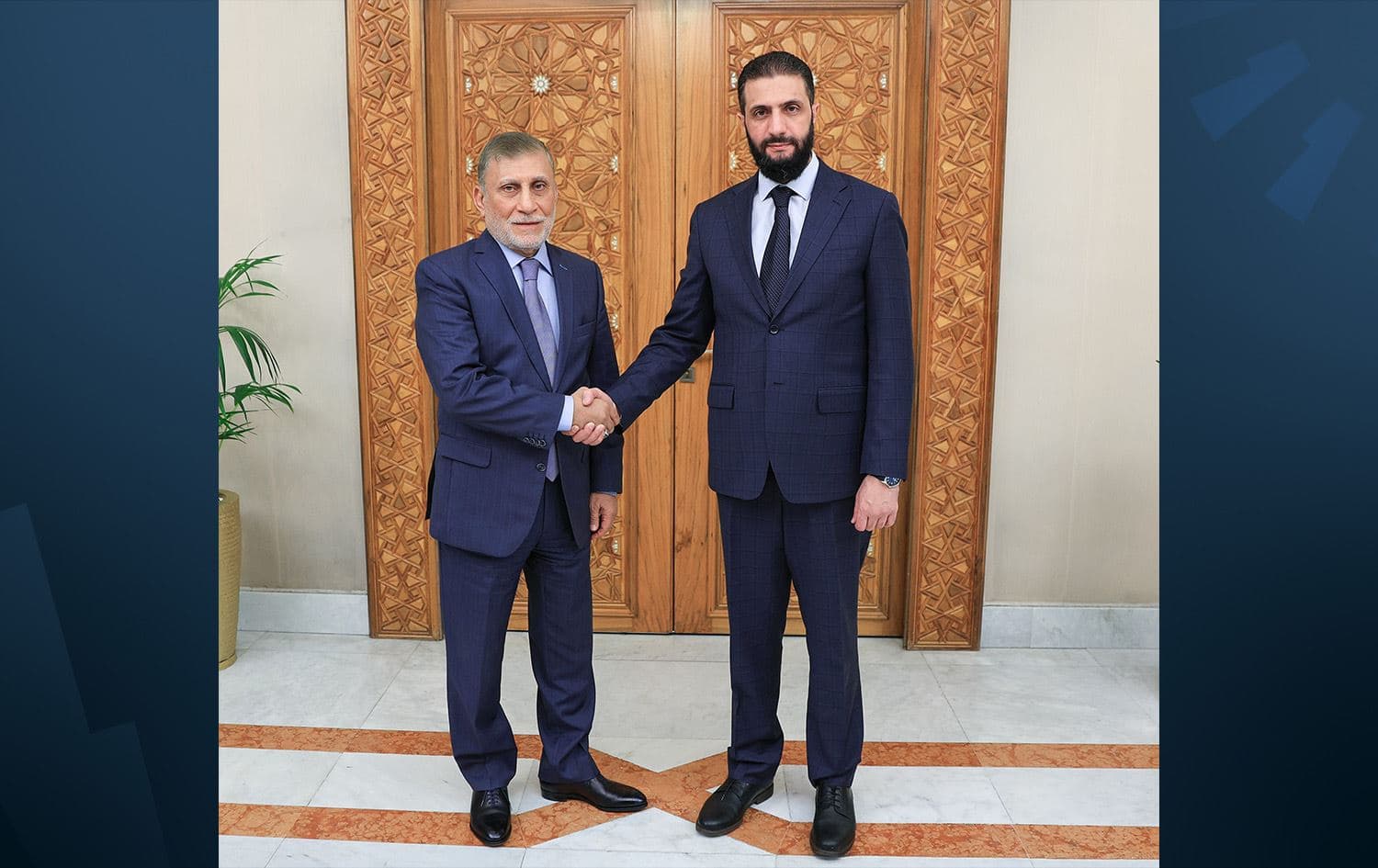

ERBIL, Kurdistan Region - Syrian interim President Ahmed al-Sharaa on Monday received Iraqi veteran politician Izzat al-Shabandar in Damascus as Iraqi Prime Minister Mohammed Shia' al-Sudani's special envoy. Shabandar described the meeting as "very beneficial" for bilateral relations.
Syrian presidency posted a photograph of Sharaa and Shabandar without revealing what was discussed.
Shabandar later told Rudaw's Maad Fayadh that his meeting with Sharaa was "very beneficial for building economic, political, and social relations between Iraq and Syria.
The Syrian presidency and Shabandar himself said that the Iraqi politician made the visit as a special envoy of Sudani.
The aim of the visit was "to discuss matters that contribute to bringing viewpoints closer and strengthening relations between the two brotherly countries," Shabandar said.
Shabandar added that "the repeated Israeli attacks on Syria were discussed and we expressed our condemnation of these attacks."
Sharaa was expected to attend the Arab League summit in Baghdad in May. Instead, he sent Foreign Minister Asaad al-Shaibani.
Sharaa’s decision to skip the summit came amid ongoing controversy over his participation. In May, protesters took to the streets in Iraq’s Shiite-majority southern province of Basra, chanting slogans against Sharaa and denouncing him as “Jolani,” his nom de guerre, Abu Mohammed al-Jolani. Demonstrators shouted, “No, no to Jolani. No, no to terrorism.”
Regarding whether Shabandar carried an official invitation from al-Sudani to Sharaa to visit Baghdad, the special envoy explained that "the reasons for President al-Sharaa's absence from the Arab Summit Regarding whether al-Shabandar carried an official invitation from al-Sudani to al-Sharaa to visit Baghdad, he explained that "the reasons for President al-Sharaa's absence from the Arab summit conference held in Baghdad recently still exist, which were summarized by some Iraqi Shiite political parties making threats and warnings against al-Sharaa that were not in Iraq's interest and are inconsistent with the awareness of state-building and were issued, in my opinion, for electoral reasons."