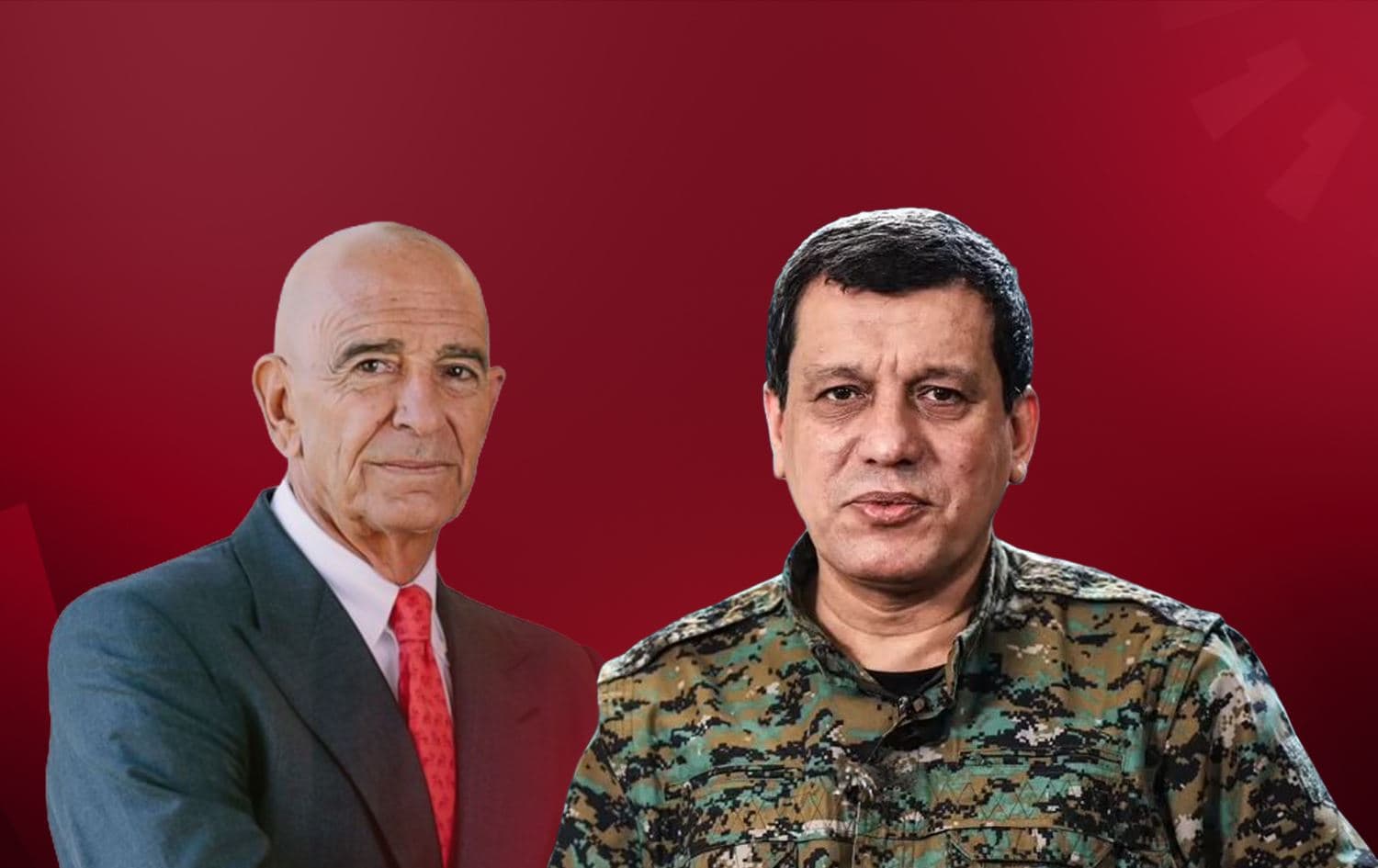

WASHINGTON, D.C - A high-level meeting between Syrian Democratic Forces (SDF) Commander Mazloum Abdi and US Special Envoy to Syria Tom Barrack in Erbil has resulted in a preliminary framework for redefining relations between the Kurdish-led force and the Syrian government, according to two sources familiar with the discussions, including one participant.
The meeting, described by sources as positive, was held at the request of the US side and focused on the future political, military, and administrative status of Kurdish-administered areas in northeastern Syria.
According to the sources, Kurdish-administered areas would remain formally part of the Syrian state, while Kurds would retain authority over local governance. Strategic assets, including international border crossings and oil fields, would be managed by the Syrian government, with Kurdish personnel embedded in state institutions overseeing these sectors.
Military integration framework
On the military front, one of the most sensitive topics - the future of the SDF - was discussed. Sources said the meeting suggested integrating SDF fighters into the Syrian army under a collective structure rather than individual enlistment, a long-standing SDF demand. Under the proposed framework, the SDF would be reorganized into three army divisions commanded by Kurdish officers, preserving unit cohesion while operating under the formal Syrian military structure.
Political representation
The talks also addressed political arrangements. According to other sources in northeastern Syria, the SDF would secure several senior positions within the Syrian government and would be allowed to propose candidates for key posts across government ministries, including - but not limited to - the Ministry of Defense.
US envoy statement
Following the meeting with Abdi and Ilham Ahmed in Erbil, Ambassador Barrack posted:
“We were honored to meet today with General Mazloum Abdi and Ilham Ahmed. The United States reaffirms its strong support for the integration process outlined in the January 18 agreement.”
Official silence from Washington
Rudaw contacted the US State Department for comment. A spokesperson, speaking on background, said the department had “no comment on private diplomatic discussions.”
Neither the Syrian government nor the SDF has publicly commented on the meeting’s details.
Concerns over narratives of ethnic conflict
A source in Rojava told Rudaw that the Syrian government is attempting to frame the conflict in northeastern Syria as an Arab–Kurdish confrontation, a narrative the source rejected. According to the source, Kurds and Arabs in the region have coexisted peacefully for many years. Kurdish authorities have consistently worked to protect and respect their Arab neighbors.
Conflicting accounts of regional diplomacy
The Erbil talks come amid heightened regional tensions and conflicting reports about recent diplomatic engagements. Reuters previously reported that potential attacks against Kurdish forces were discussed during a trilateral meeting in Paris in early January 2026, involving Syria, Israel, and the United States, and that Israel did not object to the proposal.
Israeli officials have strongly denied that account. Israel’s Ambassador to the US, Yechiel Leiter, told Rudaw the issue was never raised, calling the reports false.
“This operation was never discussed. The whole thing is a lie,” he said, adding that the meeting focused instead on broader regional concerns and deconfliction mechanisms.
Uncertain path ahead
The Erbil meeting reflects intensified US efforts to manage Syria’s post-war political and security arrangements amid uncertainty over the future of US engagement, ongoing counterterrorism concerns, and competing narratives about negotiations between Kurdish authorities and Damascus.
While no formal agreement has been announced, sources said the discussions marked a significant step toward reshaping the relationship between the SDF, the Syrian state, and international stakeholders.
“We are trying to protect the Kurds”
President Donald Trump, when asked by Rudaw on Monday how his administration plans to protect Kurdish rights in Syria, expressed support for the Kurdish people:
“I like the Kurds… we get along with the Kurds and we are trying to protect the Kurds.”
Following the president’s remarks, Rudaw spoke with Sinam Mohamad, Chief of Mission of the US Mission of the Syrian Democratic Council, who emphasized the broader role of Kurdish forces in regional security.
“If ISIS were spreading, prisoners could reach the EU and the US The only forces that can fight terror are the Kurds… we want a status in Syria that protects Kurds and other minorities," Moammad said.
Mohamad also stressed that the Kurds are committed not only to defending their own communities but also to ensuring accurate information about the region reaches US policymakers.