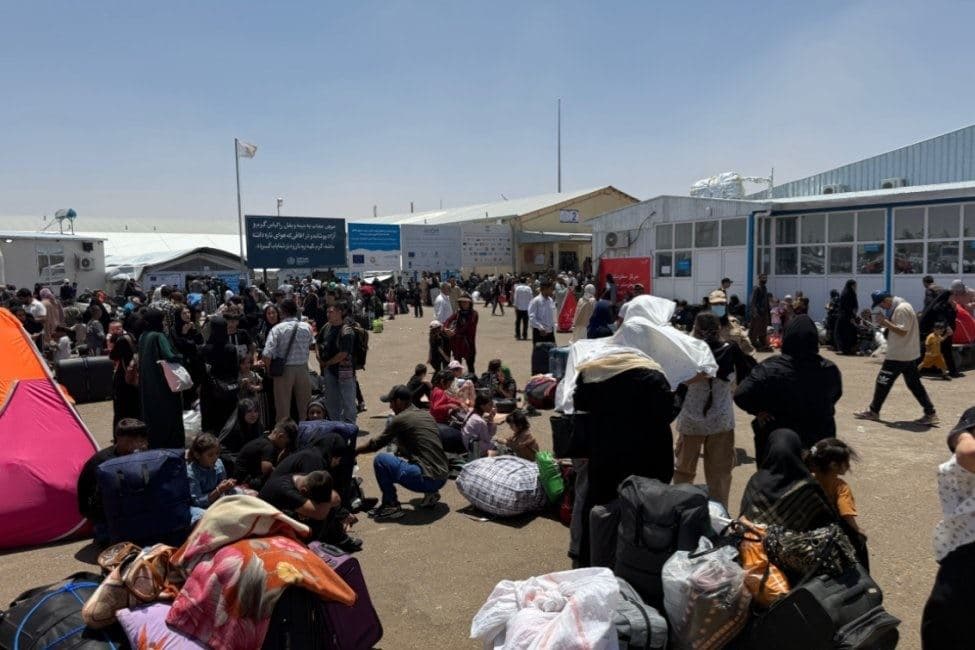

ERBIL, Kurdistan Region - International organizations are warning of an escalating humanitarian crisis, as Iran intensifies deportations of Afghan migrants, including nearly 3,000 Afghan families on Tuesday alone. The deportations coincide with Iran’s crackdown on people it alleges have collaborated with Israel during the recent 12-day conflict between the two - prompting growing concerns of “scapegoating.”
Save the Children reported on Wednesday that "about 80,000 Afghan children crossed into Afghanistan from Iran” in June - more than double the numbers recorded in May. Of these children, approximately "6,700 were unaccompanied and nearly 39 percent…were forcibly returned."
One day earlier, Afghanistan’s state-run Bakhtar News Agency reported the return of 2,954 families from Iran in a single day.
For its part, the United Nations issued a stark warning Monday, stating that the massive influx of returnees is overwhelming Afghanistan’s already fragile support systems.
The International Organization for Migration (IOM) reported that "more than 700,000 Afghan migrants have returned from Iran so far this year, including 256,000 in June alone." The IOM emphasized that 99 percent of these returnees are undocumented, with 70 percent forcibly returned, adding that this marks a concerning trend as “entire families are now being deported, rather than predominantly single young men.”
IOM attributed the surge to a March 20 directive by Iran requiring all undocumented Afghans to leave, adding that the situation was exacerbated by the June conflict with Israel, after which “border crossings skyrocketed from about 5,000 to nearly 30,000 daily.”
Israel on June 13 struck targets inside Iran resulting in the deaths of several senior military commanders and nuclear scientists. In retaliation, Iran launched missile and drone attacks on Israel. A US-brokered ceasefire came into effect on June 24 and seems to be holding.
The UN further warned that Afghanistan, already facing economic collapse and a chronic humanitarian crisis, is unprepared to absorb such large-scale returns. It elaborated that its 2025 Humanitarian Needs and Response Plan (HNRP) has received only "22.2 percent of its $2.42 billion target" to date, leaving aid operations critically underfunded.
“The scale of returns is deeply alarming and demands a stronger and more immediate international response. Afghanistan cannot manage this alone," said IOM Director General Amy Pope.
Meanwhile, Arafat Jamal, the UNHCR representative for Afghanistan, told Reuters on Wednesday that he was concerned about the recent pushbacks, warning that anger over Israel’s military actions in Iran may be spilling over onto Afghans - who risk being scapegoated. Jamal cautioned that a "perfect storm" is brewing for Afghanistan, as the country struggles to cope with a massive influx of returnees.
Tehran's take
Iran, for its part, has justified its actions on national security grounds.
The semi-official Tasnim News Agency, affiliated with the Islamic Revolutionary Guard Corps (IRGC), on Tuesday quoted Iranian government spokesperson Fatemeh Mohajerani as saying, "Iran has hosted a large number of foreign nationals for nearly five decades," but emphasized that this “does not mean expulsion, but a return to their homeland.” She stressed that “Iran’s national security is a priority, and naturally illegal nationals must return.”
In addition to the deportations, Tehran’s state-run news agency (IRNA) on Thursday reported that the government and parliament are now “more insistent than ever on organizing foreign nationals’ presence” through a proposed National Migration Organization, a draft law submitted to the Iranian legislature last December.
IRNA added that this push has been accelerated by what it described as “the Zionist regime’s aggression” on Iran, after “it became clear during and after the conflict that some foreign nationals were involved in espionage for the Zionist regime, terrorist acts, or building suicide drones for the enemy.” The outlet claimed that “a number of these individuals were arrested by intelligence and military agencies."
In the aftermath of a 12-day conflict with Israel, Iranian authorities carried out sweeping raids with IRGC-affiliated media outlet Fars News Agency, reporting that over 700 individuals, including Afghans, were arrested on charges of espionage and collaboration with Israel. Iranian authorities have reportedly confiscated phones and uncovered "active espionage and sabotage networks." State TV has also aired “confessions” from detained Afghans, although their authenticity remains unverified.
Iranian authorities have conducted widespread raids and confiscated phones, alleging "active espionage and sabotage networks." State television has aired "confessions" from detained Afghans, though their veracity is unverified.
Iran’s Interior Minister Eskandar Momeni told state media last week that “one of his main priorities is the organization of foreign nationals.” He added, “The reality is that Iran, in terms of capacity and capability, cannot accommodate this volume of foreign nationals.”
Momeni went further, stating: “We have many honorable people among them [foreign nationals], but some have entered with specific objectives, especially in the last two or three years, and this is where the necessity of organization becomes clear.” He further urged lawmakers to prioritize the National Migration Organization bill, calling it “one of the country's vital laws, as it directly relates to our demographic, economic, security, and even identity structure.”
In response to the deportations, Afghanistan's Permanent Representative to the United Nations, Naseer Ahmad Faiq, issued an urgent appeal on Wednesday calling on Iran to “immediately reconsider its decision to forcibly deport Afghan migrants.” He emphasized the need for dignity and respect for international human rights principles, warning that “unjust and mass expulsions risk creating a broader humanitarian and security crisis across the region.”