


Iran

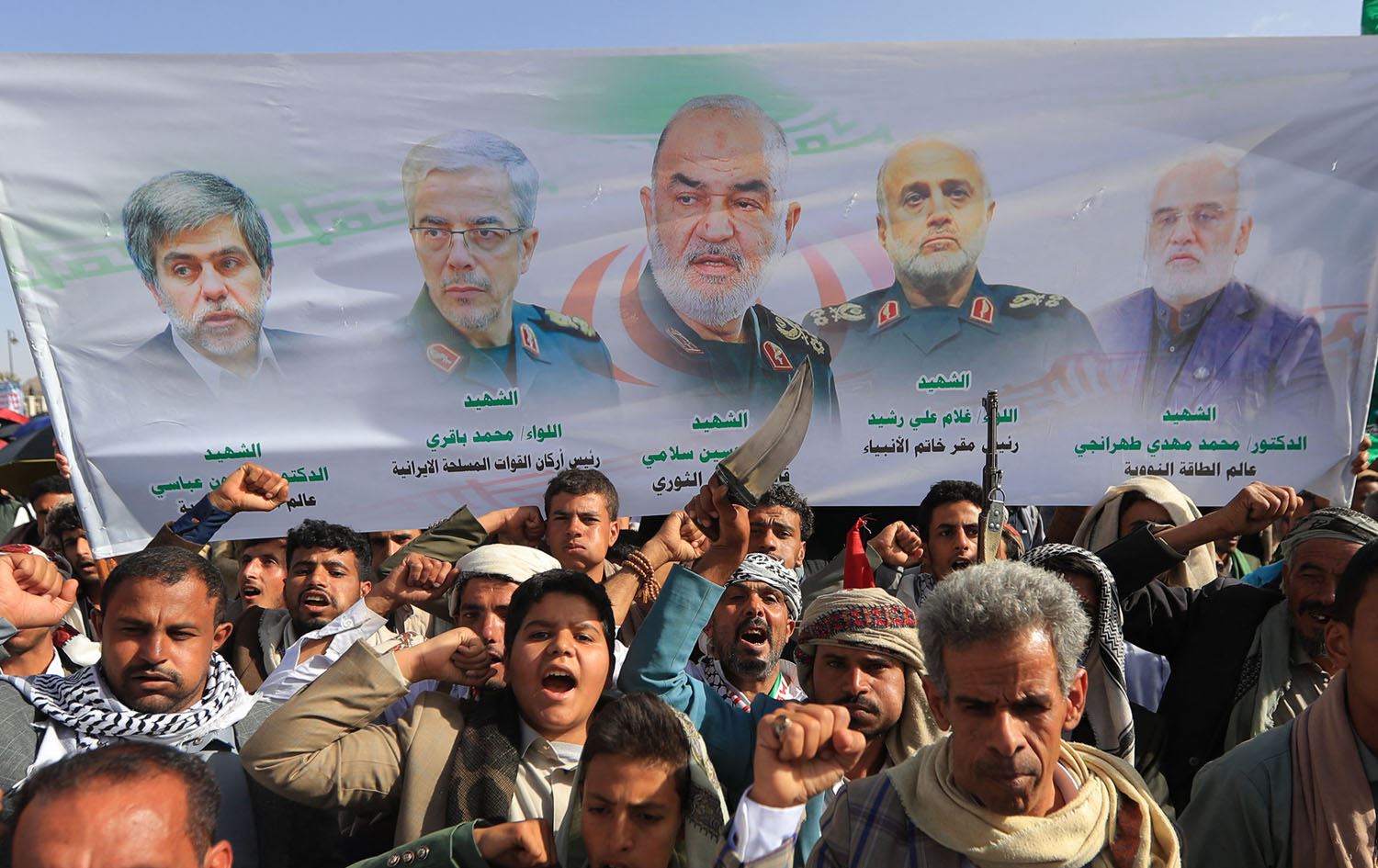
Yemenis carry portraits of slain Iranian generals and scientists during a rally in solidarity with the Gaza Strip and to condemn the Israeli strikes on Iran, in Sanaa on June 13, 2025. Photo: Mohammed Huwais/AFP
ERBIL, Kurdistan Region - Among those killed by Israel on Friday were some of Iran’s most influential military and nuclear figures - people who shaped the country’s defense strategy, missile program, and regional posture. Their deaths mark a significant blow to Iran’s leadership at a time of escalating tensions.
General Hossein Salami, commander-in-chief of Iran’s Islamic Revolutionary Guard Corps (IRGC), was among several senior figures killed in Israel’s pre-dawn strikes targeting Iranian military and nuclear infrastructure and personnel.
Salami, 65, was appointed to lead the IRGC in April 2019. The force answers directly to Iranian Supreme Leader Ayatollah Ali Khamenei.
Known for his hardline rhetoric against Iran’s adversaries, including Israel and the United States, Salami last month warned that Tehran would “open the gates of hell” if attacked. Just a day before the Israeli strikes, he said Iran was “fully ready for any scenarios, situations, and circumstances.”
“The enemy thinks it can fight Iran the same way it fights defenceless Palestinians who are under an Israeli siege. We are war-tested and experienced,” he said.
Salami joined the IRGC in 1980 during the Iran-Iraq war, becoming its deputy commander in 2009. Since the 2000s, he had been sanctioned by the United Nations Security Council and the United States for his involvement in Iran’s nuclear and military programs.
Following an Israeli strike on Iran’s embassy in Syria last April that killed seven IRGC members, including two generals, Salami warned: “Our brave men will punish the Zionist regime.”
Early Friday morning, Israel conducted what it called a “preemptive strike” targeting Iranian nuclear facilities and senior military commanders. Israeli Prime Minister Benjamin Netanyahu said the operation, dubbed Rising Lion, aimed to “roll back the Iranian threat to Israel’s very survival,” and warned that it could continue for days.
The Israeli Defense Forces (IDF) said that Iran responded by launching more than 100 drones toward Israel, activating its air defense systems.
Another key figure killed was Major General Mohammad Bagheri, chief of staff of the Iranian Armed Forces and a top IRGC commander. In his mid-60s, Bagheri oversaw both the IRGC and the country’s regular military, coordinating between Iran’s parallel security structures.
Bagheri also joined the IRGC in 1980 and held several high-ranking intelligence and operational posts during and after the Iran-Iraq war. Iranian media say he played a “special role” in a 1997 operation against Kurdish forces in Iraq. In May, he declared that Iran’s armed forces were “fully prepared for any situation.”
He was sanctioned by the US in 2019 as part of measures targeting the “inner circle” of Supreme Leader Ali Khamenei. He was also sanctioned by the European Union for supplying Russia with drones, and by the US, Canada, and the United Kingdom for his role in the 2022 crackdown on protests sparked by the death of Zhina (Mahsa) Amini.
General Gholam Ali Rashid, head of the Khatam al-Anbiya Central Headquarters - the IRGC’s main operational command - was also confirmed killed. Born in 1953, Rashid had led the headquarters since 2016. He began his military career as a deputy for intelligence and operations in Khuzestan province’s Dezful city, southern Iran, and played a prominent role in several major offensives during the Iran-Iraq war, according to Iran’s state media.
In 1984, during Operation Kheibar in Iraq’s marshes, Rashid helped establish the Khatam al-Anbiya HQ as a joint command structure between the IRGC and the army.
Also killed was General Amir Ali Hajizadeh, head of the IRGC’s aerospace division and the architect of Iran’s missile program.
Hajizadeh long vowed to expand Iran’s ballistic capabilities despite Western pressure. In 2022, he unveiled the Fattah missile, capable of hypersonic speeds of Mach 13-15.
In January 2024, Tehran drew international condemnation after launching ballistic missiles at the home of Kurdish businessman Peshraw Dizayee in Erbil, killing him, his family, and guests. Hajizadeh defended the strike by claiming the site was “a concrete fortress used for espionage” - an allegation rejected by Iraqi and Kurdistan Region officials.
Israel’s attack also claimed the lives of several nuclear scientists.
Among them was Mohammad Mehdi Tehranchi, president of Islamic Azad University and a senior nuclear physicist born in 1965. According to Press TV, he earned his doctorate in theoretical physics from the Moscow Institute of Physics and Technology in 1997. Tehranchi was described as playing “a key role in challenging Western dominance through scientific knowledge and innovation.”
Also confirmed killed were Fereydoun Abbasi-Davani, a former head of the Atomic Energy Organization of Iran - the civilian body overseeing the country’s atomic program - and Ahmad Reza Zolfaghari, a professor of nuclear engineering.
IRGC Quds Force commander Esmail Ghaani was also killed in an Israeli attack in Mashhad, an informed source told Rudaw English. New York Times first reported his death. However, Iranian authorities have yet to confirm it.
Israel’s airstrikes have escalated tensions across the region and drawn international and global condemnation and calls for de-escalation. The US and some European countries emphasized the need to stop Iran’s nuclear program and defended “Israel’s right to exist.”
Turkey, Qatar, Jordan, Saudi Arabia, and the Palestinian group Hamas condemned the Israeli strikes as unlawful and warned they could trigger broader regional escalation and jeopardize diplomatic efforts.
At least 96 people were killed and more than 340 injured, according to figures from IRGC-affiliated Fars News Agency.
Updated at 9:00 pm.


Comments
Rudaw moderates all comments submitted on our website. We welcome comments which are relevant to the article and encourage further discussion about the issues that matter to you. We also welcome constructive criticism about Rudaw.
To be approved for publication, however, your comments must meet our community guidelines.
We will not tolerate the following: profanity, threats, personal attacks, vulgarity, abuse (such as sexism, racism, homophobia or xenophobia), or commercial or personal promotion.
Comments that do not meet our guidelines will be rejected. Comments are not edited – they are either approved or rejected.
Post a comment