


Iran

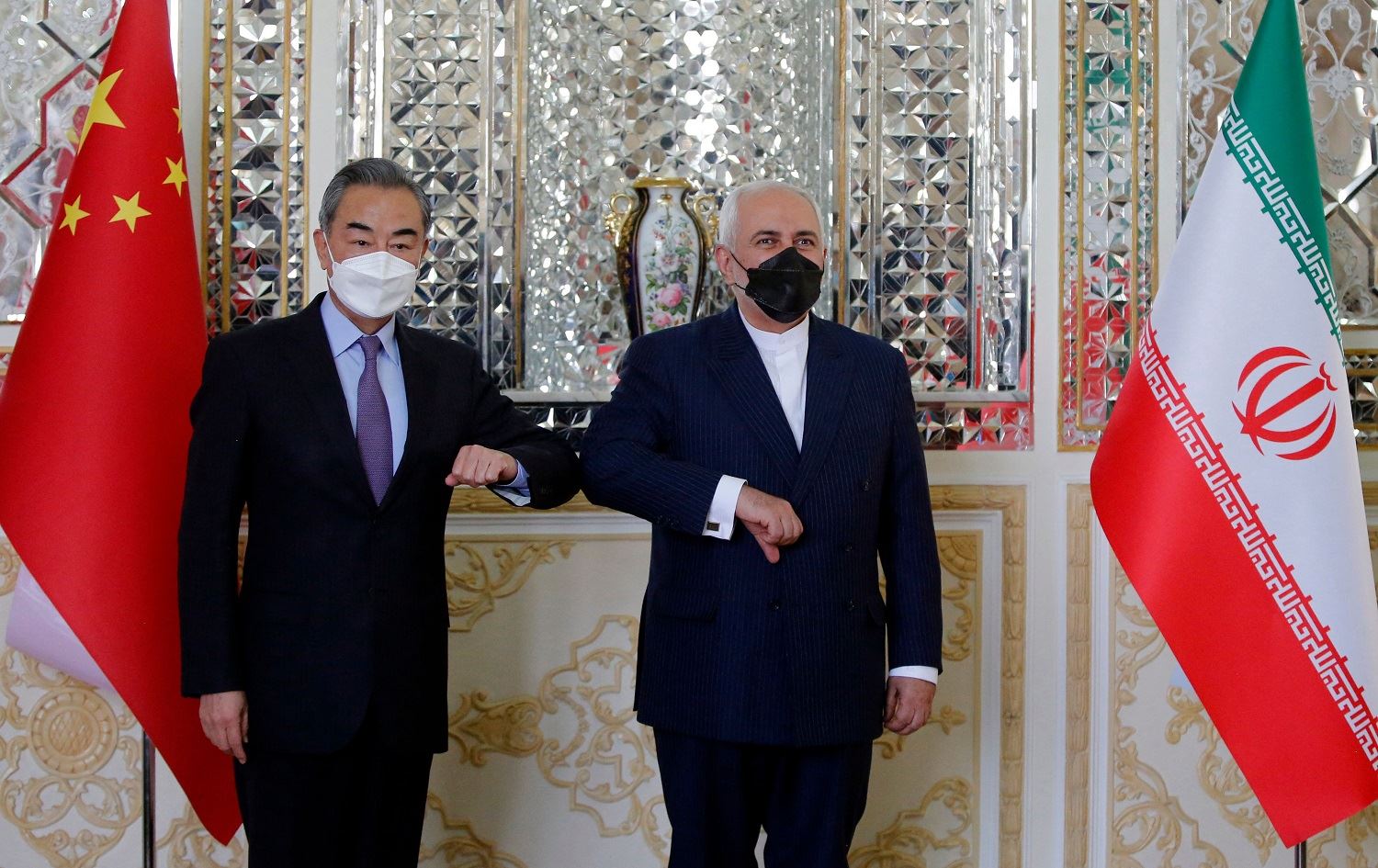
Iranian Foreign Minister Mohammad Javad Zarif (right) greets his Chinese counterpart Wang Yi (left) in the capital Tehran, on March 27, 2021. Photo: AFP
ERBIL, Kurdistan Region — Iran and China signed a 25-year cooperation accord on Saturday. The agreement, which focuses on economic ties, was inked by their foreign ministers in Tehran.
China’s Foreign Minister Wang Yi arrived in Tehran on Friday for a two-day visit and meetings with his Iranian counterpart Mohammad Javad Zarif and Iranian President Hassan Rouhani.
Rouhani, in his meeting with Wang, said he hopes to increase trade with China. “We are interested in China continuing to be a major trading partner with Iran and to have more cooperation in the field of joint ventures,” he said.
Iranian media quoted Wang saying ties with Iran are not influenced by disputes surrounding the 2015 nuclear deal. “Our relations with Iran will not be affected by the current situation, but will be permanent and strategic,” he said. “Iran decides independently on its relations with other countries and is not like some countries that change their position with one phone call.”
In an interview with Al Arabiya TV in Riyadh on Wednesday, before traveling to Iran, Wang said that peace and security in the Middle East must come from within. “For the region to emerge from chaos and enjoy stability, it must break free from the shadows of big-power geopolitical rivalry and independently explore development paths suited to its regional realities,” he said.
The details of the agreement, which has been in the works since 2015, have not been revealed, but Saeed Khatibzadeh, spokesperson for Iran’s Foreign Ministry, on Friday said it will “serve as a road-map for Iran-China relations in the next 25 years,” and has a focus on economic issues, including Iran participating in China’s One Road, One Belt initiative as well as cooperation between each country’s private sectors.
The Belt and Road Initiative is a massive infrastructure development and economic cooperation plan spanning more than 60 countries – a new Silk Road with land and maritime corridors.
Iran and China are this year marking 50 years of diplomatic relations and Tehran is hopeful it can benefit from the Belt and Road Initiative because of its strategic location at the intersection Europe and Asia.
Tehran, suffering under American economic sanctions that have crippled its oil sector, is looking to Asian customers as US President Joe Biden seeks to revive nuclear talks. According to a Reuters report earlier this month, China unofficially imported about 306,000 barrels of Iranian oil per day over the past 14 months, reaching record volumes in January and February. The oil was identified as coming from other sources such as Oman and the United Arab Emirates.
On Thursday, a day before Wang travelled to Tehran, China’s deputy foreign minister Ma Zhaoxu spoke on the phone with the US special envoy for Iran, Robert Malley, at the American’s request, and they discussed the Iran nuclear deal, which former US President Donald Trump quit in 2018 before re-imposing sanctions on Iran.
“The US side should take concrete actions as soon as possible, and both the United States and Iran need to meet each other half way for the latter’s return to compliance at an early date,” according to a readout of their call from the Chinese Foreign Ministry.
Biden has said he wants to rejoin the nuclear deal but the two sides are at a stalemate over how to proceed. Tehran wants the US to begin lifting sanctions, saying that once Washington makes the first move, Iran can quickly roll back steps it took away from compliance with the deal, including boosting uranium enrichment to 20%. The US wants to talk with Iran to devise a choreographed plan, saying returning to the deal will not happen unilaterally.
As a permanent member of the United Nations Security Council, China is a signatory to the 2015 nuclear deal.
China’s Foreign Minister Wang Yi arrived in Tehran on Friday for a two-day visit and meetings with his Iranian counterpart Mohammad Javad Zarif and Iranian President Hassan Rouhani.
Rouhani, in his meeting with Wang, said he hopes to increase trade with China. “We are interested in China continuing to be a major trading partner with Iran and to have more cooperation in the field of joint ventures,” he said.
Iranian media quoted Wang saying ties with Iran are not influenced by disputes surrounding the 2015 nuclear deal. “Our relations with Iran will not be affected by the current situation, but will be permanent and strategic,” he said. “Iran decides independently on its relations with other countries and is not like some countries that change their position with one phone call.”
In an interview with Al Arabiya TV in Riyadh on Wednesday, before traveling to Iran, Wang said that peace and security in the Middle East must come from within. “For the region to emerge from chaos and enjoy stability, it must break free from the shadows of big-power geopolitical rivalry and independently explore development paths suited to its regional realities,” he said.
The details of the agreement, which has been in the works since 2015, have not been revealed, but Saeed Khatibzadeh, spokesperson for Iran’s Foreign Ministry, on Friday said it will “serve as a road-map for Iran-China relations in the next 25 years,” and has a focus on economic issues, including Iran participating in China’s One Road, One Belt initiative as well as cooperation between each country’s private sectors.
The Belt and Road Initiative is a massive infrastructure development and economic cooperation plan spanning more than 60 countries – a new Silk Road with land and maritime corridors.
Iran and China are this year marking 50 years of diplomatic relations and Tehran is hopeful it can benefit from the Belt and Road Initiative because of its strategic location at the intersection Europe and Asia.
Tehran, suffering under American economic sanctions that have crippled its oil sector, is looking to Asian customers as US President Joe Biden seeks to revive nuclear talks. According to a Reuters report earlier this month, China unofficially imported about 306,000 barrels of Iranian oil per day over the past 14 months, reaching record volumes in January and February. The oil was identified as coming from other sources such as Oman and the United Arab Emirates.
On Thursday, a day before Wang travelled to Tehran, China’s deputy foreign minister Ma Zhaoxu spoke on the phone with the US special envoy for Iran, Robert Malley, at the American’s request, and they discussed the Iran nuclear deal, which former US President Donald Trump quit in 2018 before re-imposing sanctions on Iran.
“The US side should take concrete actions as soon as possible, and both the United States and Iran need to meet each other half way for the latter’s return to compliance at an early date,” according to a readout of their call from the Chinese Foreign Ministry.
Biden has said he wants to rejoin the nuclear deal but the two sides are at a stalemate over how to proceed. Tehran wants the US to begin lifting sanctions, saying that once Washington makes the first move, Iran can quickly roll back steps it took away from compliance with the deal, including boosting uranium enrichment to 20%. The US wants to talk with Iran to devise a choreographed plan, saying returning to the deal will not happen unilaterally.
As a permanent member of the United Nations Security Council, China is a signatory to the 2015 nuclear deal.


Comments
Rudaw moderates all comments submitted on our website. We welcome comments which are relevant to the article and encourage further discussion about the issues that matter to you. We also welcome constructive criticism about Rudaw.
To be approved for publication, however, your comments must meet our community guidelines.
We will not tolerate the following: profanity, threats, personal attacks, vulgarity, abuse (such as sexism, racism, homophobia or xenophobia), or commercial or personal promotion.
Comments that do not meet our guidelines will be rejected. Comments are not edited – they are either approved or rejected.
Post a comment