
ERBIL, Kurdistan Region - Iraq’s customs authority is rapidly advancing toward full electronic automation, a senior customs official told Rudaw on Monday, noting that the initiative has already boosted state revenues and control over smuggling. He added that efforts are also underway to integrate the Kurdistan Region’s customs system into the federal framework adopted.
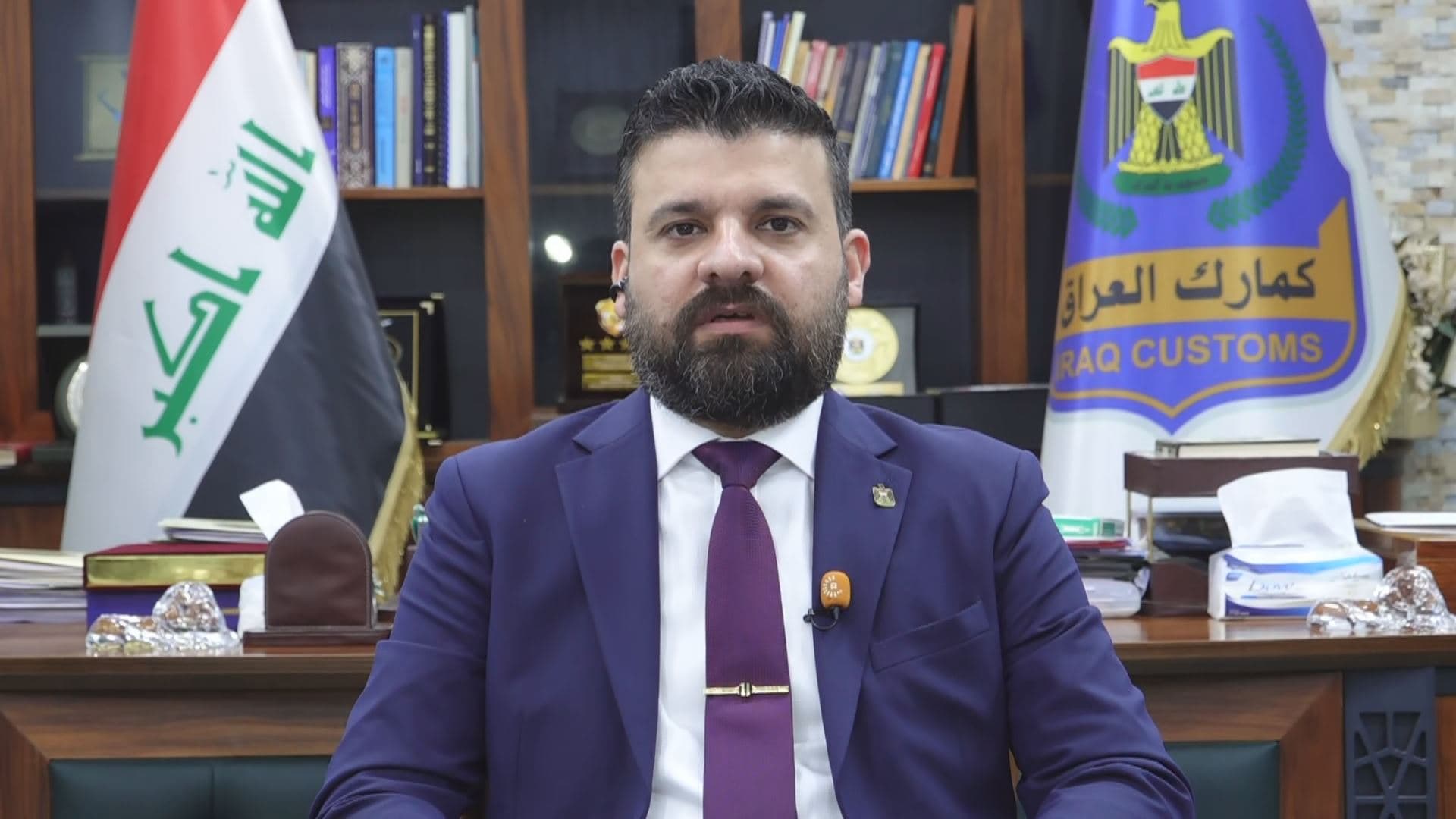
Thamer Qasim Dawood, Director-General of the General Commission of Customs, said that the successful rollout of the Automatic System for Customs Data (ASYCUDA) - developed by the United Nations Conference on Trade and Development (UNCTAD) - now covers all 22 of Iraq’s federal border crossings, including key ports in southern Iraq.
Dawood said the Commission, with direct backing from Prime Minister Mohammed Shia’ al-Sudani, “has implemented customs reforms” aimed at “facilitating trade, minimizing manipulation in customs transactions, and boosting state revenues.”
“These reforms have directly contributed to smoother trade movement and a significant increase in revenues,” he noted, adding, “Over the past two years, revenues have risen by between 100 and 150 percent.”
The Iraqi customs official projected even stronger financial performance as automation expands, estimating that “revenues could reach three trillion dinars [around $2.3 billion] in the coming years as a result of the new reforms and automation.”
Another major achievement recorded due to the new system, Dawood added, has been the dramatic reduction in smuggling, with illicit trade now “under control at a rate ranging from 80 to 90 percent.” While he acknowledged that smuggling has not been entirely eliminated, he described the decline as “significant and unprecedented.”
Regarding coordination with the Kurdistan Regional Government (KRG), Dawood confirmed that “direct and ongoing discussions” are taking place with Erbil’s customs authorities.
“We have held preliminary meetings on automating the Region’s customs centers and linking them to the ASYCUDA system,” he said. “However, automation has not yet been implemented at the Region’s crossings.”
The Kurdistan Region operates nine official border crossings with Iran, Turkey, and Syria.
Despite the delay in technical integration, Dawood revealed that “there is joint coordination regarding the pre-customs declaration” which will be implemented starting December 1. The system “requires an electronic customs declaration via the ASYCUDA system and currency conversion based on it,” he said.
He also emphasized that customs tariffs are unified across all federal crossings and structured in accordance with Iraq’s customs tariff law, which balances revenue collection with public welfare.
“The customs tariffs and values at federal crossings are unified,” Dawood said. “The government has ensured that essential goods linked to citizens’ daily lives - such as medicines and basic foodstuffs - are exempt or subject to minimal fees, while higher rates apply to luxury and non-essential items like cars and electronic devices.”
.jpg&w=3840&q=75)