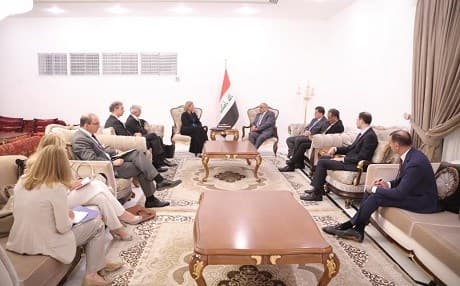

ERBIL, Kurdistan Region – A senior European Union official promised “side by side” European support for Iraq’s mediatory role in rising US-Iran tensions, as well as the country’s post-Islamic State reconstruction, after a meeting with Iraqi officials in Baghdad on Saturday.
Federica Mogherini, High Representative of the Union for Foreign Affairs and Security Policy of the European Commission met with figures including Iraq’s prime minister Adil Abdul-Mahdi and foreign minister Mohamed Ali al-Hakim to discuss the economic, political and social issues currently blighting Iraq. The European Commission is the executive branch of the European Union.
“The European Union stands side by side with Iraq to rebuild cities destroyed by Islamic State (ISIS), and supports Iraq’s survival through current regional tensions, especially between the United States and Iran,” a joint statement from Hakim and Mogherini said.
She added that avoiding any kind of tensions and clashes between the US and Iran, in which Iraq would inevitably encounter fallout, is a European Union priority.
“Escalations of tensions between the United States and Iran would be catastrophic for Iraq first, then for the entire region,” Mogherini stated in a press conference with Hakim on Saturday.
Sunday's joint statement by al-Hakim and Mogherini asserted the need for stronger cooperative ties between Iraq and the European Union, particularly in the realm of counter terrorism.
“Iraq is grateful for all the support the EU provided Iraq with in the fight against Islamic State (ISIS),” the Iraqi PM said in a statement released on Saturday.
He called for continued EU assistance to, and investment in, Iraq, “as the country is recovering post-ISIS war and developing very rapidly.”
After withdrawing from the 2015 Iran nuclear deal in May 2018, Washington reimposed economic sanctions on Iran targeting its oil sector, dealing a severe economic blow to its economy. It later designated the country’s Islamic Revolutionary Guard Corps (IRGC), a foreign terrorist organization, placing sanctions on some of its senior members.
In breach of the 2015 deal, Iran announced earlier this month that it has surpassed set production limits of 300 kilograms of 3.67 percent purity uranium.
A US aircraft carrier group, B-52 bombers, and hundreds of troops have also been dispatched to the region, prompting fears the dispute could escalate into all-out war.
The escalation in tensions appears to have spilled over into Iraq, with a spate of rocket attacks targeting US interests in the country in recent months, including military bases with a US military presence.
Current and former senior Iraqi politicians have made repeated calls to foreign-backed groups to stop launching attacks from Iraqi soil.
Iraq’s immediate material needs have compelled it to tread lightly. US sanctions on Iran also extend to countries that purchase Iranian energy exports. Iraq, highly energy dependent on Iran, has been reliant on US waivers for a continued supply of Iranian electricity and gas.