


Iraq

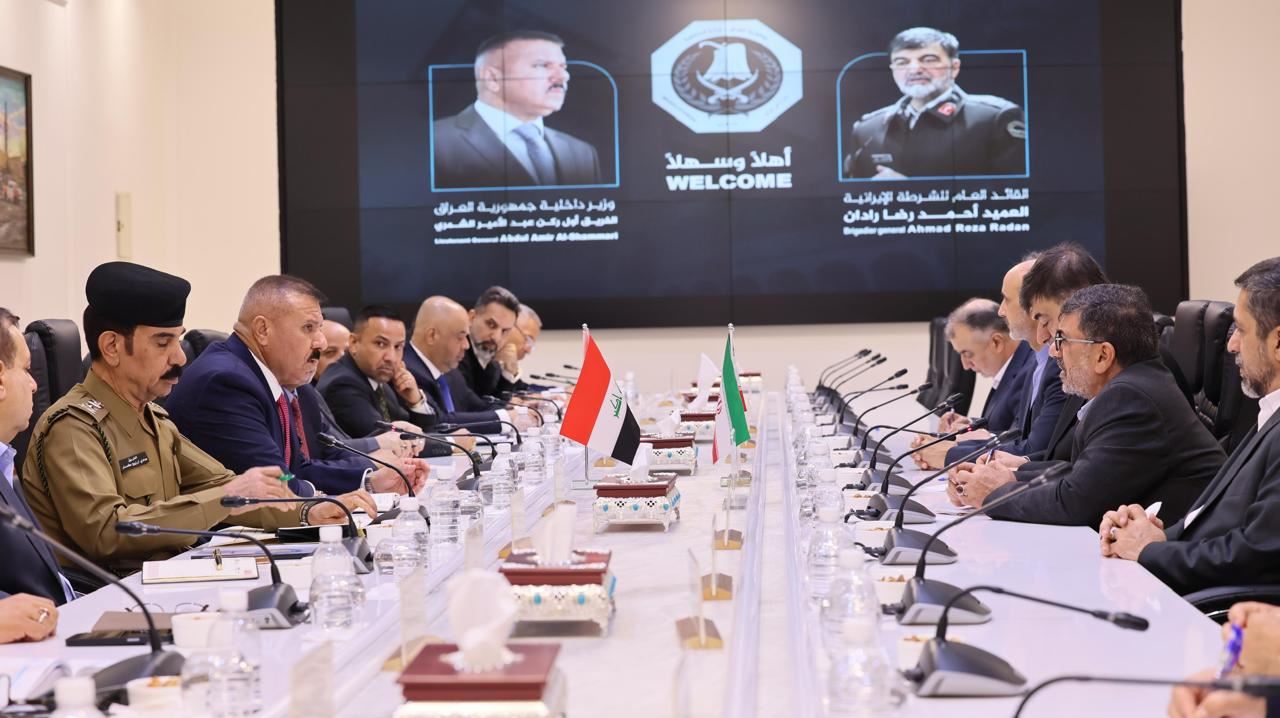
Iraqi Interior Minister Abdul Amir al-Shammari receives Iranian National Police Chief Brigadier General Ahmad Reza Radan in Baghdad on September 14, 2025. Photo: Iraqi interior ministry
ERBIL, Kurdistan Region - Baghdad says it captured “dangerous drug traffickers” in collaboration with Tehran, as part of joint security efforts to tighten the control over their shared borders, Iraqi state media reported Sunday.
The state-run Iraqi news agency (INA) quoted Iraqi Interior Minister Abdul Amir al-Shammari as affirming that security cooperation with Iran has led to "the arrest of dangerous drug traffickers and those wanted for organized crimes, in addition to securing international borders.”
Shammari’s remarks followed an “extensive meeting” he held the same day in Baghdad with Iranian National Police Chief Brigadier General Ahmad Reza Radan “in the presence of a number of commanders” from both countries, INA said.
According to INA, the senior security officials discussed various key topics, “foremost among them, enhancing cooperation in combating cross-border crime … activating memoranda of understanding and defining areas and timelines to ensure the implementation of agreements and the achievement of agreed-upon goals."
Iran and Iraq on Friday signed a memorandum of understanding aimed at “expanding cooperation and coordination in the fight against narcotics and psychotropic substances,” the state-run Iranian news agency (IRNA) reported.
The agreement prioritizes “strengthening control at border crossings, empowering law enforcement forces through mutual training workshops” and “increasing the monitoring of psychotropic substances and precursor chemicals under international supervision to prevent their use in the illicit manufacturing of drugs,” among other things.
Iran's Vice President and Secretary-General of the Drug Control Headquarters Hossein Zolfaqari stated on Friday that Baghdad and Tehran “have been able to dismantle smuggling networks between the two countries."
Following a meeting with Shammari in Baghdad, Zolfaqari said his country was a "victim of drug transit" given its geographic proximity to Afghanistan - the world's largest producer of opiates and a major producer of cannabis and methamphetamine - and on the other side, its adjacency to lucrative European drug markets.
Zolfaqari noted that bilateral cooperation with neighboring countries is crucial, emphasizing that cooperation between Tehran and Baghdad is advancing in all areas, including the fight against narcotics and psychotropic substances.
The Iranian official also revealed that in the first nine months of 2025, Tehran has “dismantled 1,700 drug gangs” and “seized nearly 250 tons of various types of narcotics, including heroin, morphine, and methamphetamine.”
For its part, Iraq is often viewed as a crucial node in a regional drug-trafficking triangle that sees Iranian producers reportedly export drugs to Iraqi intermediaries, who facilitate the movement of opiates through southern Iraqi ports.
This drug-trafficking triangle also includes Syria, which under the regime of the now-deposed dictator Bashar al-Assad, was a primary source of Captagon production and distribution, including into Iraq. The trade became a political and economic tool for the Assad regime.
Numerous factories were established along the Lebanese-Syrian border, especially in the Bekaa Valley, where rugged terrain, long-standing clan-based networks and weak state control have turned the region into a smuggling hotbed.
In mid-August, the Iraqi interior ministry said it dismantled “one of the largest Captagon manufacturing factories in the Middle East” in the Bekaa, in cooperation with Lebanese authorities.
The latter developments align with Iraq’s broader fight against drug trafficking.
In early April, Baghdad's interior ministry reported foiling an attempt to smuggle 400,000 Captagon pills across the Euphrates from Syria into Iraq.
In mid-March, the ministry announced the seizure of a truck carrying some 1,100 kilograms of Captagon pills coming from Syria towards Iraq through Turkey. That same month, Iraq’s narcotics control directorate reported that Baghdad has seized some 1.75 tons of illicit substances since the beginning of 2025 and made 2,000 arrests in the process.
In late 2024, the directorate had revealed that a total of six tons and 183 kilograms of illicit drugs were seized that year, with 14,483 suspects arrested. Among these, 144 individuals have been sentenced to death for international drug smuggling, while 454 local dealers were sentenced to life in prison - a term of 20 years.


Comments
Rudaw moderates all comments submitted on our website. We welcome comments which are relevant to the article and encourage further discussion about the issues that matter to you. We also welcome constructive criticism about Rudaw.
To be approved for publication, however, your comments must meet our community guidelines.
We will not tolerate the following: profanity, threats, personal attacks, vulgarity, abuse (such as sexism, racism, homophobia or xenophobia), or commercial or personal promotion.
Comments that do not meet our guidelines will be rejected. Comments are not edited – they are either approved or rejected.
Post a comment