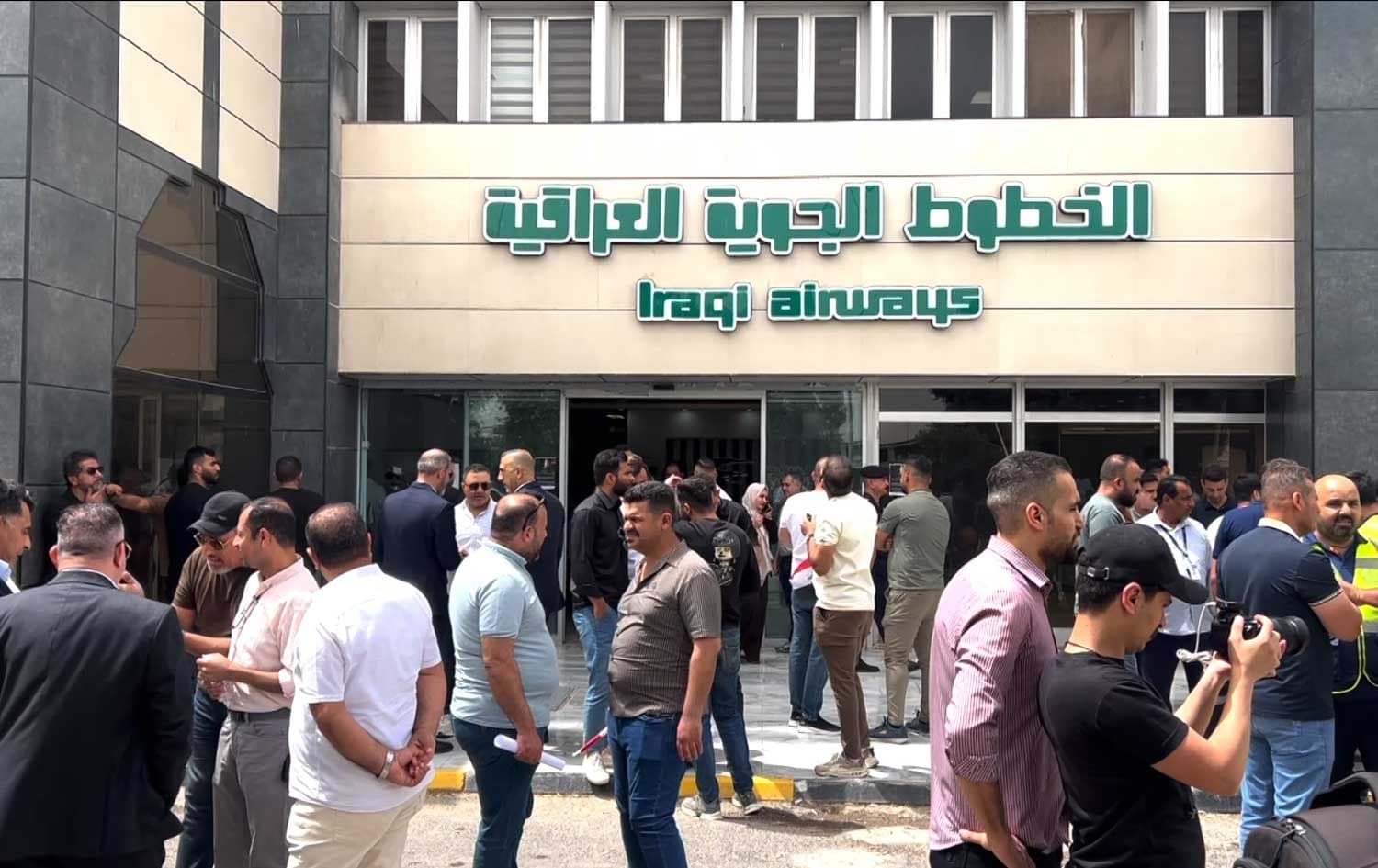
ERBIL, Kurdistan Region - Pilots and employees of Iraqi Airways on Sunday stormed the company’s headquarters inside Baghdad International Airport in protest over what they described as “corruption and administrative failure.”
The demonstrators, including pilots, managers, and staff, said their action was aimed at confronting the airline’s top leadership and pressing for accountability over financial and administrative practices they say have contributed to the deterioration of the national carrier.
“We demand an opening of an urgent investigation and the formation of investigative committees against both the legal director and the director general, because the legal director has destroyed the company," Adil al-Saadi, a manager at Iraqi Airways, told Rudaw.
This comes against the backdrop of Iraq reopening its airspace in early April after a 40-day closure. The decision followed weeks of disruption that began on February 28, when Baghdad shut down its skies amid the war between the United States, Israel, and Iran, forcing travelers to rely on land routes and effectively halting a major international transit corridor.
Saadi’s remarks reflect growing internal frustration among employees who say allegations of financial mismanagement have gone unaddressed for years.
"What is the point of his presence when the company has been subjected to the theft of 172 billion [Iraqi Dinars (over $131 million)]?” he questioned, referring to the company’s director general.
Adil al-Saadi, a senior manager of Iraqi Airways, told Rudaw, “Based on official records, we’ve lost more than 172 billion Iraqi dinars due to theft,” which resulted in no maintenance for the aircraft.
Employees argue that despite significant state investment in the airline, much of its fleet remains underused or grounded, contributing to declining operational performance.
Qasim al-Mahbash, an Iraqi Airways employee and one of the protest organizers, criticized what he described as the underutilization of the company’s fleet. He told Rudaw that Iraqi Airways owns 45 aircraft. “Is it reasonable for the state to buy national transport aircraft worth six billion dollars only for them to be left to rot?”
Captain Arafat al-Bassam, a pilot with Iraqi Airways, pointed to what he described as a dramatic reduction in the airline’s international reach compared to previous decades.
Founded in 1945, Iraqi Airways is one of the region’s oldest airlines.
“Iraqi Airways was the first airline in the Middle East; it used to fly from Baghdad to all parts of the world, reaching Europe, South America, and Africa. Now, we have only four or five destinations,” he said.
“We don’t have work, we have only seven planes,” Saadi said, adding that Iraq’s Hajj authority, responsible for organizing the annual Islamic pilgrimage to Mecca, cannot rely on Iraqi Airways due to the insufficient fleet, forcing pilgrims to travel by land routes instead.
The protest has also drawn political reaction. Qastal al-Hajami, a member of parliament from the Hikma Movement, said lawmakers are preparing to intervene. “As members of Parliament, we will not allow such things to happen at Iraqi Airways," he told Rudaw, adding they will "hold the corrupt accountable."
Transport Ministry spokesperson Maytham al-Safi told Rudaw earlier this month that the airspace closure caused significant financial losses. He said that before the shutdown, around 750 to 850 international flights crossed Iraqi airspace daily, adding that total losses reached approximately $14.4 million.
Following the protest, Iraqi Prime Minister Mohammed Shia' al-Sudani directed the formation of an auditing committee to review the performance and operational files of Iraqi Airways management.
The Prime Minister’s media office said in a statement that the directives "come as part of the general service reform process and in response to the demands of a large number of Iraqi Airways employees, including their observations and grievances regarding their rights, the quality of service provided, the future of the national carrier, and its international reputation.”
Ziyad Ismail contributed to this article.
.jpeg&w=3840&q=75)