
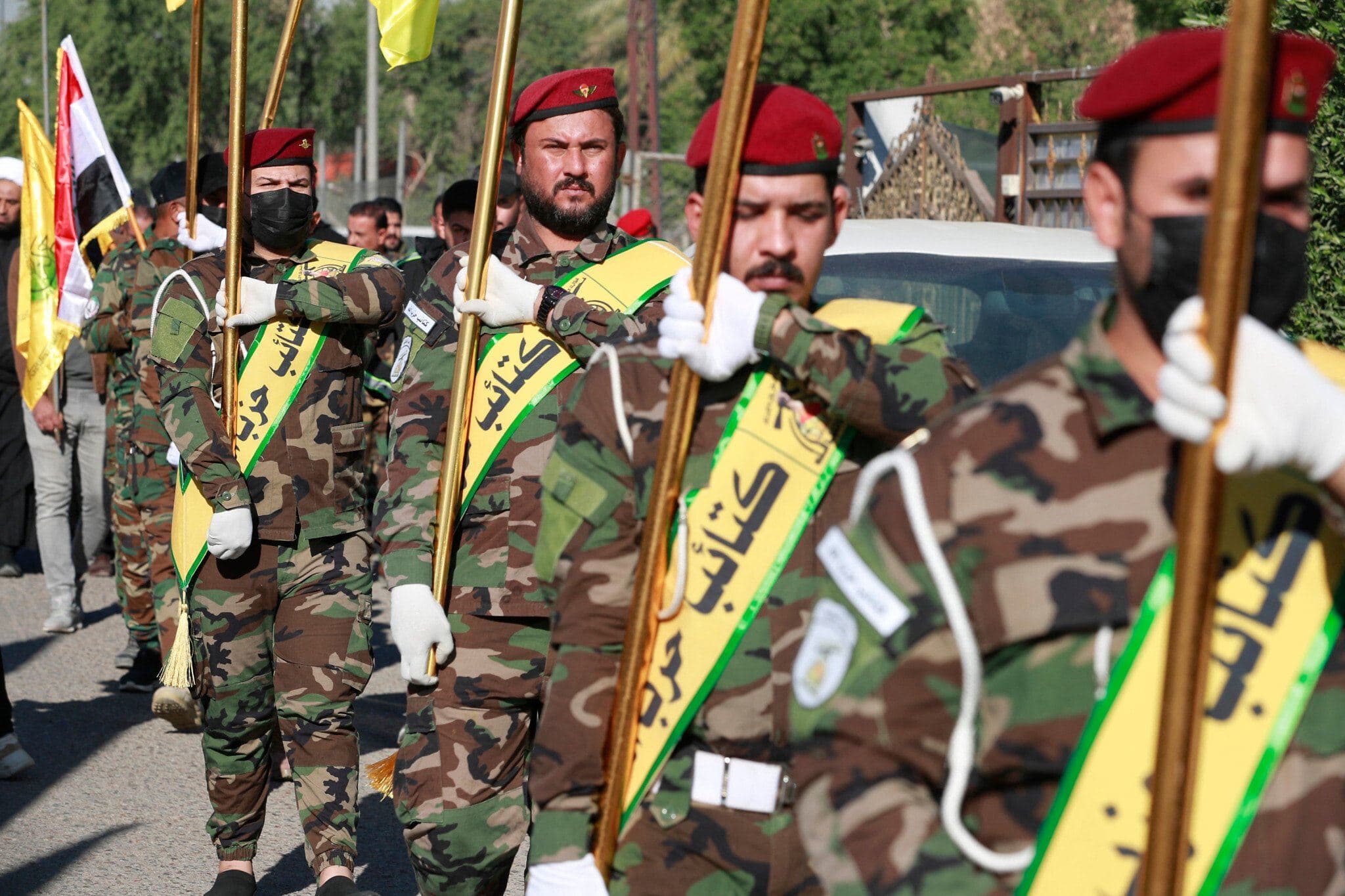

ERBIL, Kurdistan Region - The Iran-aligned Iraqi armed group Harakat Hezbollah al-Nujaba says it is under imminent threat of Israeli attacks, a senior official from the group told Rudaw on Wednesday, while also voicing strong support for a controversial bill aimed at formalizing the Popular Mobilization Forces (PMF).
“We are facing real and continuous threats,” said Hussein al-Moussawi, deputy secretary-general of Harakat Hezbollah al-Nujaba. “We have received information about [Israel planning to] launch attacks on our forces.”
Harakat Hezbollah al-Nujaba is a powerful faction within the PMF, comprising its 12th brigade.
The PMF is an umbrella organization of primarily Shiite armed factions that was formed in 2014 following a religious edict, fatwa, by Iraq’s supreme Shiite religious authority, Grand Ayatollah Ali al-Sistani. The edict came against the backdrop of the blitz offensive launched by the Islamic State (ISIS), which saw the group overrun nearly a third of Iraqi territory.
Harakat Hezbollah al-Nujaba also operates with a significant degree of autonomy and is considered a key component of the Iran-led "Axis of Resistance," alongside groups like Asa’ib Ahl al-Haq and Kata’ib Hezbollah.
It is also believed to be a core part of the "Islamic Resistance in Iraq" - a loose network of Iran-backed armed groups that emerged following the outbreak of the Israel-Hamas war in October 2023. The entity has claimed dozens of attacks on US interests in Iraq, Syria, and Jordan since the war began, ostensibly aimed at pressuring Washington to reduce its support for Israel.
Support for PMF bill
Moussawi additionally reaffirmed to Rudaw his group’s support for the PMF bill currently under debate in Iraq’s Parliament, describing it as a step that “gives legitimacy to the Iraqi government.”
The bill seeks to institutionalize the PMF as a permanent part of Iraq’s formal security forces, granting it a dedicated budget, hierarchical structure, and even a military academy. Proponents, largely from the Shiite-led Coordination Framework, argue the law is essential to recognize the PMF's contributions in the war against ISIS and to provide long-term benefits to its fighters.
However, critics - including the United States - warn that the legislation could entrench Iranian influence in Iraq by providing Iran-aligned factions with financial independence and increased political leverage within Baghdad.
The senior Harakat Hezbollah al-Nujaba official also welcomed the US-led coalition’s planned drawdown from Iraq.
A senior advisor to Iraqi Prime Minister Mohammed Shia’ al-Sudani confirmed on Sunday that coalition forces will withdraw from “their headquarters in the capital Baghdad and the Ain al-Asad base in [western Iraq’s Anbar province]” by September-end, adding that the full conclusion of the coalition’s mission is scheduled for September 2026.
The US-led Global Coalition to Defeat ISIS was formed in 2014 under President Barack Obama to degrade and ultimately defeat the group. Its military operations in Iraq began in October 2014 with airstrikes and later expanded to include advising and training Iraqi security forces.
The coalition consists of over 60 countries and international organizations, including key members such as the US, United Kingdom, France, Germany, Canada, Australia, and several Middle Eastern nations. Member states contribute through military personnel, equipment, training, and financial support. As of mid-2025, the US maintains around 2,500 troops in Iraq.
However, the coalition forces presence in Iraq became a contentious issue after the US strike that killed Iran’s Quds Force commander Qasem Soleimani and Abu Mahdi al-Muhandis, the deputy chief of Iraq’s PMF, near Baghdad International Airport in January 2020. Days later, 168 members of Iraq’s 329-member parliament voted to expel foreign forces from the country.
.png&w=3840&q=75)