ERBIL, Kurdistan Region - Iraqi Prime Minister and Commander-in-Chief of the Armed Forces Mohammed Shia’ al-Sudani traveled on Wednesday to the Iraq-Syria border to assess security conditions, according to a statement from his office. The visit comes amid reports that hundreds of Islamic State (ISIS) militants were released from prisons previously secured by the Syrian Democratic Forces (SDF) after the facilities were seized by the Syrian Arab Army and allied armed factions.
In a statement posted on X, the premier’s office said Sudani visited the Iraqi-Syrian border area, specifically the al-Qa’im district in Anbar province, which lies adjacent to Syria’s Albu Kamal district, as “part of a field tour to follow up on the readiness of our armed forces units holding the Iraqi-Syrian border strip in Anbar and Nineveh provinces.”
Notably, the twin districts of al-Qa’im and Albu Kamal served in 2014 as a critical connective hub for ISIS’s so-called caliphate, linking its operations in Iraq and Syria. By merging the two areas into what it termed Wilayat al-Furat - the Euphrates Province - ISIS treated the Euphrates River valley as a unified administrative and military zone.
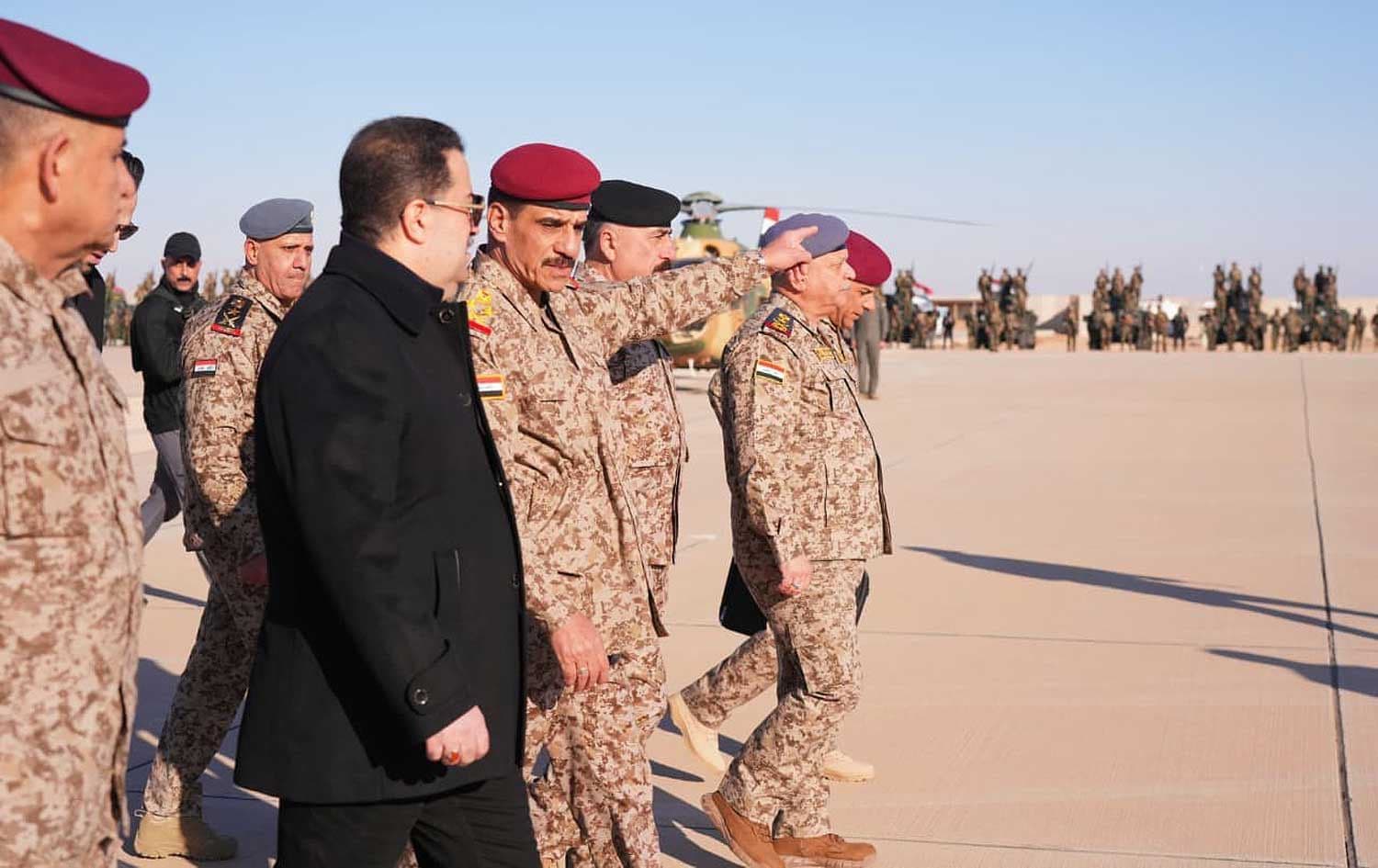
Sudani chaired a high-profile security meeting at the headquarters of the forces “responsible for securing the al-Qa’im border strip,” his office added, noting that it was attended by Baghdad’s interior minister, the army chief of staff, commanders of land, air, and border forces, the director of military intelligence, and several field commanders.
The meeting covered “measures taken to secure the Iraqi-Syrian border, existing challenges, and the high level of readiness and military capabilities of the forces,” with the Iraqi prime minister stressing “the importance of continuing the efforts of all military and security units.”
Earlier in the day, Sudani’s office reported he had arrived at Ain al-Asad Air Base in western Anbar province as the first stop of “a field tour to assess the readiness of our armed forces units securing the Iraqi-Syrian border.”
He further reviewed “the levels of alert and field movements of the deployed formations and units,” and observed “the takeoff of a squadron of four F-16 fighter jets during a tactical exercise involving reconnaissance, surveillance, patrol missions, and rapid-response operations.”
Sudani’s visit to the Iraq-Syria borders comes a day after the SDF on Tuesday announced that they had withdrawn their forces from the al-Hol camp housing ISIS militants, following "fierce clashes" with Damascus-affiliated armed groups in its vicinity.
The al-Hol camp, located southeast of Hasaka in northeast Syria (Rojava), was previously managed by the SDF and affiliated Internal Security Forces (Asayish). It hosted tens of thousands of people, including the spouses and children of former ISIS militants.
Sheikhmous Ahmed, who oversees camps for internally displaced people (IDPs) and refugees in Rojava, told Rudaw English on Tuesday that “a total of 7,130 families - 25,183 individuals - were held at al-Hol camp prior to the SDF’s withdrawal.” He added that “it remains unclear how many detainees have fled and who currently controls the camp.”
Earlier on Monday, the SDF said it lost control of another prison facility that holds ISIS militants, the al-Shaddadi prison in southern Hasakan, to Damascus-affiliated forces and armed groups.
SDF spokesperson Farhad Shami told Rudaw that around "1,500 ISIS militants - including both foreign and Syrian nationals - have been released" by Damascus-affiliated armed groups from al-Shaddadi facility.
Earlier on Tuesday, an SDF source speaking to Rudaw on condition of anonymity had also reported that clashes with Damascus-affiliated forces had intensified for the second consecutive day around another facility which holds around 2,000 ISIS detainees - the al-Aqtan prison in Raqqa.
In response to recent developments, Iraq has been increasing security along its borders with Syria for several days, amid concerns over potential infiltration by ISIS elements.