



Error occured during this request! Please try again later.
Iraq

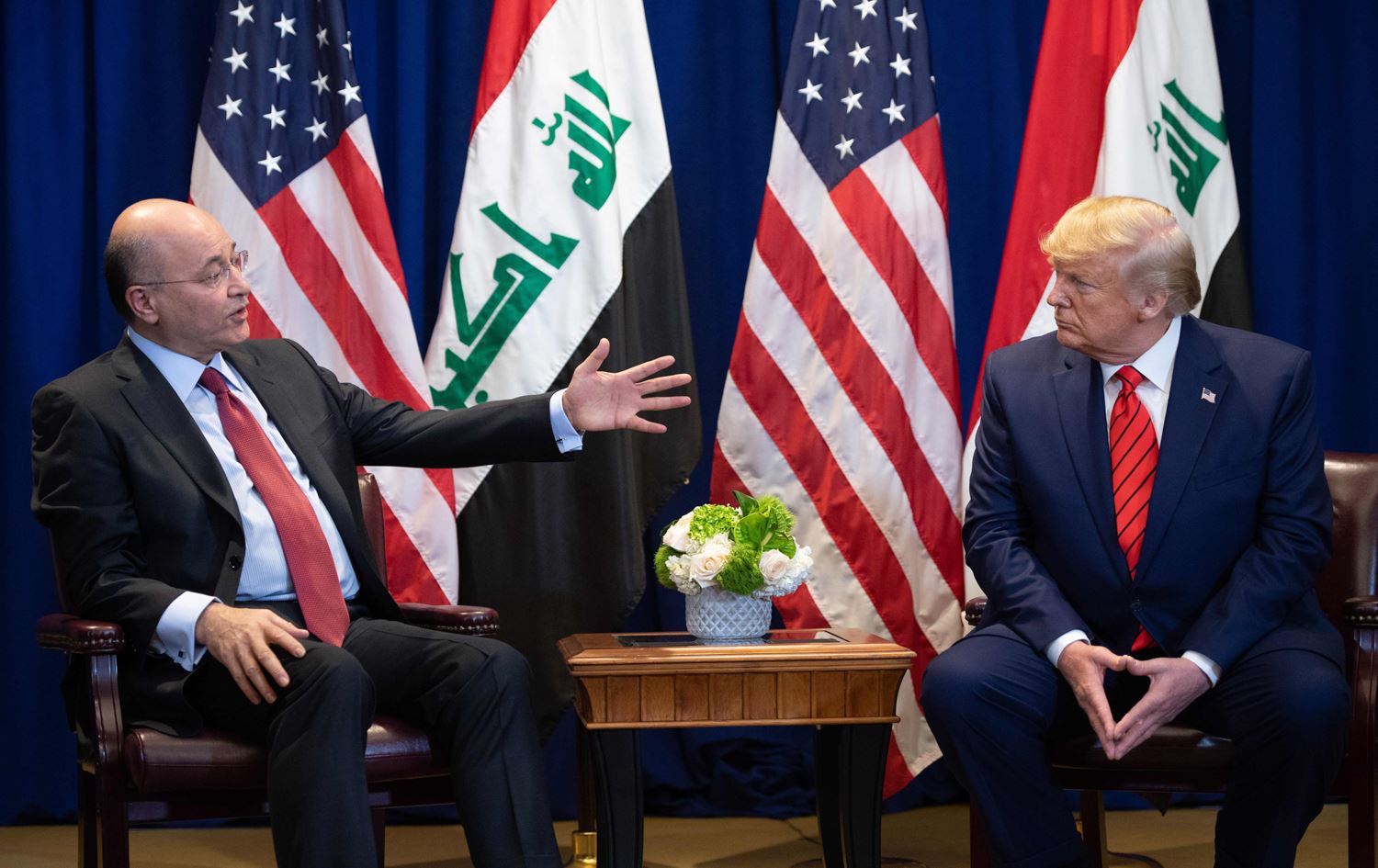
US President Donald Trump and Iraqi President Barham Salih hold a meeting in New York on September 24, 2019, on the sidelines of the United Nations General Assembly. Photo: Saul Loeb / AFP
ERBIL, Kurdistan Region — Iraq’s President Barham Salih and US President Donald Trump met Tuesday before the United Nations General Assembly session to reaffirm Iraqi sovereignty amid heightened US-Iran tensions and to discuss post-Islamic State war strategy.
While the meeting covered a broad range of topics, which according to a White House tweet included trade and energy, discussion centered on the “continued fight against ISIS” and on heightening regional tension.
“The two leaders also discussed regional and global developments, topics of common concern to both the United States and Iraq, and mechanisms for enhancing bilateral relations and combating terrorism,” the Iraqi Presidency Media Office said.
President Salih highlighted “the need to support hard-won stability in Iraq, and to complete the victory against terrorism through construction and development,” added the statement.
Speaking to media before the meeting, Salih expressed “gratitude” for US-led International Coalition against ISIS support in the battle against the group.
“Iraqis were at the forefront of this battle, but your support has been absolutely crucial, and we appreciate it,” he said.
US forces withdrew from Iraq in 2011, but returned to Iraq upon invitation from an overwhelmed Baghdad in 2014 as ISIS swept across the north and west of the country. Leading the Operation Inherent Resolve multinational task force, the US continues to conduct airstrikes on ISIS remnant targets in both Iraq and Syria.
Trump, on his part, lauded the “great achievement” of the defeat of ISIS and the capture of its fighters, but added discussions would be needed on what to do with those currently in detention in the the two countries.
“As you know, we have thousands of people. We’ll talk about that also because we’re going to have to do something — put them on trial, et cetera, et cetera,” the US President said.
These first known talks between the two presidents come at a time of heightened tension between the US and its regional allies on the one hand and Iran on the other.
An attack on an Aramco oil facility in Saudi Arabia last week which knocked out half of the kingdom’s oil output has been widely blamed on Iran, despite the Houthi rebels of Yemen claiming responsibility.
Iraq has said repeatedly that it wants to avoid being a playground for US-Iran tension, a stance reiterated by Salih on Tuesday.
“It’s our sovereign responsibility … Iraq [is] not to be used as a base for any threat against our neighbors. It is work in progress, and Iraq has been a constructive player in the neighborhood, trying to assure all our neighbors that the stability and sovereignty of Iraq is a common interest,” he said in reply to a journalist's question.
However, on Monday night, two mortars were fired at the direction of the US Embassy in Baghdad’s secured Green Zone. This was the second attack reported to have been aimed at the embassy since May.
The amicable meeting could mark a departure from previously testy relations between Trump and Iraq. The US has previously antagonized some in the Iraqi political field, who have accused him of violating Iraqi sovereignty.
At the end of December 2018, Trump made a surprise visit to US troops stationed at al-Asad airbase, West of Baghdad, much to the dismay of Iraqi officials who declined to meet him.
He caused further outrage in February of this year when he said he would like for US troops to remain in Iraq to “watch” Iran.


Comments
Rudaw moderates all comments submitted on our website. We welcome comments which are relevant to the article and encourage further discussion about the issues that matter to you. We also welcome constructive criticism about Rudaw.
To be approved for publication, however, your comments must meet our community guidelines.
We will not tolerate the following: profanity, threats, personal attacks, vulgarity, abuse (such as sexism, racism, homophobia or xenophobia), or commercial or personal promotion.
Comments that do not meet our guidelines will be rejected. Comments are not edited – they are either approved or rejected.
Post a comment