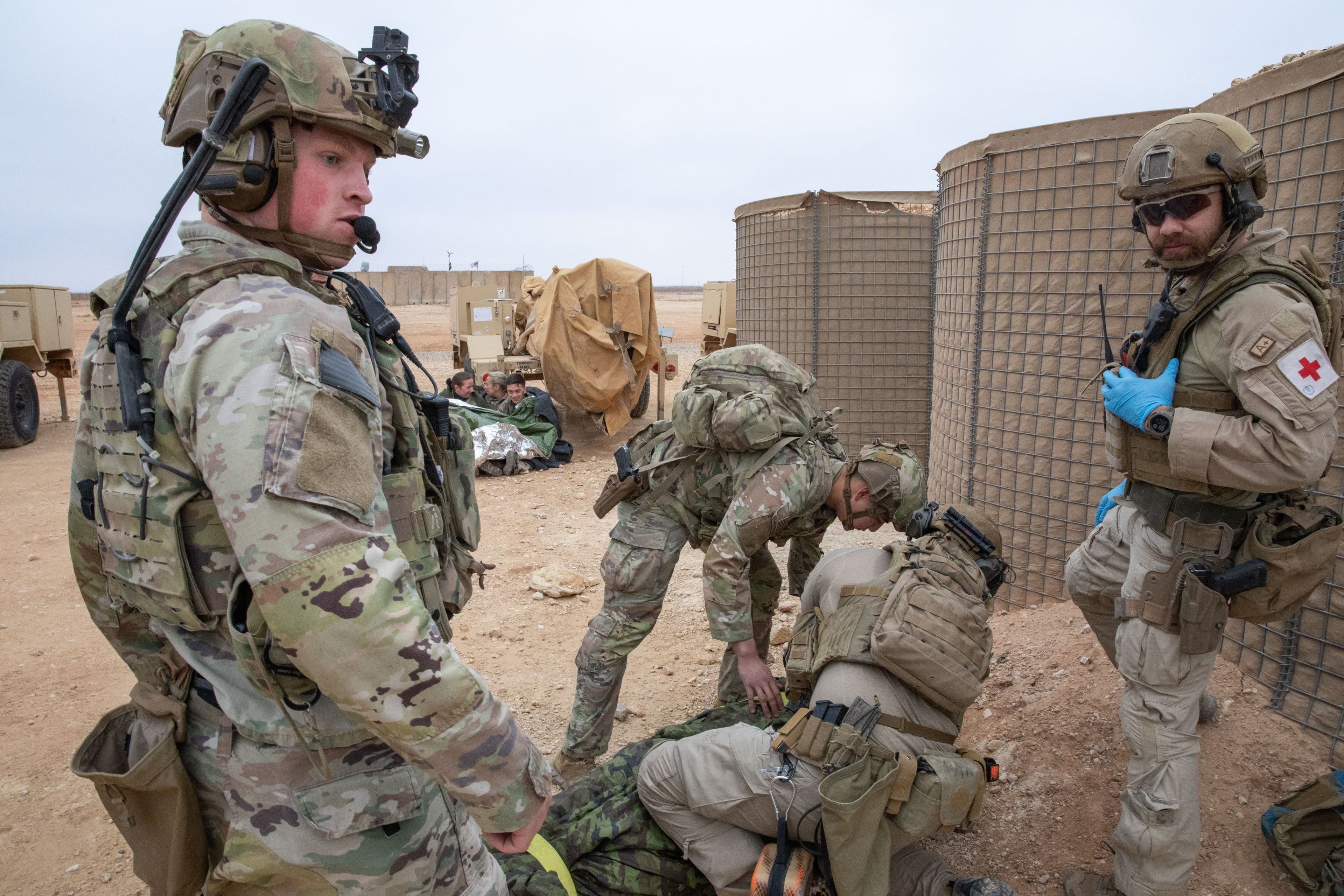

ERBIL, Kurdistan Region - The withdrawal of US-led Global Coalition forces from western Iraq and Baghdad will begin in several weeks, with troops set to be redeployed to the Kurdistan Region’s capital Erbil, a high-ranking security source told Rudaw on Monday.
Responding to Rudaw's inquiry about the planned relocation of coalition troops from Ain al-Asad Airbase in western Iraq’s Anbar province and their headquarters in Baghdad, the source stated, “According to the agreement between Iraq and the Global Coalition [to defeat the Islamic State (ISIS)], the withdrawal will begin from the Ain al-Asad and Baghdad base at the end of September.”
Speaking on condition of anonymity due to the sensitivity of the issue, the source confirmed that current activity at these bases is part of the withdrawal preparations, emphasizing that “the redeployment will be directed toward Erbil, and not to neighboring countries,” as some reports have speculated.
Importantly, this statement appears to contradict comments made in mid-August by Hussein Allawi, a senior advisor to Iraqi Prime Minister Mohammed Shia’ al-Sudani. At the time, Allawi had said that coalition forces would complete their withdrawal from “their headquarters in the capital Baghdad and the Ain al-Asad base in” by the end of September.
Allawi also noted that the withdrawal is part of the December 2021 agreement between Baghdad and Washington to transition the coalition’s role from combat operations to advising, training, and assisting Iraqi security forces.
He detailed that the coalition's mission will conclude within the previously agreed timeline - with the first phase ending in 2025 and final withdrawal by 2026. This shift is intended to lay the foundation for a “new phase of security cooperation” between Iraq and coalition member states, focused on developing “sustainable” and “stable bilateral defense relations,” grounded in military coordination and in “political, economic, and cultural ties.”
Also on Monday, a US Department of Defense official told Rudaw’s Washington DC correspondent, Diyar Kurda, that “the United States will continue a bilateral security cooperation relationship with Iraq” following the coalition’s withdrawal.
When asked specifically about the reported transfer of coalition troops to Erbil, the US defense official responded, “We do not have anything new to announce right now,” but added that “the United States continues to review and, as appropriate, adjust its force posture in Iraq in accordance with the U.S.-Iraq Joint Statement on the transition of the Global Coalition to Defeat ISIS in Iraq.”
Formed in 2014 under former US President Barack Obama, the Global Coalition to Defeat ISIS launched its operations in Iraq with airstrikes, later expanding to include training and advising Iraqi forces. The coalition comprises nearly 89 countries and international organizations, including the US, UK, France, Germany, Canada, Australia, and several Middle Eastern nations, contributing military personnel, equipment, and financial support.
As of mid-2025, the US maintains approximately 2,500 troops in Iraq.
However, the presence of coalition forces in Iraq has remained a contentious issue, particularly after the January 2020 US strike that killed Abu Mahdi al-Muhandis, deputy chief of Iraq’s Popular Mobilization Forces (PMF) and Iranian Quds Force commander Qasem Soleimani near Baghdad International Airport. Days later, 168 members of Iraq’s 329-member parliament voted to expel foreign forces from the country.
Of note, Iran struck western Iraq’s Ain al-Asad airbase - now slated for closure - in the aftermath of the killings.