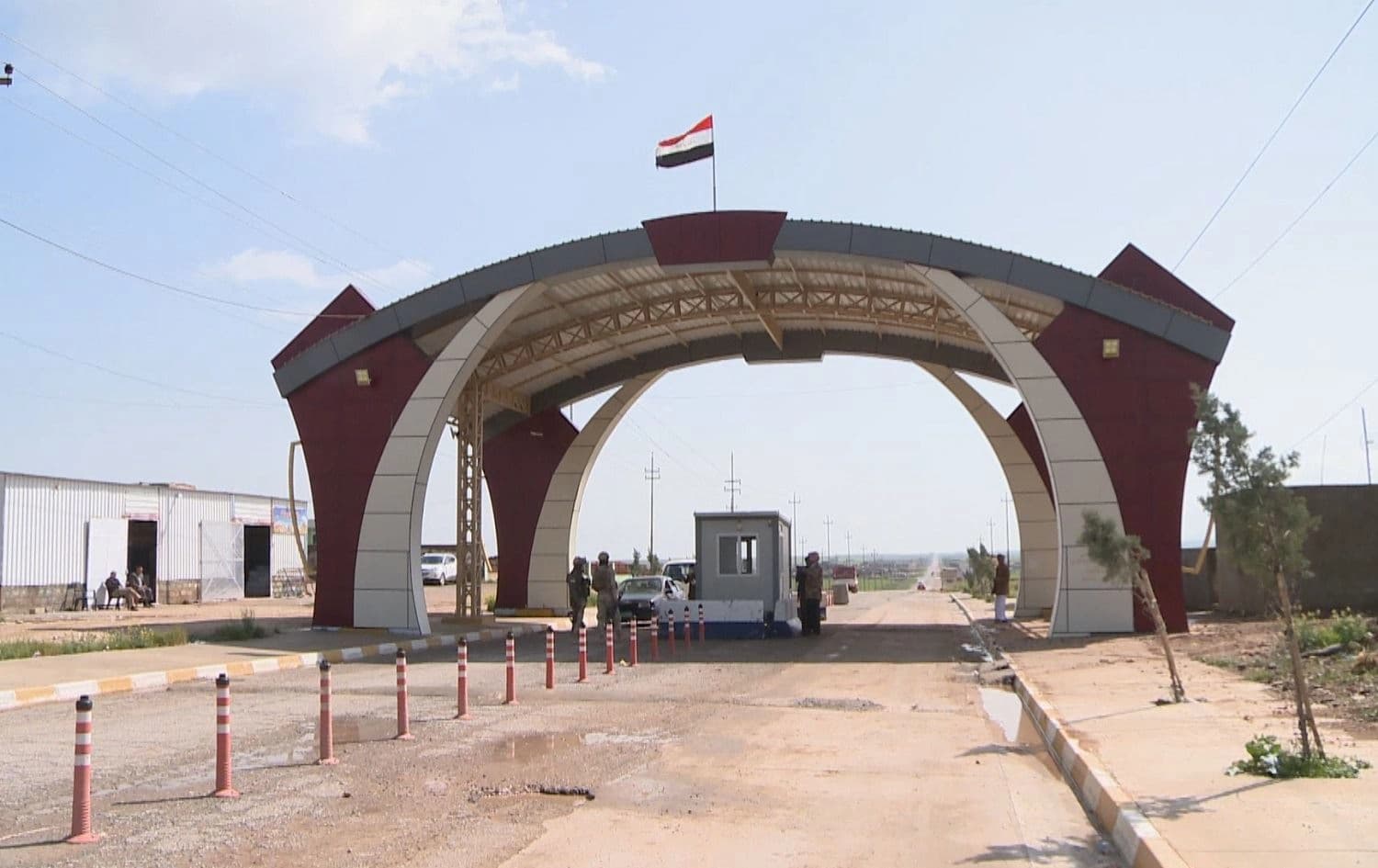

Dawoud Haji is a commander in the Shingal Resistance Units (YBS). He told Rudaw that they took their flag down today in downtown Shingal “as a sign of respect for the Iraqi government after the federal police arrived in the region to implement the deal.”
YBS is affiliated to the Kurdistan Workers’ Party (PKK) – an armed group fighting for the rights of Kurds in Turkey. Their positions have been targeted by Turkey many times. Some YBS units have refused to take down their flag.
A half dozen armed groups are operating in the Shingal district. They have been given two days to abide with the order or their flags will be taken down by force.
Baghdad reached a deal with the Kurdistan Regional Government (KRG) on October 9 over the governance and security of Shingal, which is disputed between the two governments.
Implementation of the agreement began last week with the deployment of some 6,000 federal police to the areas of Shingal that border Syria. “Three brigades of Iraqi federal forces are placed on the border between Shingal and Syria in order to prevent any forces from going back and forth,” Deputy Governor of Nineveh province Sirwan Rozhbayani told Rudaw on Tuesday.
Flying only the Iraqi flag is the second phase in the deal that will ultimately put federal forces in full control of Shingal’s security.
The Popular Mobilization Forces (PMF, known as Hashd al-Shaabi in Arabic) are also split on compliance with some units taking down their militia flags on Friday but others refusing to do so.
Khal Ali, PMF commander in Shingal, told Rudaw they have taken down their flags and will fully abide by the Erbil-Baghdad deal if all services are restored to the district. “If only the Iraqi flag remains raised in downtown Shingal, a [new] administration is formed to serve people, and municipalities, the mayor's office, schools and hospitals are back to service, then we will support it,” he said.
Yazidi House is a small armed group. It has been based on Mount Shingal since 2014. They fly the Iraqi flag alongside their own and have refused change.
“We want them to respect us and the fact that we have resisted [fought the Islamic State, ISIS]. Therefore, we want them to respect our flag,” said Ibrahim Murad, spokesperson for the force.
Many people in Shingal are opposed to Erbil-Baghdad deal, saying it is an agreement being imposed on the local population who were not consulted. Haso Ibrahim, a YBS commander, warned on Tuesday that forcing implementation of the deal could “return [Shingal] to a period of war like it did in 2014,” referring to the beginning of the ISIS attack on the district.
“The people of Shingal do not want to go back to such a time,” the commander told Rudaw.
Jeanine Hennis-Plasschaert, chief of the United Nations Assistance Mission Iraq (UNAMI), said during a virtual meeting of the UN Security Council on Tuesday that the agreement is “just a very first step.”
It’s a “chapter in which the interests of the people of Shingal will come first; in which reconstruction will be accelerated and public service delivery improved. A chapter in which displaced people of Shingal can return home,” she said.
Thousands of Yazidi families have not been able to return to their homes in the Shingal area, five years after ISIS militants were forced out, because of lack of reconstruction, no basic services, and ongoing insecurity.
Additional reporting by Tahsin Qasim