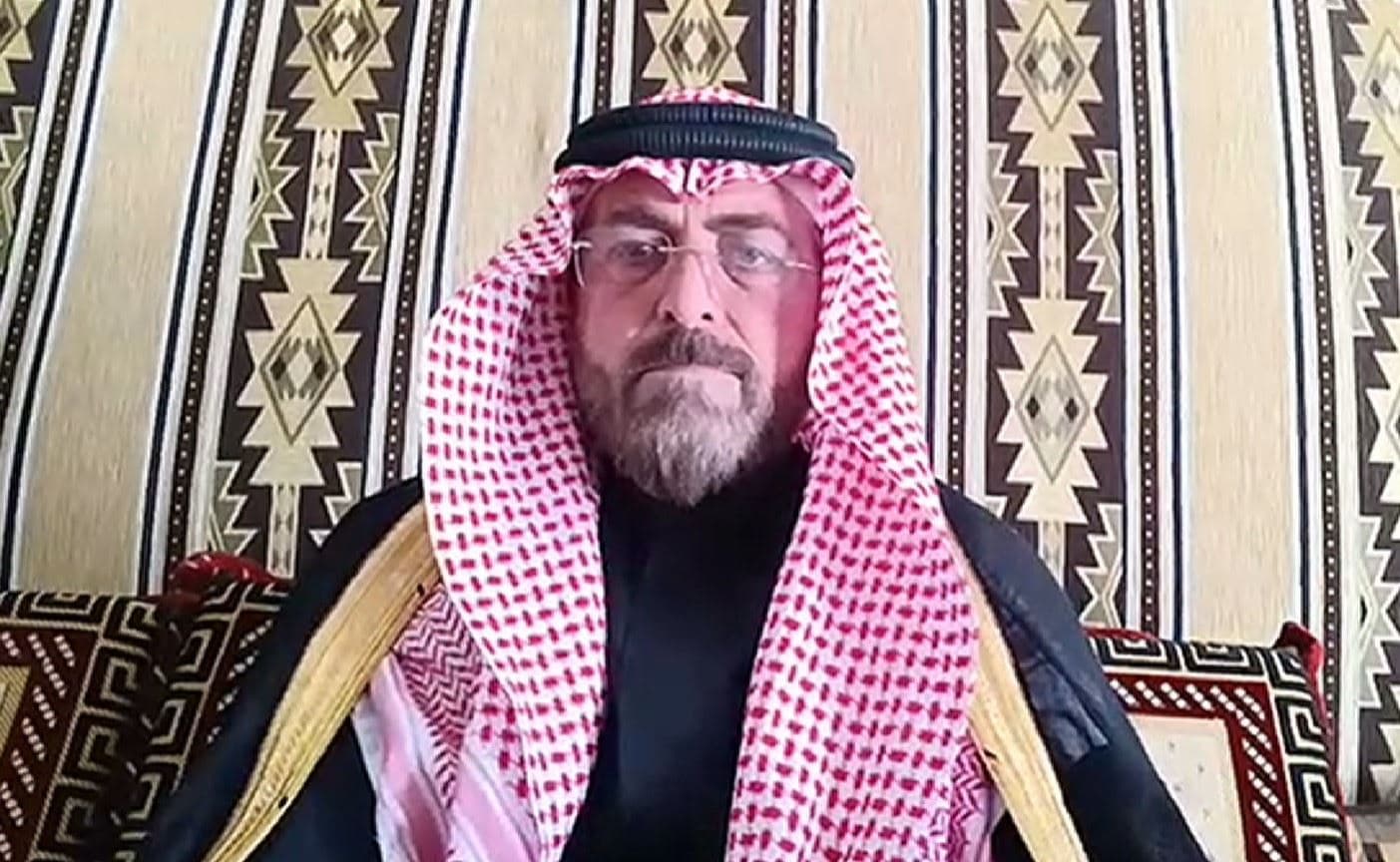
ERBIL, Kurdistan Region - A prominent figure from the Sunni Arab al-Uqaydat tribe in Syria’s eastern Deir ez-Zor province has told Rudaw that much of his community views administrative decentralization as the “most appropriate choice” for their regions, strongly defending the Kurdish-led administration in northeast Syria (Rojava) and its armed wing, the Syrian Democratic Forces (SDF), against accusations of separatism.
In a Monday interview with Rudaw, Ammar al-Haddawi highlighted the decades-long marginalization of Deir ez-Zor, which he says is continuing under the current leadership in Damascus.
“Deir ez-Zor is rich in oil and has many large wells and fields, yet the refinery is in Baniyas, in Tartous. Why not build a refinery in Deir ez-Zor?” he asked, citing this as a key example of neglect.
Haddawi expressed dismay over the policies of the new administration in Damascus, arguing that they necessitate a fundamental shift in governance.
“We now have an almost absolute conviction that administrative decentralization, even in its minimum form, is most suitable for Deir ez-Zor - allowing it a fair share of its wealth, which is a legitimate demand and inherent right,” Haddawi said.
He emphasized that any future government in Damascus must serve all citizens equally, stressing that the people of Deir ez-Zor would “never accept or tolerate” a state that mirrors the toppled regime of longtime Syrian dictator Bashar al-Assad.
Crucially, Haddawi rejected the narrative that the Kurdish-led Democratic Autonomous Administration of North and East Syria (DAANES) and its military force, the SDF - operating east of the Euphrates River - are pursuing an independent state.
“I don’t believe the DAANES has a separatist agenda, and to be clear, the narrative promoted by some that the DAANES or the SDF have a separatist project is merely an illusion and is not correct,” he stressed, pointing to the multi-ethnic nature of the Kurdish-led forces that currently maintain security in the area.
When asked about the possibility of an SDF withdrawal, Haddawi warned of potential chaos.
“The SDF is not composed solely of one ethnic group. It includes Arabs, Kurds, Assyrians, Syriacs - there is cohesion and harmony among them. A sudden withdrawal would create chaos, and no rational person would support that,” he cautioned.
Underscoring the deep-rooted ties between Arab and Kurdish communities east of the Euphrates, Haddawi said, “The Kurds are our brothers, and this is not a new reality. There has been a historical coexistence between us that dates back thousands of years,” he affirmed.
“We - Arabs, Kurds, Syriacs, Assyrians, and all other components - are in urgent need of one another... This can only be accomplished through social harmony, genuine reconciliation, and comprehensive civil peace.”
The senior al-Uqaydat tribal figure called for a “purely Syrian-Syrian dialogue” to resolve the country’s crisis, without external regional interference. He also urged the drafting of a new constitution that guarantees the rights of all Syrian communities.
Importantly, Haddawi warned of the rise in Islamic State (ISIS) activity in eastern Syria, attributing it to “chaos” and “security fragility.” He called for long-term solutions, including the establishment of specialized centers to counter extremist ideologies that target vulnerable youth.
Below is the full transcript of the interview with Ammar al-Haddawi, a prominent figure from the Sunni Arab al-Uqaydat tribe in Syria’s eastern Deir ez-Zor province.
Rudaw: How do you describe the current living and security conditions in your areas, particularly in al-Shuhail and the eastern Deir ez-Zor countryside?
Ammar al-Haddawi: There is no doubt that Syria, in general, has emerged from a prolonged conflict lasting more than fifteen years, which has led to difficult living conditions across all Syrian geography. Deir ez-Zor, being an integral part of Syria, shares in this suffering - even though the eastern region is rich in oil, water, livestock, and human resources.
The truth is, the citizens of eastern Syria - by which I mean the provinces of Deir ez-Zor, Raqqa, and Hasaka - have long endured injustice, extending even before the events of the 2011 revolution, perhaps going back over sixty years. These areas have been marginalized, viewed as peripheral and are unfortunately viewed with an inferior lens, despite their wealth of natural and human resources. The people continue to suffer, yet they hold on to hope and optimism that conditions will improve.
Do essential services like electricity, water, healthcare, and education meet the minimum needs of residents?
As I mentioned, the events Syria has gone through have clearly affected these sectors, and there is indeed a severe shortage of services. However, I bring good news to viewers and followers: intensive meetings are currently being held, during which a new approach has been established to rehabilitate these basic service sectors. I believe tangible improvements will be noticed in the near future.
Meetings between whom?
These meetings are between citizens and the [Kurdish-led Democratic] Autonomous Administration [of North and East Syria - DAANES] as well as with the executive councils affiliated with it.
There are international efforts to reach a final agreement between the DAANES and the interim government in Damascus. What do you know about the fate of Deir ez-Zor?
Deir ez-Zor has long been marginalized. From what we observe of the current policies of the transitional government in Damascus, this marginalization continues. This is unacceptable to us as tribal leaders and citizens. We aspire for our region to be on par with other Syrian cities in terms of development and prosperity.
Based on ongoing developments over the past year, we believe that administrative decentralization may be the most appropriate choice to serve the interests of Deir ez-Zor and lift it from the poverty, marginalization, and exclusion it has long endured. We now have an almost absolute conviction that administrative decentralization, even in its minimum form, is most suitable for Deir ez-Zor - allowing it a fair share of its wealth, which is a legitimate demand and inherent right.
I’ll give a simple example: Deir ez-Zor is rich in oil and has many large wells and fields, yet the refinery is in Baniyas, in Tartous. Why not build a refinery in Deir ez-Zor? These are major issues that require real solutions and reevaluation.
Does the Syrian interim government agree to grant administrative decentralization in Deir ez-Zor?
In principle, after all the sacrifices made by the Syrian people - displacement, martyrs, wounded, and destruction - it’s only fair that Syrians aspire to live free and equal in a homeland that stands at an equal distance from all, and to enjoy freedom of opinion regarding the form of the future state. We do not want a state reinstated in the image of the toppled [Assad] regime. That is something we will never accept or tolerate.
Any government formed in Damascus, through agreements or otherwise, must serve all citizens, regardless of their ethnicity or sect. We, the people of Deir ez-Zor, believe that administrative decentralization is in our best interest, with clear subordination to the central authority in sovereign matters. I speak here from an administrative perspective, as this system best guarantees the fulfillment of the demands and interests of the citizens in these areas.
Has the fate of Deir ez-Zor been discussed in recent meetings between the Syrian interim government and the DAANES?
In fact, we haven’t received direct information from official sources, but based on leaked reports, it appears that Deir ez-Zor is currently divided into two parts: the right bank and the left bank of the Euphrates. If rapprochement occurs and the March 10 agreement between General Mazloum Abdi and [interim President] Ahmed al-Sharaa is implemented, I believe the first steps toward integration of civil institutions will begin in Deir ez-Zor. I expect the initial stage to include forming committees composed of local residents and DAANES representatives to negotiate with Damascus and create a clear framework for cooperation.
Do you view this integration positively? Would you prefer your areas be governed by DAANES or the Syrian government?
I don’t believe the DAANES has a separatist agenda, and to be clear, the narrative promoted by some that the DAANES or the SDF have a separatist project is merely an illusion and is not correct. We, in these areas, engage with the political authority here, and the topics of separation or even federalism have never been raised. We are an integral part of Syria and we are keen on the unity of Syrian territory and for Syria to be a homeland that stands at an equal distance from all its citizens.
The issue is not about choosing sides, but about the exclusionary policies witnessed in some areas like the [Druze-majority] southern Syria or the [Alawite-majority] coastal regions. This same behavior extends to the east of the Euphrates, then the calls for partition or federalism will be a result of the central government’s policies, not the peripheries.
Are you in favor of the SDF withdrawing from Deir ez-Zor?
That’s a hypothetical question. If we woke up one day with no governing authority, the resulting security vacuum would be extremely dangerous and harmful to the region. Also, it is important to note that the SDF is not composed solely of one ethnic group. It includes Arabs, Kurds, Assyrians, Syriacs - there is cohesion and harmony among them. A sudden withdrawal would create chaos, and no rational person would support that.
Do you call for international guarantees in the event of integration between the SDF and the Syrian government, especially in Deir ez-Zor?
We hope for a purely Syrian-Syrian dialogue. I believe that, had dialogue been going on without regional interference - especially from some neighboring countries that influence the central government’s decision-making - we could have reached solutions long ago.
Regarding guarantees, if negotiations are genuinely Syrian, we may not need international guarantees. What we need is a new constitution that includes all components and geography of Syria - not the current constitutional declaration, which has failed to satisfy all parties. A new constitutional framework that guarantees rights of all components across the Syrian geography will provide reassurance to all.
What about the Islamic State (ISIS). Are the extremist group’s activities increasing in your areas and how does it affect civilians?
Indeed, the [ISIS] project was present in our region, and perhaps lasted for two or three years, and then, as you know, then it was pushed back by [military] campaigns from the [US-led] Global Coalition [to defeat ISIS] and the SDF. However, we now observe signs of renewed activity and attempts by the group to restore some of the previous structures. It is trying to reestablish itself and expand geographically.
How do you explain recent ISIS operations? Is it due to security lapses?
Syria is not fully under control, and the resulting chaos creates fertile ground for extremist ideologies. The security situation is still fragile due to many factors. Extremist groups are trying to resume their activity by exploiting political differences and security fragility in Syria generally.
Can you pinpoint where ISIS cells are most active in Deir ez-Zor?
I cannot give exact locations, as I lack confirmed security information.
Are there tribal initiatives to combat extremism and recruitment?
In fact, efforts are being exerted, however, they are limited and carried out cautiously due to security concerns. It is not an easy task. People naturally prioritize their own safety. That said, awareness is increasing, but the reality remains difficult.
The challenge is that, after 14 years of war, many youth in the eastern region grew up with minimal education or guidance - making them vulnerable to extremist ideas. This is a deep-rooted problem requiring long-term solutions, including specialized centers focused on prevention and rehabilitation.
You mentioned oil. Who currently manages the oil fields in Deir ez-Zor?
In the eastern Euphrates region, oil is managed by a body within the DAANES. It includes engineers and specialists but operates with limited resources and in a rather basic manner. It is not at a complete professional level, so to speak.
Nonetheless, it does cover some of the region’s needs, and part of the revenues is distributed to residents. However, the available quantities are insufficient, and management remains incomplete. In short, the oil is currently managed by the DAANES.
What message would you like to send to the people of Deir ez-Zor and to your Kurdish brothers?
The Kurds are our brothers, and this is not a new reality. There has been a historical coexistence between us that dates back thousands of years. We and the Kurds have lived side by side since the time of the Median civilization and beyond. In the Islamic era, the Kurds became part of the social fabric starting from the time of Caliph Omar ibn al-Khattab in the first Hijri century. This coexistence, harmony, and social solidarity between us have continued throughout the ages. The Kurds have always been eager to remain an integral part of this cohesive society, and we are equally committed to them.
These bonds have been strained in recent times due to hateful propaganda, which has left negative effects. We are now working to repair and overcome those divisions. We - Arabs, Kurds, Syriacs, Assyrians, and all other components - are in urgent need of one another. From ethical, historical, and national perspectives, it is essential that we cooperate and support one another in order to achieve the freedom, justice, and democracy we all aspire to. This can only be accomplished through social harmony, genuine reconciliation, and comprehensive civil peace. Just as we need the Kurds, they need us equally.