
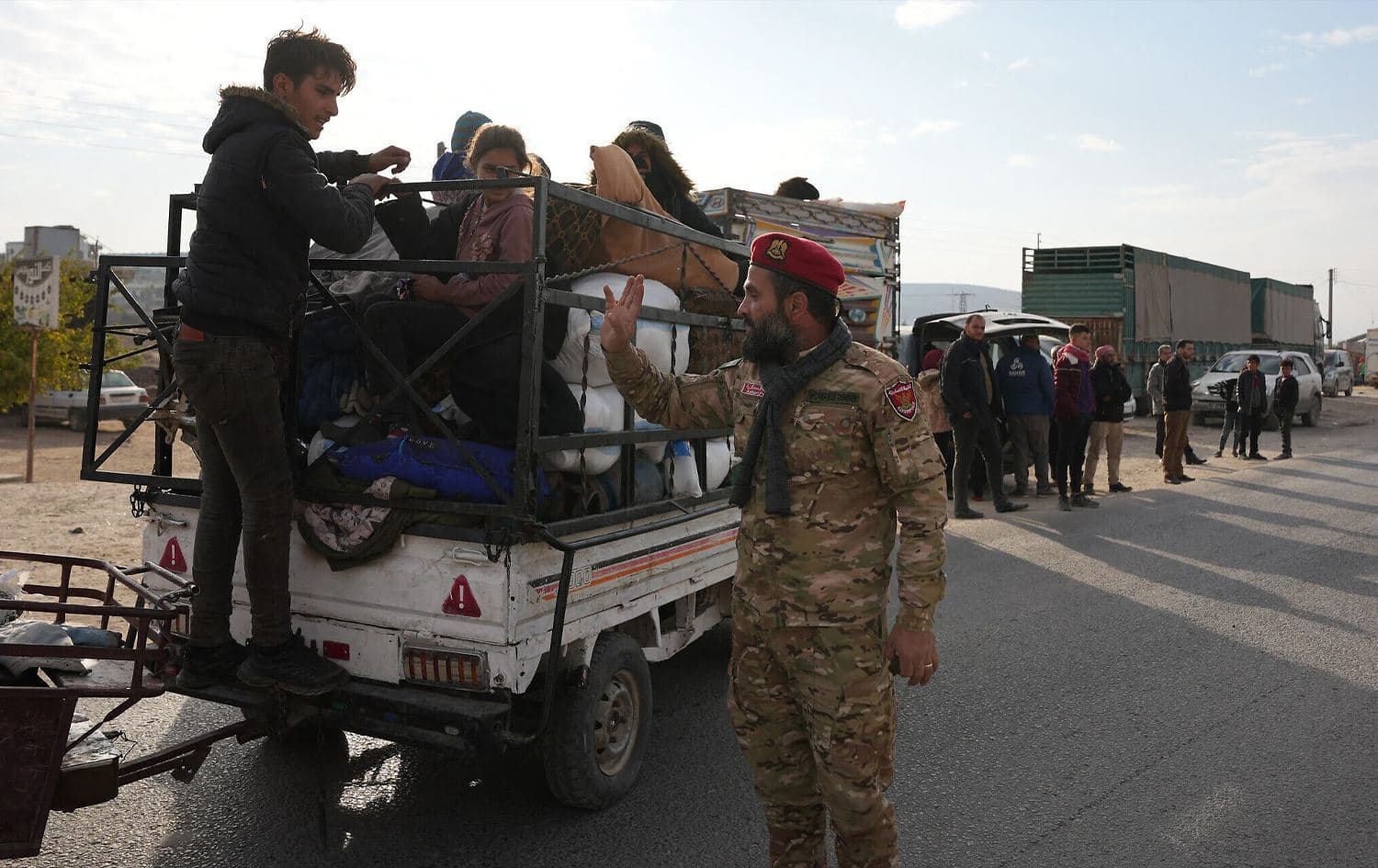
ERBIL, Kurdistan Region - The issue of internally displaced persons (IDPs) expelled from Kurdish-majority areas in northern Syria is a key topic in the ongoing negotiations between the Kurdish-led administration in northeast Syria (Rojava) and the interim government in Damascus, chief of the Syrian Democratic Forces (SDF), Mazloum Abdi, confirmed to a committee representing the IDPs.
Mohammad Hajo, a member of the Rojava IDP committee, told Rudaw on Monday that they had met with Abdi the previous day, presenting him with a detailed report documenting human rights violations committed in the Kurdish towns of Sari Kani (Ras al-Ain) and Gire Spi (Tal Abyad) in Rojava, over the past six years.
Turkey and Turkish-backed Syrian militia groups had seized the Kurdish towns of Sari Kani and nearby Gire Spi in a military offensive - dubbed Operation Peace Spring - against the SDF in 2019.
The offensive sent hundreds of thousands of the area’s residents fleeing into Kurdish-held areas in the northeast as well as the Kurdistan Region. Ankara has been accused of bringing in Arab settlers to take over their lands.
Hajo quoted Abdi as pledging immediate action through Rojava’s governing Democratic Autonomous Administration of North and East Syria (DAANES). This includes “improving conditions in the IDP camps, in addition to relocating displaced persons from schools to alternative accommodation, to allow students to return to their classrooms.”
Furthermore, the SDF chief reportedly discussed the different pathways to allow the predominantly Kurdish IDPs to return to their hometowns, not just Sari Kani and Gire Spi, but also Afrin.
In 2018, Turkey and its allied Syrian militias seized control of Afrin, a Kurdish enclave in northwest Syria. Thousands of Kurds fled, many moving to the nearby Shahba region, and families displaced from elsewhere in Syria moved into Afrin.
However, following the early December ouster of longtime Syrian dictator Bashar al-Assad, control of Afrin has largely shifted to General Security forces aligned with the new Syrian leadership.
On Sunday, Abdi reportedly drew a clear distinction between the IDPs from Afrin and those from Sari Kani and Gire Spi. While the former requires resolution with the interim leadership in Damascus, the situation of the latter two “ought to be discussed with Turkey,” the SDF chief was quoted as saying.
.jpg "Mazloum Abdi, commander of the Kurdish-led Syrian Democratic Forces (SDF), receives the committee of internally displaced persons on October 12, 2025. Photo: SDF-affiliated media")
Top talking point
The SDF chief, on March 10, signed a landmark agreement with Syrian interim President Ahmed al-Sharaa. The deal aims to bring all civil and military institutions in Rojava under state control and to establish a nationwide ceasefire. Crucially, it also “ensures the return of all displaced Syrians to their towns and villages,” guaranteeing “their protection by the Syrian state.”
Talks to implement the agreement have been ongoing since March.
On Sunday, Abdi reportedly told the committee that the return of IDPs to the Kurdish-majority areas from which they were expelled is a central element currently under discussion with Damascus, within the framework of his March agreement with Sharaa.
The SDF chief reportedly described the engagement as being generally “positive,” noting progress in both military and political integration.
“There are understandings and ongoing meetings between military delegations from [Rojava and Damascus],” Abdi reportedly said, adding that the integration of the SDF into state forces would take place “on the condition that it retains some form of autonomy - either as a corps or a special entity tasked with protecting its areas - along with the [SDF-affiliated] Internal Security Forces [Asayish].”
Abdi further anticipated that the existing regional administrations under DAANES will largely remain in place.
“The areas of the DAANES will be administered in a manner similar to what they are now,” he reportedly said, indicating that local governance structures would continue operating with their current leadership.
Acknowledging that external pressures are complicating the integration process, Abdi was cited as reaffirming that the SDF would neither disarm nor withdraw from eastern Syria regions, including key areas such as Raqqa and Deir ez-Zor provinces in eastern and northeastern Syria, respectively.
Of note, the SDF chief had announced Friday that the Kurdish-led forces’ integration into Syria’s national army will begin soon and will include the Kurdish forces’ specialized counterterrorism unit sharing its expertise across the country.
“The SDF will become a strong part of the new Syrian army. In the coming days, we as the SDF command, will dispatch a delegation to the Syrian defence ministry in Damascus in order to implement the March 10 agreement. The process of SDF’s integration into the Syrian army will begin,” Abdi said while addressing the SDF’s Anti-Terrorism Units (YAT).
The remarks followed a visit by the SDF chief to Damascus to meet with Sharaa, where they reached a verbal agreement on several issues, including a nationwide ceasefire to end deadly clashes between the two sides in the north of the country.
Sinam Mohamad, a Rojava representative in Washington, told Rudaw English on Thursday that the latter deal aligns with the March agreement.
Abdi also announced that the YAT will be deployed across Syria to help the new Syrian security apparatus in the fight against the Islamic State (ISIS).
“In the new Syria, in addition to the SDF’s integration into the Syrian new army, our anti-terrorism forces (YAT) will also play a new role. Their work will not be limited to northeast Syria, but will be nationwide. They will work alongside other units of the Syrian army. We believe that the experience the YAT has gained in the past 11 years of fighting against terrorism will play a leading role in the new process in the fight against terrorism, ISIS, across Syria rather than only in northeast Syria,” he said.
The SDF has been the main partner of the US-led global coalition against ISIS on the ground in Syria and fought the bulk of the battle to territorially defeat the radical group.
Khalid Jamil Mohammed contributed to this report.


