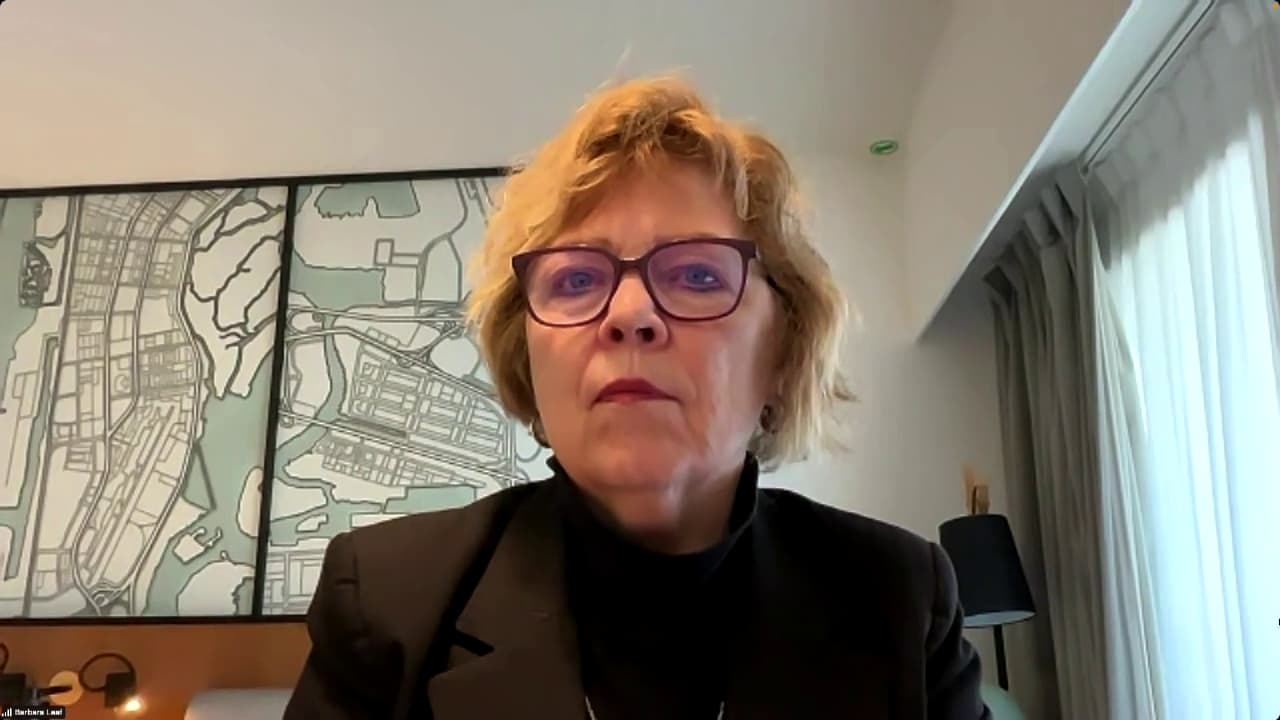
ERBIL, Kurdistan Region – Senior US diplomat and former Assistant Secretary of State for Near Eastern Affairs Barbara Leaf described the landmark meeting between US President Donald Trump and Syria’s interim President Ahmed al-Sharaa in Riyadh as a “historic” moment and a pivotal “turning point” in US-Syria relations. Speaking to Rudaw, Leaf also hailed the Kurdistan Workers’ Party's (PKK) decision to disarm as a significant step toward broader regional stability.
During the high-profile meeting - hosted by Saudi Crown Prince Mohammed bin Salman (MbS) and attended remotely by Turkish President Recep Tayyip Erdogan - President Trump urged Sharaa to normalize relations with Israel and to assume responsibility for detention centers currently housing Islamic State (ISIS) affiliates in northeast Syria (Rojava), now controlled by the Kurdish-led Syrian Democratic Forces (SDF).
A day earlier, Trump announced his intention to lift US sanctions on Syria as part of a broader strategy to normalize relations with Damascus.
Speaking to Rudaw on Wednesday, Leaf said the move to lift “all US sanctions” would “have a tremendous effect on regeneration of the Syrian economy.
She also pointed to the symbolic weight of the Syrian interim presidet’s appearance alongside President Trump and MbS, calling it “a very dramatic and strong signal of support for this transition” that Sharaa is leading in Syria.
However, Leaf stressed that expectations of Sharaa are now substantial, particularly “from the Syrian people, regional partners, and now very explicit expectations proffered by the US president.”
“Many of those expectations on the American part have to do with terrorism - that is to say, getting rid of all the foreign terrorist fighters who are still in Syria,” she noted.
The senior US diplomat additionally ruled out an eventual normalization of ties between Syria and Israel. “I think that's a very distant prospect,” she said, “but on the other hand, I think there is room to hope that there will be a calming of tensions between Israel and Syria over the coming months.”
Sharaa, then the commander of Hay’at Tahrir al-Sham (HTS), led a coalition of opposition forces that ousted Syrian dictator Bashar al-Assad on December 8. He was appointed interim president in late January.
While HTS remains designated as a terrorist organization by the US, Washington previously offered a $10 million reward for Sharaa’s capture, but the bounty was dropped in late December.
Leaf acknowledged Sharaa’s controversial past but emphasized the vision he presented during their meeting.
“He laid out a clear sense of his hopes - his ambitions - for what he said was a new Syria,” she explained, “a new Syria that would have good relations with all of its neighbors and with the broader region, a Syria that would no longer present threats to its neighbors and would not allow other parties or actors to present threats, whether it was to Israel, to Turkey, to Jordan or anyone else.”
On the topic of the PKK, Leaf underscored the importance of the group’s decision to disarm and dissolve, calling it “the most significant recent event” that could pave the way for securing the rights of Syria’s Kurds within a unified state.
Founded in 1978, the PKK originally sought to establish an independent Kurdish state but later shifted its demands toward securing broader cultural and political rights for Kurds in Turkey.
On Monday, the group announced that it would end its decades-long armed campaign against the Turkish state, describing the decision as a step toward a peaceful resolution.
According to Lead, the PKK’s decision further aligns with President Trump’s push for the “calming of tensions and conflict in this area through and across Syria."
The following is the full text of the interview with Leaf.
Rudaw: Hello Ms. Barbara. Thank you for this opportunity. Today, we witnessed a historic event. Donald Trump met Ahmed al-Sharaa in Riyadh. Will the new Syria commit to normalizing ties with Israel, as the White House said and as Donald Trump requested?
Barbara Leaf: Well, look, I think this was, as you say, a historic meeting. First of all, he preceded this by an announcement yesterday [Tuesday] that he was going to lift all US sanctions [imposed on Syria]. That is going to have a tremendous effect on the regeneration of the Syrian economy.
And then to see him standing there near the president with the Crown Prince of Saudi Arabia [Mohammed bin Salman] is a very dramatic and strong signal of support for this transition.
You were the first US official to visit Ahmed al-Sharaa in the previous months. Did you expect that five months after your visit, the US President would meet him? I want you to talk about the process over the past four to five months.
Well, I think there are a lot of expectations that have been heaped on him, expectations by the Syrian people, expectations by regional partners, and now very explicit expectations proffered by the US president. Many of those expectations on the American part have to do with terrorism, that is to say, getting rid of all the foreign terrorist fighters who are still in Syria.
But also the president raised expectations or hopes that eventually there would be a cooling or warming of relations, rather, with Israel and potentially normalization of relations. I think that's a very distant prospect. But on the other hand, I think there is room to hope that there will be a calming of tensions between Israel and Syria over the coming months.
An interesting point that I want to ask you is that during your visit to meet Ahmed al-Sharaa a few months back, there was a reward for Ahmed al-Sharaa’s arrest, but after your visit, the bounty was scrapped. How did this happen?
Yes, there was a $10 million bounty on his head for some years put by the US government, because he was originally, he still is under US law. He is designated as a terrorist and Hay’at Tahrir al-Sham is designated as a terrorist organization. But given the decision by the Trump administration that we should meet with him and begin engagement, diplomatic engagement, it was just logical that we would remove the bounty.
And so I was asked to let him know that, and we had, there was a bit of joking about it on the part of the foreign minister who suggested that he could, that President Sharaa could offer himself up and get the $10 million bounty himself. But in any case, it was an important gesture at the time.
Did he speak about this topic when you met him during your visit?
Well, look, he laid out a clear sense of his hopes, his ambitions for what he said was a new Syria, a new Syria that would have good relations with all of its neighbors and with the broader region, a new Syria that would no longer present threats to its neighbors and would not allow other parties or actors to present threats, whether it was to Israel, to Turkey, to Jordan or anyone else. So he laid out a very ambitious agenda and he was at pains to reassure this first American official that he had met, that he intended to turn the page on a very dark history that the Assad family had made; a history of violence towards its own people and insecurity towards all of its neighbors.
At today’s meeting, were the rights of Kurds in Syria on the table between Trump and Sharaa? Did they speak about the Kurds and Rojava?
I have not gotten all the details. They are just coming out now. It was a meeting [that lasted] for about a half an hour.
We know that President [Recep Tayyip] Erdogan of Turkey called in during the meeting. I think that is a significant piece [of information] right there. I also think, of course, that the most significant recent event was the decision by the [Kurdistan Workers’ Party] PKK to disarm and demobilize and to dissolve as an organization.
So I think all of these events come together and offer some real promise for Syrian Kurdish rights within a unified Syria. This is something that Ahmed al-Sharaa, again, was emphasizing in my meeting with him, that he regarded and he would take the approach that Syria's Kurds had exactly the same rights as any other Syrian citizen, and that he would look to protect them.
You made an important point regarding the PKK. On Syria, will the principle of self-administration or federalism as a Kurdish right in Syria be implemented in the Syrian constitution?
So I think all of those details are issues that have to be worked out in a political set of compromises among Syrians, with Damascus, with the transitional and interim government.
I think there is a lot of room for compromise to allow the kind of self-government or decentralized government, I might say, across the country. But these are issues that Syrians themselves really need to discuss around the [discussions] table.
There is another topic. The David Corridor is a project that is frequently mentioned. Is it just social media rumors, or is there actually a project to expand Israel’s hegemony in northeast Syria and until the Rojava-Kurdistan Region border?
If you mean a project of Israel towards Syria, I think Israel's approach to Syria is premised, I think, still on the notion that there are many threats in this new Syria, that there are foreign terrorist fighters there, may be extremist Palestinian groups that are still active in Syria.
So I think, frankly, that events this week, the move by President Trump, will have its impact in Israel as well. And my hope and expectation would be that there would be channels opened up eventually between Israel and Syria to manage their… even if they don't have diplomatic relations, even if they don't have formal relations, they can have an arrangement where they can manage their security concerns directly or with the assistance of a friendly government, be it the US or someone else.
About the PKK, you said that the meeting discussed the process of the PKK laying down arms. Can you give us the details?
Look, I think it's very clear what the PKK leader has laid out in terms of the future of this group, that it has met its goals and that it is time to disarm, demobilize, and no longer carry out militant actions.
So I think this also adds to the positive nature of the conversation that President Trump and the Crown Prince of Saudi Arabia and President Erdogan had today [Wednesday]. In the end, I think the US wants to see what a lot of regional neighbors want to see, which is a calming of tensions and conflict in this area through and across Syria. The Syrian people, be they Syrian Kurds or Syria's many other communities; they have suffered enormously because of the conflicts that have raged through the country.
Will the US participate in the practical process of the PKK’s disarmament? If it participates, will it participate as an observer or a guarantor?
Well, if you mean oversee the PKK, I don't think the US has a direct role. Of course, the PKK has been listed as a foreign terrorist organization under US law for many years. So I don't think the US will have a direct role, but of course the US will monitor it closely.
Is the US looking to have a role in deploying Iraqi border guards and Peshmerga forces in the places that the PKK will evacuate?
Well, if the government of Iraq or the Iraqi security forces ask for some sort of technical support, advice, consultations, of course, I would imagine that we will be willing to offer that. Again, I don't see us having a direct role unless we're asked by the parties, unless we're asked by one of the governments or several of the governments to do so. Thank you so much.
.jpeg&w=3840&q=75)