
ERBIL, Kurdistan Region – Syria’s top Christian leader, Greek Orthodox Patriarch of Antioch and All the East, Patriarch John X Yazigi, delivered a rare public rebuke to the country’s new interim government, urging it to take full responsibility for protecting religious minorities. The statement came in the wake of a deadly church bombing in Damascus that killed dozens recently.
According to Syria’s interior ministry, a suicide bomber affiliated with the Islamic State (ISIS) attacked the Mar Elias Church in the Duwaila neighborhood of Damascus during Sunday mass. The assailant opened fire on worshippers before detonating an explosive vest. The Syrian health ministry confirmed on Monday that 25 people were killed and 63 injured in the attack.
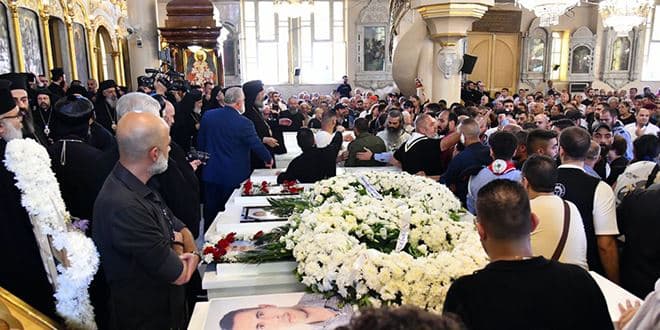
Speaking during a funeral service held Tuesday at the Holy Cross Church in Damascus for nine of the victims, Patriarch Yazigi addressed Syria’s interim President Ahmed al-Sharaa, stating, “Condolences are not enough for us… the crime that unfolded is a little bigger than that.”
He underscored that it is the Syrian government’s fundamental duty to protect all of its citizens, adding, “What is important to me - and I will say it - is that the government bears responsibility in full.”
That same day, Syrian security forces announced they had dismantled an Islamic State (ISIS) cell responsible for the church bombing, preventing a second planned attack on the Sayyidah Zainab shrine in southern Damascus - a site predominantly visited by Shiite Muslims.
The Syrian interior ministry stated that all members of the ISIS-affiliated cell were apprehended, including the group’s leader and two non-Syrian suicide bombers who had allegedly infiltrated Syria from the al-Hol camp in northeast Syria, where thousands of individuals with alleged ISIS ties remain detained.
At a press conference, Syrian interior ministry spokesperson Noureddine al-Baba emphasized the transnational nature of ISIS, reiterating Syria’s commitment to regional cooperation in combating terrorism.
Baba revealed that interrogations with one of the detained terrorists led authorities to the group’s hideouts, where raids resulted in the capture of all members and the seizure of a significant cache of weapons and explosives. The cell’s leader, identified as a Syrian national with the initials M.J., was formerly known within ISIS as "Wali al-Sahraa" - Arabic for "Governor of the Desert."
Baba insisted that the two suicide bombers - one who carried out the church attack and another captured en route to the Sayyidah Zainab shrine - were both non-Syrians who had arrived in Damascus via al-Hol Camp with M.J.’s assistance.
He warned that ISIS continues to exploit any security gaps to carry out destabilizing attacks but praised Syrian security forces for delivering a “devastating security blow” to the group in Damascus and its surrounding areas.
Meanwhile, a group calling itself the Ansar al-Sunnah Brigades on Tuesday claimed responsibility for the Mar Elias Church attack. In a statement, the group identified the suicide bomber as Mohammed Zain al-Abideen and said the attack was retaliation for what it called “provocations against Islamic Da’wah and Muslims by Damascus’ Christians.”
The group is a relatively new and ultra-extremist Salafi militant faction that emerged in Syria in February. Reportedly formed by former Hay’at Tahrir al-Sham (HTS) member Abu Aisha al-Shami, the group promotes an intensely sectarian ideology, aiming to purge Syria of Alawite, Christian, Druze, and Shiite communities. It also opposes the current interim government led by Sharaa, which it accuses of being overly moderate.
Operating through decentralized "lone wolf" cells, Ansar al-Sunnah Brigades publicly denies formal ties to ISIS, but its rhetoric and actions closely mirror the group, leading analysts to believe it may be a pro-ISIS splinter faction or a covert front for the group.