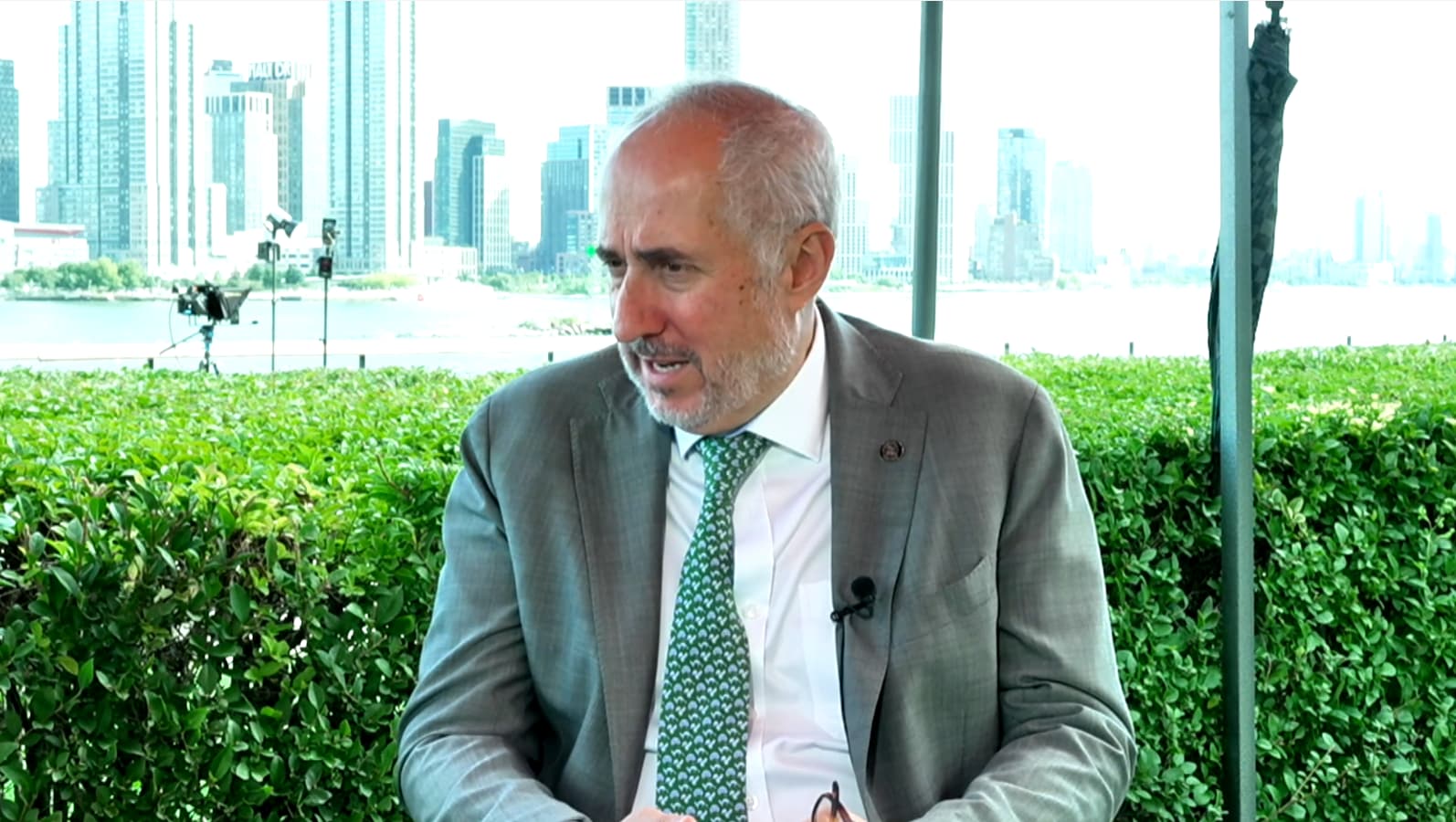
ERBIL, Kurdistan Region - The head of Germany’s Schleswig-Holstein state said Germany must both maintain a humane refugee policy and enforce stricter deportations for migrants who break the law, while also opening its doors to skilled labor.
“I support a liberal policy. But if people become criminals, then I'm not with them,” Daniel Gunther, Minister President of Schleswig-Holstein, told Rudaw in an interview. “If someone has guest status … they must behave very well. If this doesn't happen, then sending them back is justified, and I have no problem with deporting people.”
Germany has faced mounting pressure over migration policy in recent months. The far-right Alternative for Germany (AfD) party has gained support in state elections on an anti-immigration platform, while Chancellor Friedrich Merz’s government has backed new measures to speed up deportations of rejected asylum seekers, particularly those with criminal convictions.
Gunther, a member of the Christian Democratic Union (CDU), argued that social acceptance of refugees depends on drawing a clear line.
“Someone who doesn't want to comply with our rules doesn't have the right to be accepted in our country,” he said, adding that the number of arrivals must be limited to ensure integration is possible.
Immigration was a central issue in Germany’s February parliamentary elections. The Christian Democratic Union/Christian Social Union bloc - considered center-right - secured 28.5 percent of the vote, followed by the far-right Alternative for Germany (AfD) with 20.5 percent, and the Social Democrats (SPD) with 16.4 percent.
At the same time, Gunther said Germany needs immigration to confront an expected labor shortfall.
“According to various statistics, by 2035 we will have between 300,000 to 350,000 fewer workers,” he noted. “If we want to continue economically with this current success in Schleswig-Holstein, then we need skilled workers.”
He explained that his state has already set up a “Welcome Center” to ease administrative procedures and connect directly with foreign regions to recruit workers. “We are very open to that matter,” he said. “As a country where the feeling of welcoming is very strong, I think we can really create opportunities.”
Despite backing tougher deportation rules, Gunther emphasized that integration should remain Germany’s long-term goal. “Immigration and integration is a task that never ends,” he said. “We've come a long way… but obstacles and difficulties remain.”
Germany is a popular destination for tens of thousands of Iraqis and residents of the Kurdistan Region who attempt to reach Europe each year, often through smuggling routes.
The following is the full transcript of the interview with Daniel Gunther:
Rudaw: Most companies in Schleswig-Holstein see achieving carbon neutrality by 2040 as a major challenge. How specifically are you preventing small and medium-sized companies from failing in this process?
Daniel Gunther: Thank you very much, welcome. We have clarified this issue, especially with those companies in Schleswig-Holstein that I visited during my summer tours - they wholeheartedly support this goal. In a country where we have established renewable energies more extensively than other regions, there is a strong belief that we can remain an industrial nation with a balanced climate. Many small and medium-sized companies also see this opportunity. In Schleswig-Holstein, we can now produce 200 percent of our energy needs from renewable sources, meaning twice as much. We can even export it. So we are a very successful region. That's why fewer people are concerned about this goal. It's certainly an ambitious goal, but I believe that as a region between two seas, a region of renewable energies, we can achieve such a goal.
Immigration is an important issue in Germany. Now, ten years after Angela Merkel's famous statement, “we can do this,” have you succeeded? I want to know how you view the federal government's policy regarding deportations and Germany's border controls. Do you support deportations and border controls?
I don't believe we can say we've achieved our goals; one cannot make such a decision. Yes, this issue in general - immigration and integration - is a task that never ends. Rather, in my opinion, we need to always work on it. We've come a long way. I also think we've changed many laws in our country so that everything runs properly, and we've placed a large number of those who have come to us in the job market, and many things are going well in that area. But obstacles and difficulties remain. I think in the matter of immigrants, one needs to face the realities.
How can one organize the situation if - like myself and as a state government - we intend to pursue a humane policy and carry out integration in the best possible way, from kindergartens and schools to providing housing? This cannot be implemented with a very large number of people. That's why I certainly support trying to limit the number of people coming to us to some extent. This requires appropriate measures. Of course, the right thing is to separate the good from the bad. We want to offer a country to those who comply with our normal procedures and laws, just as any other state would want to do. I believe we need to do this in Germany as well. Someone who doesn't want to comply with our rules doesn't have the right to be accepted in our country. Even if we're a bit strict, I think it's very important to preserve social acceptance for receiving refugees.
How is the immigration policy in your state?
Well, I think several different factors come together. First, I believe seriousness in this matter is helpful, as I mentioned earlier. This has been very helpful for becoming familiar with the immigration issue in our region. I believe this becomes the key to success for Schleswig-Holstein when people from other areas know they are welcome in our region. We haven't reached the point where our factories say that a shortage of skilled workers is bad, but before I bring someone from another culture, from another country to my factory, it's better to remain without workers.
This situation certainly exists in some other places, but not here in Schleswig-Holstein. There is a strong readiness here to accept people from different countries for factories in Schleswig-Holstein. I believe this is an important characteristic. As I see it, this is in our tradition in Schleswig-Holstein. The immigration story exists in my family because our roots are not from Schleswig-Holstein. My father was born in Weisenberg in the Mecklenburg-Vorpommern state. My mother is from Rendsburg, but her parents had fled from East Prussia [Ostpreußen] to Schleswig-Holstein. After World War II, half of Schleswig-Holstein's population wasn't from that region. So we know those times when refugees came to us - that was our experience. That's why this is very helpful in this era when people knock on our door and say, "I fled from war, I became displaced, I lost my home and property, please help me." People in Schleswig-Holstein see this differently. And I believe this helps us view the integration issue positively as well.
According to my information, many Kurds live in your region. It's always said that Kurds integrate well. What's your opinion on this? Also, I want to know if Seyran Papo, a Kurdish member of parliament from your party, has an impact in conveying the specific demands of the Kurdish community in your region?
As I see it, the readiness for integration is very strong. I don't know if this number is higher in Schleswig-Holstein compared to other regions or not. I think we're at the same level. We have tens of thousands of Kurds in Schleswig-Holstein, and this is going very well. I'm very happy that we have someone like Seyran Papo and have brought her to a high level; we have a Kurdish woman in the Christian Democratic Party faction who brings these issues into daily politics. She also carries out activities and brings people with that background closer to politics. She has also invited me to events, and I've been a guest as state president. I think it's very important that from wherever someone comes here, they understand that they can not only meet people connected to politics but can also be active themselves. Seywan Papo is the first participant. But Seywan Papo proved that the CDU party can achieve success in the eastern coastal circle as well. Since World War II, we hadn't been able to achieve this accomplishment, but she could, because she has great popularity and many supporters in that area. This popularity doesn't annoy us. Cooperation with her goes very well. And I think this also helps the Kurdish community to have a representative in power.
One of the demands of the Kurdish diaspora here is that their children be taught in Kurdish formally in all schools. It exists in some regions and not in others. How important is mother tongue education for you?
One needs to ensure that organizing this matter is provided for people. To me, it's somewhat a sign of strength that one doesn't ignore their mother tongue, but that it also plays its role. I believe it's the government's duty to make understanding effective in our country. Successful integration depends on knowing the language of the country you live in. This should be our goal. But bilingualism is always a strong point for our country. A region that proves minority rights are positive, where we promote Danish due to our proximity to Denmark and Frisian [languages] in our region. This is certainly true for that part as well. Whatever can be done organizationally, I fully support it. But it must be feasible to implement, especially when our budget situation isn't at its best.
You were aware of the deportation of a Yazidi Kurdish family from Germany. This resonated in the media. If this had happened in your state, would you have allowed this action? Now, a large number of Yazidi Kurds fear deportation. Do you think this is right?
We have announced our position, and with broad support in the Schleswig-Holstein state parliament, we decided to provide clear support for the Yazidis in our country and will do whatever is necessary so they are not sent back. We have expressed our position this way at the federal level as well. We also have the same position in the Federal Council. There is a common position among all parties in Schleswig-Holstein.
Some states have plans to bring craftsmen from Kurdistan. Do you have any plans to work with the Kurdistan Region to bring skilled workers?
We are very open to that matter, and as a state minister-president, I conduct many negotiations to find states and regions that have skilled workers and want to work in Schleswig-Holstein. According to various statistics, by 2035, we will have between 300,000 to 350,000 fewer workers, and gaps will be created. If we want to continue economically with this current success in Schleswig-Holstein, then we need skilled workers. Of course, I also support teaching those who are here and having them fulfill their duties in the job market. But we certainly need immigration as well. As I mentioned at the beginning, we are a country that has proven itself at international and national levels. As a country where the feeling of welcoming is very strong, I think we can really create opportunities for them.
That's why we decided to establish a "Welcome Center" in Schleswig-Holstein in this cabinet, and it's now working. To directly contact people, regions, and governments and with minimal administrative procedures, organize work opportunities for people in Schleswig-Holstein so they can start living here.
You are aware of the current situation in Syria, where Kurds are the only force maintaining stability in northeast Syria (Rojava). Do you think Germany has the necessary role in restoring stability to Syria, or do you think it should be stronger and provide more support to Syria and Rojava?
I believe yes, we should have our attention on that matter. The federal government, Germany's advisor, and Foreign Minister Johann Wadephul are all working on it. We play a significant role in this region. I think this will be important for us. In general, in Europe, there was a need for Germany, as the largest state, to play an appropriate role in representing all interests in Europe. After the change of government, this has changed significantly; Germany has a stance on all issues and even has a leading role in some matters. I believe it's good that this path was chosen, and the Federal Republic of Germany now holds its stance with confidence in the state and in the European Union in this area.
There are discussions about allowing Syrian citizens to visit Syria and then decide whether to return to Syria or not. Do you support this plan?
I believe it was too early for this discussion in Germany, because people thought that after [Bashar al-]Assad's fall, everything had become normal and everyone could return. I stood against this because to me, there's no reason to suggest to those who have integrated well to return. However, I understand well that there are people who say, "I don't feel danger and I'd like to return to my old country." No one should be prevented.
Well, if a Syrian or Afghan person commits a crime, do you support deporting them back to Syria and Afghanistan?
Yes, I have a clear position. I support a liberal policy. But if people become criminals, then I'm not with them. Here, I support that if someone who doesn't comply with the rules or seriously injures another person and is punished in Germany, that person shouldn't be afraid of being in a worse situation in the country they're deported to. I think one needs to think beforehand. If someone has guest status - because initially one is a guest and hasn't fully integrated and doesn't have the right to obtain citizenship - they must behave very well. If this doesn't happen, then sending them back is justified, and I have no problem with deporting people to Afghanistan and Syria as well. One can take responsibility for that. From my Christian and moral understanding perspective, I warmly support this decision.
There's a proposal to provide loan services to immigrants that they must pay back later. Is this a solution? What's your opinion on this?
Yes, we had a mechanism in our country in some other areas where if someone received financial assistance for vocational training, they had to return part of that assistance. It's like that.
I only received 78.15 marks monthly. There was an opportunity to return that money. I believe it's good if it's returned. If someone initially receives social assistance based on the asylum seekers assistance law, then later receives assistance like "Citizen’s Benefit" [Bürgergeld], then works and pays taxes. I think it's the right way for people to reach the level where they earn their own income. Someone who works in Germany pays taxes on that basis. One can say that's compensation for that [assistance]. If we have a situation in Germany where someone comes to our country due to fleeing or other reasons, and due to procedures, work is prohibited for some of them, then one cannot say on one hand "we punish them and they must return it as a loan." I have doubts about this proposal - is it the right way? I understand the principle of it. I think if from day one we allow those people to work to provide for their livelihood, that would be a more successful way, because this way social acceptance for this matter increases.
Language learning is also important, which was not allowed to immigrants. What are your thoughts on this matter?
Yes, this adds to it. I also think people learn the language while working. I believe people should do it this way: not that initially they can't work, then must learn the language, and then must work. I'm sure there are many factories in our state that take responsibility that even if someone doesn't know the language well, there's still a way in which they can serve us. At the same time, one can also learn the language. One learns in daily life and at the factory. From my own experience, I know that even in English class, we learned that language by reading words and selecting them. If I look today at how young people learn English - while using it at school and at work - they learn faster that way. I think we should be more flexible in our state.