


Interview

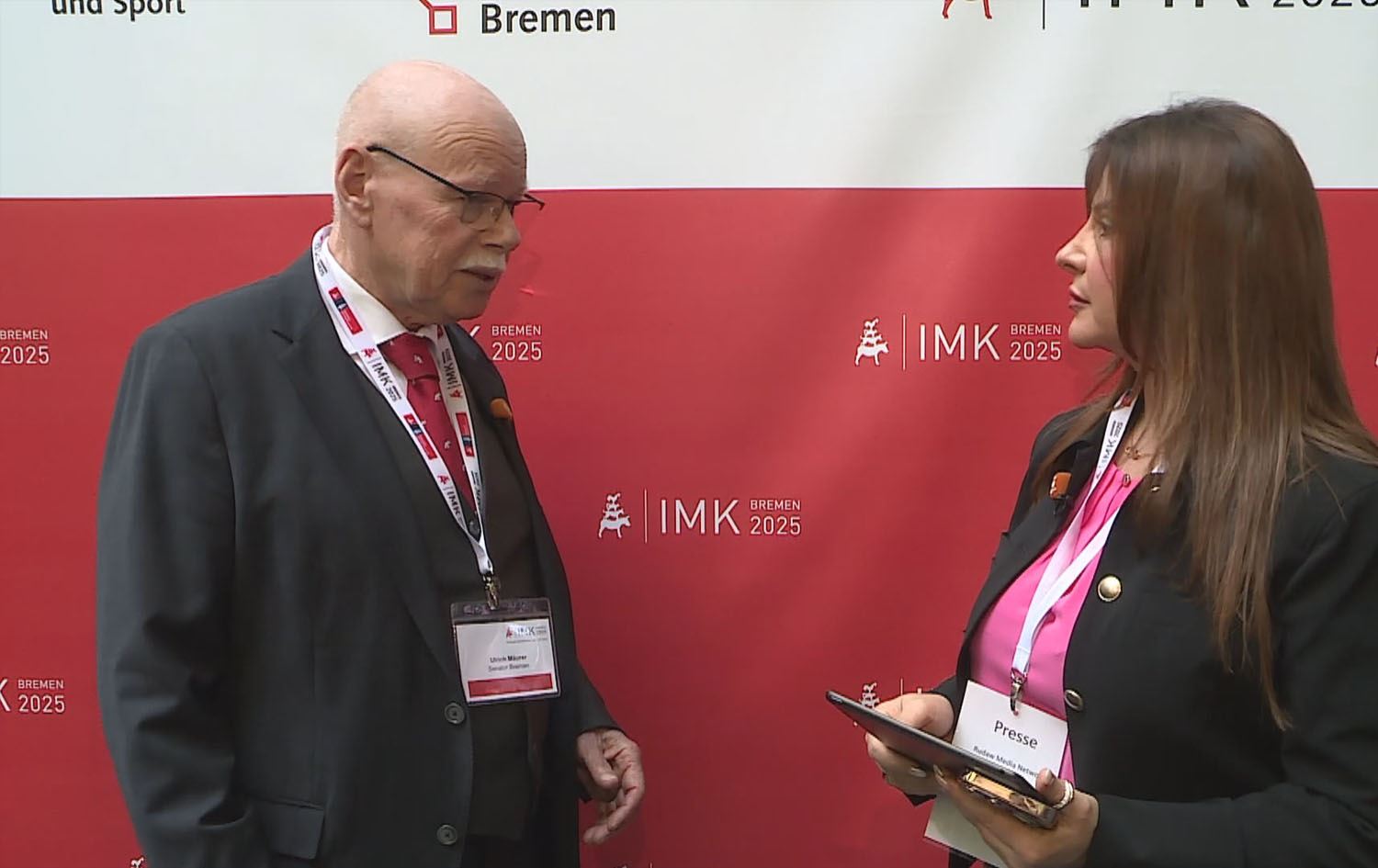
Ulrich Maurer, a member of the Social Democratic Party (SPD), speaking to Rudaw in Bremen, Germany, on June 11, 2025. Photo: Rudaw
BREMEN, Germany - A senior member of Germany’s center-left Social Democratic Party (SPD) has called for tighter migration controls and welcomed the Kurdistan Workers’ Party’s (PKK) recent announcement of its dissolution, citing potential benefits for his country’s security.
Speaking to Rudaw on Wednesday, Ulrich Maurer emphasized that his country cannot “take in [an influx of] 600,000 people once again” as it had done in recent years, stressing that Berlin must “return to a managed migration policy.”
Maurer further highlighted that with regard to the immigration dossier, Germany “exceeded the limits of its capabilities in many areas,” pointing to strains on public services, including education, housing, and infrastructure.
Maurer also responded positively to the PKK’s early May declaration that it was dissolving and ending its armed struggle against the Turkish state - a conflict that has spanned four decades and resulted in an estimated 40,000 deaths, including around 35,000 PKK fighters.
“I am pleased by the announcement,” Maurer stated, noting that German security agencies have been significantly burdened by PKK-related investigations and legal cases. “Our security institutions are very burdened by this issue,” he added.
The following is the transcript of the interview with Ulrich Maurer.
Rudaw: Honorable Senator Maurer, thank you for your time and for being with us. The Interior Ministers’ Conference this year starts in a few days, and you are hosting it. It lasts two days. What is the importance of the conference at this time, and what do you expect from it?
Ulrich Maurer: Yes, this is a meeting of all federal states together with the Federal Interior Minister. The timing is special because this meeting comes after the formation of the new government in Berlin. Therefore, expectations are certainly very high that we can solve the current internal security issues together.
What topic is important to you that you want to discuss as the first priority?
Certainly, the issue of migration is at the top of the agenda. There, everyone agrees that we cannot, as in the past two years, take in 600,000 people once again. We must return to a managed migration policy, to a planned policy, and this requires a lot of activity.
What other topic on the discussion table is very important? What other issue besides the migration question?
The migration issue and another topic. We have a special situation in the Federal Republic. Nearly every day, a woman is killed. Therefore, the issue of violence against women is also a very central concern. We also have a clear view of what we can do against this.
Honorable Maurer, regarding the migration issue, as we know, you say that to limit illegal migrants, border controls are necessary, and restrictions at borders are also important. Do you think this will lead to a reduction in the arrival of migrants?
I am a strong supporter of protecting Europe’s external borders. Until that is available, individual national steps must be taken. We see this now in the Federal Republic. We conduct border controls. How successful is that? I don’t know, but I say if we let things continue as they are and do nothing, this is unacceptable. We have exceeded the limits of our capabilities in many areas for a long time. This is not just an internal security issue, but we also have major problems in schools, kindergartens, and we have problems in the housing market. Certainly, migration is not the cause of all problems, but these wrong developments that existed before are greatly amplified again with the arrival of large numbers of migrants. Therefore, we need major action.
You say we need serious steps. Now you say that the Dublin system does not work. How do you want to make that system work, and what about the EU’s common asylum policy?
We see that more than two percent of those who come to Europe are not entirely Germany’s responsibility and can be returned. This means that when 350,000 people are received and two percent are returned according to Dublin laws, that's a drop in the ocean. That means most countries don't register refugees but simply send them toward Germany's border. As I said, regarding returns, we witness that Greece and Italy say no, we won't take anyone.
What exactly do you mean by protecting the EU's external borders? I was at Greece's borders - the situation of migrants is not very good there. What exactly should be done?
Border security alone is not enough; this is one measure among several. But one must return or generally try once to solve migration through planning. That means one must truly help those people who need help. Not simply, as today, we see that those who come to Germany are not only women and children who come to us first, but also young men. Therefore, we need a fundamental change in all areas.
So the migration issue is very important. I also want to discuss another issue - internal security. As we know, the PKK issue is also one of the topics discussed at this conference. Now that the PKK has decided to dissolve, the peace process in Turkey is ongoing. How do you discuss the PKK issue at this conference?
I requested that we discuss this topic at this conference because certainly our security institutions are very burdened by this issue. When the PKK announced that it would dissolve, I was pleased with that position. But we are not the decision-makers; this issue must be resolved in Europe. This is the federal government's work, and therefore, the new Federal Interior Minister reports to us on how this plan will continue. In any case, we are very interested in what happens in Turkey.
But now the PKK is on the terrorism list. How do you deal with the PKK? Will they remain on that list?
Well, that's the question that arises correctly. When that organization dissolves itself, the ban no longer remains. But that, as I said, we cannot decide from here in Bremen or Bremerhaven, but it must happen, as I said, in Europe. But what we are watching this process and discussing - this itself is very important.
Honorable Maurer, you said that your state's security office is busy with the PKK case. Can I know how it's busy with the PKK case?
There are a large number of criminal proceedings due to charity fundraising and many other things and demonstrations, all of which create a lot of work for us. As I said, if all this ends peacefully, we will be happy.
We too. I have another question, which is about the AfD [Alternative for Germany] party. Is banning this party a topic of the conference?
We have an important meeting, where several very trusted people participate, we engage at a very deep level, and think about what the future steps are. This is a very complex topic that also needs to see what the courts decide. What this report says, how one should deal with it, and we dedicate a lot of time to this.
Are you in favor of banning the AfD?
I am somewhat cautious in this matter because I was involved in two banning processes that dealt with banning the NPD party [National Democratic Party of Germany]. Both processes failed, and this makes me generally more cautious than many others. Some think this is like a walk in the park. I see it differently, and therefore, I think we should carefully examine this report and think about what results we get from it.
My last question to you is about internal security. If we look at the tragic events in Magdeburg, similar incidents have occurred in Germany, or last week several times someone drove their car into people or attacked people with knives. German people are now very afraid. What are you doing to protect them?
Yes, this issue has been with us for several months, for a long time, and unfortunately, the number of attacks has clearly increased. One can certainly try to protect certain areas through those devices that block streets and many other things, but that alone is not enough. We always see that attacks happen in places where one doesn't expect them. Therefore, we have actually put forward the demand for a long time that others, those who participate in the health sector, in hospitals, those who know these people, those who might have more information than the police, should exchange information with each other, because police measures alone cannot control this.
Honorable Maurer, thank you very much for this conversation.
Thank you very much for being with us. We hope for a successful conference.


Comments
Rudaw moderates all comments submitted on our website. We welcome comments which are relevant to the article and encourage further discussion about the issues that matter to you. We also welcome constructive criticism about Rudaw.
To be approved for publication, however, your comments must meet our community guidelines.
We will not tolerate the following: profanity, threats, personal attacks, vulgarity, abuse (such as sexism, racism, homophobia or xenophobia), or commercial or personal promotion.
Comments that do not meet our guidelines will be rejected. Comments are not edited – they are either approved or rejected.
Post a comment