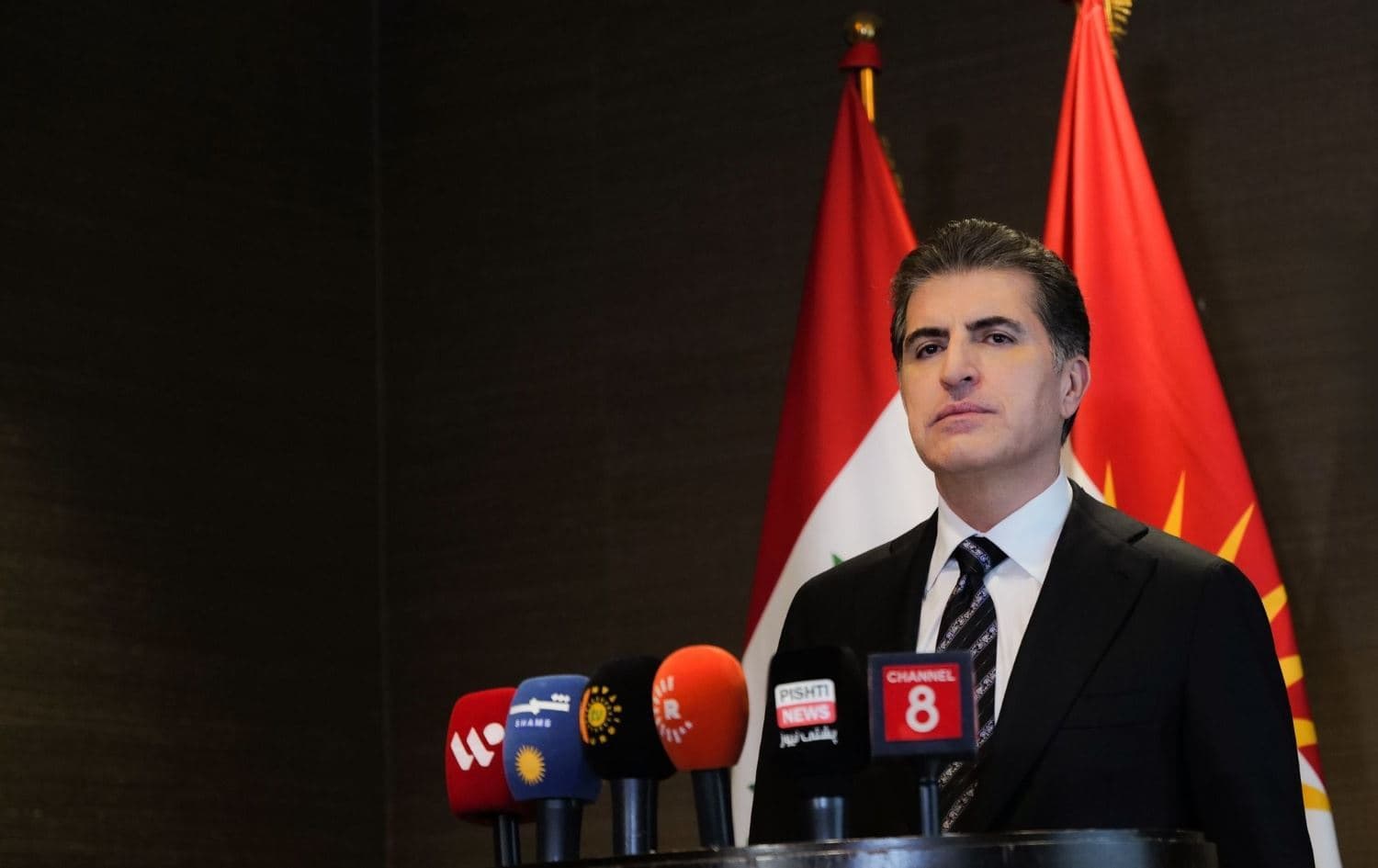
ERBIL, Kurdistan Region - Kurdistan Region President Nechirvan Barzani said on Sunday that the Kurdistan Region is widely viewed as a pillar of stability within Iraq, reaffirmed support for dialogue between Kurdish-led forces and Damascus, and said Turkey is serious about advancing its renewed peace process.
President Barzani made the remarks on the final day of the Munich Security Conference, during a press conference in which he addressed political developments in Iraq and the Kurdistan Region, the SDF-Damascus agreement, and the peace process in Turkey.
Regarding the Kurdistan Region’s position in the region, President Barzani said that “all countries want a strong Kurdistan Region within the framework of a federal Iraq,” adding that “we will be a primary factor of stability in the region.”
Kurdistan Region politics and government formation
On efforts to form a new Kurdistan Regional Government (KRG) cabinet following the October 2024 elections, and discussions over the Iraqi presidency - a post traditionally held by a Kurd - President Barzani said, “a very good meeting was held between President [Masoud] Barzani and Mr. Bafel [Talabani]. The meeting was very positive. It was a successful meeting.”
President Masoud Barzani, leader of the Kurdistan Democratic Party (KDP), and Patriotic Union of Kurdistan (PUK) leader Bafel Talabani met in Erbil on Wednesday amid ongoing negotiations to form the new KRG cabinet and agree on the Kurdish nominee for Iraq’s presidency.
PUK spokesperson Karwan Gaznayi on Sunday also described the meeting as “very positive.”
“I believe it is true that up to now we have not agreed on any specific point, but what I can say is that we are on the right track to reach an outcome that serves the interests of the Kurdistan Region and Iraq,” President Nechirvan Barzani said.
Iraq held parliamentary elections in early November. Under the country’s informal power-sharing system, the speakership goes to Sunni Arabs, the premiership to Shiite parties, and the presidency to the Kurds.
Kurdistan Region parliamentary elections were held in October 2024, but parties have yet to reach a final agreement to fully reactivate parliament and form a new cabinet.
Syria and SDF-Damascus talks
President Nechirvan Barzani also addressed developments in Syria, highlighting the late-January internationally brokered agreement between Syria’s interim government and the Kurdish-led Syrian Democratic Forces (SDF), which established a ceasefire and outlined the integration of northeast Syria’s (Rojava) civil and military institutions under Damascus.
“Our position in the Kurdistan Region is that we support this process. Regarding this political process now between the SDF and the Syrian government, we want the other Kurdish parties, such as [Kurdish National Council] ENKS, to also participate in the political talks currently being held with Damascus,” President Barzani said.
The ENKS is Syria’s Kurdish opposition umbrella group.
President Barzani and SDF commander Mazloum Abdi met in Munich on Sunday, discussing the latest developments in Syria.
“What we strongly emphasize is that the rights of the Kurds and all other communities must be fully enshrined in Syria's future constitution, and that is the guarantee for everyone to feel secure. What we intend, and what we encourage all parties to do, is to reach an agreement within the framework of a unified Syria. That is our policy in the Kurdistan Region,” he said.
In January, Damascus-affiliated forces advanced on Kurdish-held areas in Rojava, which displaced about 170,000 people, according to UN figures.
Regarding Rojava’s future in Syria, President Nechirvan Barzani said there is “an opportunity for a resolution,” but stressed that the process and form of any agreement should be decided by Kurdish actors themselves in talks with Damascus.
“That is, to the Kurdish parties, with Damascus. When I say Kurdish parties, I mean the SDF, ENKS, and all of them,” he said.
Barzani added that replicating the Kurdistan Region’s governance model in Syria would be difficult, but pointed to opportunities in Hasaka province, where a Kurd holds the governorship.
“If they can serve the Kurds, the Arabs, and all the other communities, the entire population will stand behind them,” he said, adding that this could demonstrate a model that represents all components of the province.
Turkey peace process
Turning to Turkey, President Barzani said that “Turkey genuinely wants to resolve this issue. The process may be moving somewhat slowly, but what matters is that all parties are committed to the success of this process.”
His remarks come amid a renewed peace process in Turkey, launched after imprisoned Abdullah Ocalan, leader of the Kurdistan Workers' Party, called in February last year for the group to disarm, followed by a unilateral PKK ceasefire.
Alla Shally contributed to this report from Munich.
Updated at 6:16 pm.