


Halabja was designated a province by the Kurdistan Regional Government in December 2013.
The period immediately after its designation saw an economic crisis in the Kurdistan Region. Oil prices plummeted, and overstretched funds were earmarked to meet the needs of the Peshmerga, who were fighting a fast-spreading Islamic State.
Halabja, 110 kilometers south of Sulaimani, became an internationally notorious landmark of Saddam’s genocide on Kurds when on March 16, 1988, the town was chemically bombarded, killing an estimated 5,000 people.
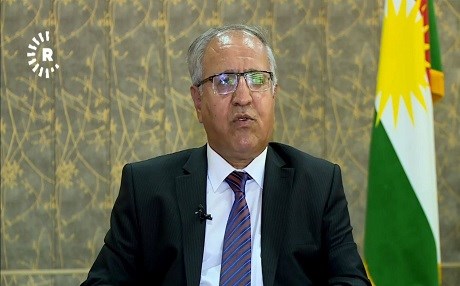
Newly-elected Halabja governor Azad Tofiq, proposed an open auction of the province’s vehicle plate numbers. All revenue will fund service and reconstruction projects in the province, Tofiq says, a proposition approved by current President Nechirvan Barzani and outgoing deputy prime minister Qubad Talabani. Iraqis of any ethnic or religious group can bid to buy the unique plate numbers.
Rojan Abubakr, Rudaw: When are you going to sell the Halabja car plates?
All the legal measures have finished for the sale of Halabja car plate numbers 1-9, according to a decree from the Kurdistan Regional Government (KRG) and the Iraqi federal government. The KRG decided to sell all the number plates in an open auction, with the income to be spent on service projects in the province, including the city of Halabja and the areas of Sharazoor and Hawraman.
All the numbers will be auctioned off in the presence of officials from the interior ministry, the finance ministry and the governor of Halabja. It will be held by the end of this month.
Numbers in high demand will also be auctioned off for bidders. These numbers will be lucrative, and we can spend the money they raise on reconstruction projects.
Which numbers will be auctioned off?
 What we want to do is make money to spend on the provision of public services for Halabja
  It will go from No.1 to 1000001. The odd numbers range from one to nine and then even numbers from [two] to [98]. There are some repeating numbers that are on high demand, for example 222, 555, or 333.
It is said you have sold plate No.1 to an Arab for a large amount of money. Is it true? Who are they? The story has gone viral on social media.
How much did the Arab person bid for plate No.1?
First of all, they have to apply in a formal way. They have to leave an amount of money as insurance. The money will not be refunded if the bidder chooses to abandon the auction. This is not a simple thing because the bids can reach over a million dollars, and it not just one number, but dozens.
[March 16, 1988] was a day of catastrophe, a day full of tears.
It has been said that the price of No. 1988 is similar to that of No.1.
The revenue will be spent on many different sectors - agriculture, families of martyrs, municipalities, health, education and so on
What are the projects you plan to spend the earnings on?
It is important to note that traditionally, 80 percent of the revenue should go to the KRG and 20 percent to Halabja province. But the KRG, Mr. Nechirvan Barzani [President of the KRG] and Qubad Talabani [deputy Patriotic Union of Kurdistan leader] all agreed that the income must be spent exclusively on Halabja, because it is a new province. We appreciate their decision.
We hope that as part of their future plans, the government be able to repay the debts it owes to civil servants
What are the major issues Halabja suffers from?
Halabja has been a province for five years now. When it became province, war with ISIS was ongoing, oil prices plummeted and there were economic and political issues between the KRG and the federal government.
There is now, thank God, a glimmer of hope that we will overcome our economic woes, now that salaries have improved with everyone getting paid monthly. We hope that as part of their future plans, the government be able to repay the debts it owes to civil servants.
The period immediately after its designation saw an economic crisis in the Kurdistan Region. Oil prices plummeted, and overstretched funds were earmarked to meet the needs of the Peshmerga, who were fighting a fast-spreading Islamic State.
Halabja, 110 kilometers south of Sulaimani, became an internationally notorious landmark of Saddam’s genocide on Kurds when on March 16, 1988, the town was chemically bombarded, killing an estimated 5,000 people.
Newly-elected Halabja governor Azad Tofiq, proposed an open auction of the province’s vehicle plate numbers. All revenue will fund service and reconstruction projects in the province, Tofiq says, a proposition approved by current President Nechirvan Barzani and outgoing deputy prime minister Qubad Talabani. Iraqis of any ethnic or religious group can bid to buy the unique plate numbers.
Rojan Abubakr, Rudaw: When are you going to sell the Halabja car plates?
All the legal measures have finished for the sale of Halabja car plate numbers 1-9, according to a decree from the Kurdistan Regional Government (KRG) and the Iraqi federal government. The KRG decided to sell all the number plates in an open auction, with the income to be spent on service projects in the province, including the city of Halabja and the areas of Sharazoor and Hawraman.
All the numbers will be auctioned off in the presence of officials from the interior ministry, the finance ministry and the governor of Halabja. It will be held by the end of this month.
Numbers in high demand will also be auctioned off for bidders. These numbers will be lucrative, and we can spend the money they raise on reconstruction projects.
Which numbers will be auctioned off?
What we want to do is make money to spend on the provision of public services for Halabja Every Iraqi citizen, be they Kurds or Arabs, Chaldean or Assyrian, Christian or Muslim, Shiite or Sunni, can bid. Bidding is open to all. What we want to do is make money to spend on the provision of public services for Halabja.
It is said you have sold plate No.1 to an Arab for a large amount of money. Is it true? Who are they? The story has gone viral on social media.
You could ask the [Halabja] traffic department, who receive applications for the number plates. It is true. They said someone had come asking for the number plate, and they were told they should apply for it. We are in a country called federal Iraq. Just as there are people in Sulaimani whose number plate is from Mosul, there are people in Erbil or Duhok who want to buy Halabja plates... everyone can bid at the auction.
How much did the Arab person bid for plate No.1?
First of all, they have to apply in a formal way. They have to leave an amount of money as insurance. The money will not be refunded if the bidder chooses to abandon the auction. This is not a simple thing because the bids can reach over a million dollars, and it not just one number, but dozens.
[March 16, 1988] was a day of catastrophe, a day full of tears. In fact, 1988 is an ominous number. We were chemically gassed on March 16, 1988... it is neither a beautiful nor sacred day. It was a day of catastrophe, full of tears. However, this number is in high demand. This is something the bidders decide on. It is a matter of supply and demand. Whoever is interested in a number can bid for it. Whoever wants to bid for No.1988 must pay that extra dinar, cent or dollar.
The revenue will be spent on many different sectors - agriculture, families of martyrs, municipalities, health, education and so on It is important to note that traditionally, 80 percent of the revenue should go to the KRG and 20 percent to Halabja province. But the KRG, Mr. Nechirvan Barzani [President of the KRG] and Qubad Talabani [deputy Patriotic Union of Kurdistan leader] all agreed that the income must be spent exclusively on Halabja, because it is a new province. We appreciate their decision.
The revenue will be spent on many different sectors – agriculture, families of martyrs, municipalities, health, education, and so on. Halabja has been a province for five years now, but there was no allocated budget for it in that period of time as there was an economic crisis. So, we need to fund all sectors. When the funding is ready, it will be placed in the Halabja treasury. Then, in coordination with engineers and those who have experience in reconstruction, together with investors, we will do the work Halabja needs. It will also help to create jobs for the province.
We hope that as part of their future plans, the government be able to repay the debts it owes to civil servants Halabja has been a province for five years now. When it became province, war with ISIS was ongoing, oil prices plummeted and there were economic and political issues between the KRG and the federal government.
There is now, thank God, a glimmer of hope that we will overcome our economic woes, now that salaries have improved with everyone getting paid monthly. We hope that as part of their future plans, the government be able to repay the debts it owes to civil servants.
Translated by Zhelwan Z. Wali


Comments
Rudaw moderates all comments submitted on our website. We welcome comments which are relevant to the article and encourage further discussion about the issues that matter to you. We also welcome constructive criticism about Rudaw.
To be approved for publication, however, your comments must meet our community guidelines.
We will not tolerate the following: profanity, threats, personal attacks, vulgarity, abuse (such as sexism, racism, homophobia or xenophobia), or commercial or personal promotion.
Comments that do not meet our guidelines will be rejected. Comments are not edited – they are either approved or rejected.
Post a comment