


Interview

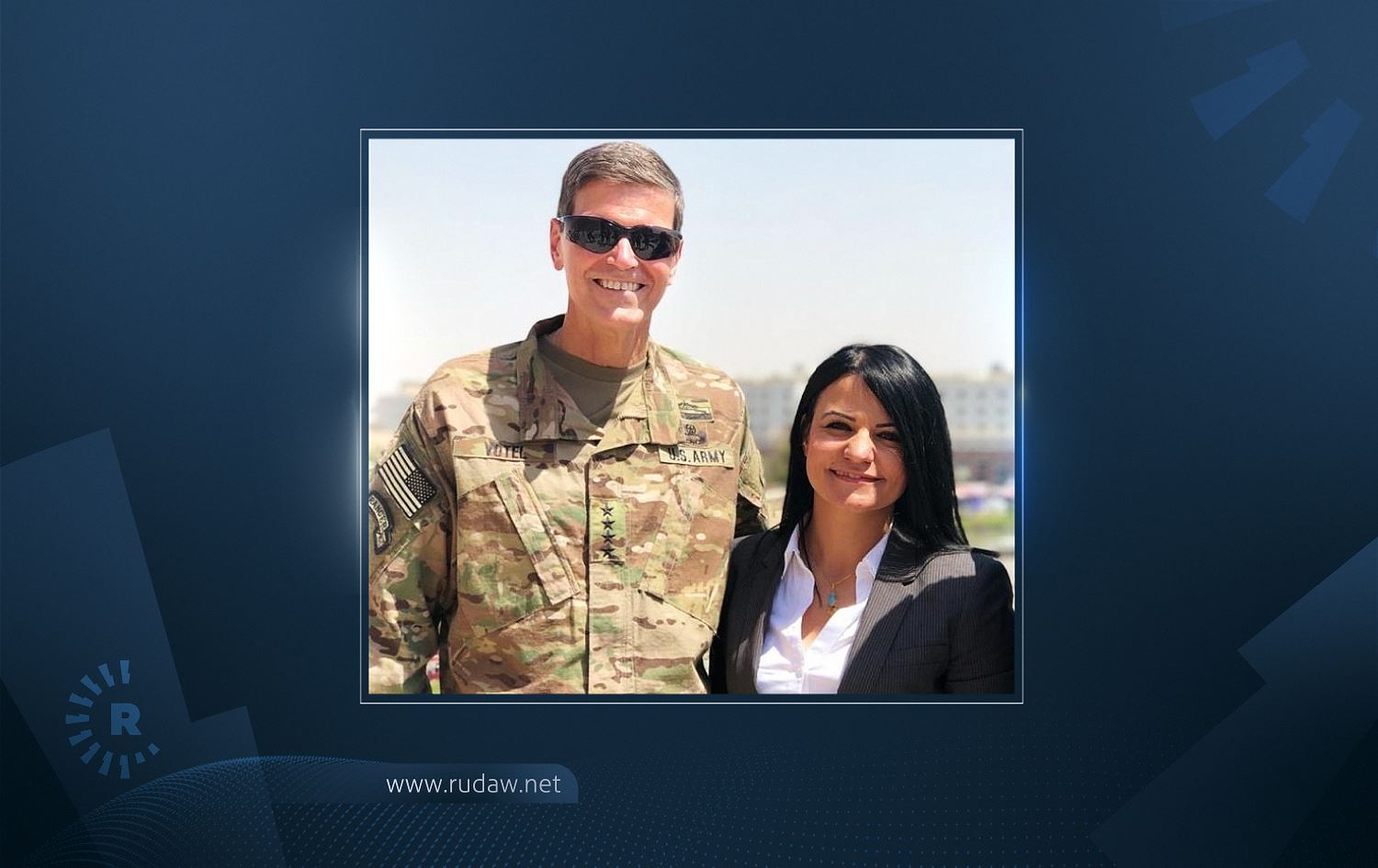
Tanya Aziz (right) with US General Joseph Votel in Erbil in February 2019. Photo via Tanya Aziz
Tanya Aziz, the Coalition Commanding General's special advisor for cultural affairs and politics, was recently awarded a medal for her contributions to the International Coalition against the Islamic State (ISIS).
Aziz is a “lion, majestic and magnificent, nothing can stop her from advocating for Kurdistan and people in this region, she is an expert in defense, diplomacy and counter-terrorism,” said former coalition spokesperson Col. Myles B Caggins III.
An American citizen from Sulaimani, Aziz has worked with the US Department of Defense for 18 years, and with the coalition for four years.
Speaking with Rudaw Radio on Monday, Aziz spoke of her feelings when she received the medal, as well as her experience working with the coalition for the past four years.
She says she was also proud to have worked with the US Department of Justice from 2004 to 2008 to help document the atrocities of Saddam Hussein regime.
Rudaw: You were an advisor to the international coalition for cultural and political affairs and you are from the region. It might be a little bit difficult given that there are different ethnic and religious groups. How did you manage to do this work?
Aziz: As a matter of fact, I have been working with the US Department of Defense for 18 years now. This is my work. I am an expert in political, diplomatic, cultural and strategy affairs of the region particularly Iraq, and of Kurdish issues in Iraq and Syria and the four parts of Kurdistan.
What was the advice that you gave the coalition, especially concerning Kurds? This is delicate given that many other ethnic groups live in the region.
Definitely, it is all contingent upon expertise on the nature of the groups living in the region especially when it is related to Kurds, because there are other religious groups and ethnicities living among the Kurds. It is a little bit difficult for foreigners to understand it. So, the advice given was mainly about the cultural side, and the religious differences between Kurds and others. Advice is also given about political subjects and the political situation of Kurds in the past and at recent times as well as the history of Kurds, because whenever a problem comes up, history is followed to deal with the issue and find the best possible solution.
There is long-lasting political rivalry in the region and there are many different political groups among Kurds themselves. As a political advisor, in addition to being a cultural advisor, how challenging was this for you to offer balanced advice?
There are always objections when it comes to creating harmony. As an advisor who worked with the commander-in-chief of the coalition, a coalition which was made up of 77 countries, I faced these objections as well. You should always be ready to expect any undesirable political event to happen, be it a domestic or external problem. Therefore, whenever I speak with my colleagues or any Kurd, I am trying to create harmony and unanimity, because this makes everyone's job very easy. I have one to two times faced such situations. When you want to make a proposal, some unpleasant political events rise up creating issues in the way of your work. So, this needs plenty of work and time to persuade those you advise about the realities on the ground.
As you stated, you have been working with the US Department of Defense for a long time now. In general, what is your work like with them? Did your work change during the fight against the Islamic State?
Working during Daesh (ISIS) was definitely quite different. To me, the rise of Daesh was quite expected, because I have been well aware of the movement of all the militant groups for a long time now, during the time that I have been working with the US Department of Defense. The most effective period of time for me during my work with the DoD was the last four years when I worked with the coalition, and from 2004 to 2008 when I worked simultaneously with the DoD and the US Department of Justice to help document Saddam Hussein's atrocities. I worked as an advisor for one of the international judges. This is the biggest source of pride for me, as a Kurdish girl who in 2004, managed to become the first to sit in a court with Saddam Hussein. It was something absolutely very unexpected. I remember the day Saddam received his verdict, the first person I called was my late father, may he rest in peace. I cried out and told my father "Dad, he was sentenced." This will remain a great source of pride of me.
I would like you to tell me about the moment you received the medal.
It was a pleasant and unpleasant feeling, because I was unaware that I would receive the medal during the press conference. Receiving the medal, and [attending] the farewell press conference for Myles Caggins, the coalition spokesman, made me sad. He was a close friend of mine. He was a very caring person. Myles will be one of those whose influence will remain for Kurds, for Iraq and for anyone Myles has worked with.
Translated by Zhelwan Z.Wali


Comments
Rudaw moderates all comments submitted on our website. We welcome comments which are relevant to the article and encourage further discussion about the issues that matter to you. We also welcome constructive criticism about Rudaw.
To be approved for publication, however, your comments must meet our community guidelines.
We will not tolerate the following: profanity, threats, personal attacks, vulgarity, abuse (such as sexism, racism, homophobia or xenophobia), or commercial or personal promotion.
Comments that do not meet our guidelines will be rejected. Comments are not edited – they are either approved or rejected.
Post a comment