


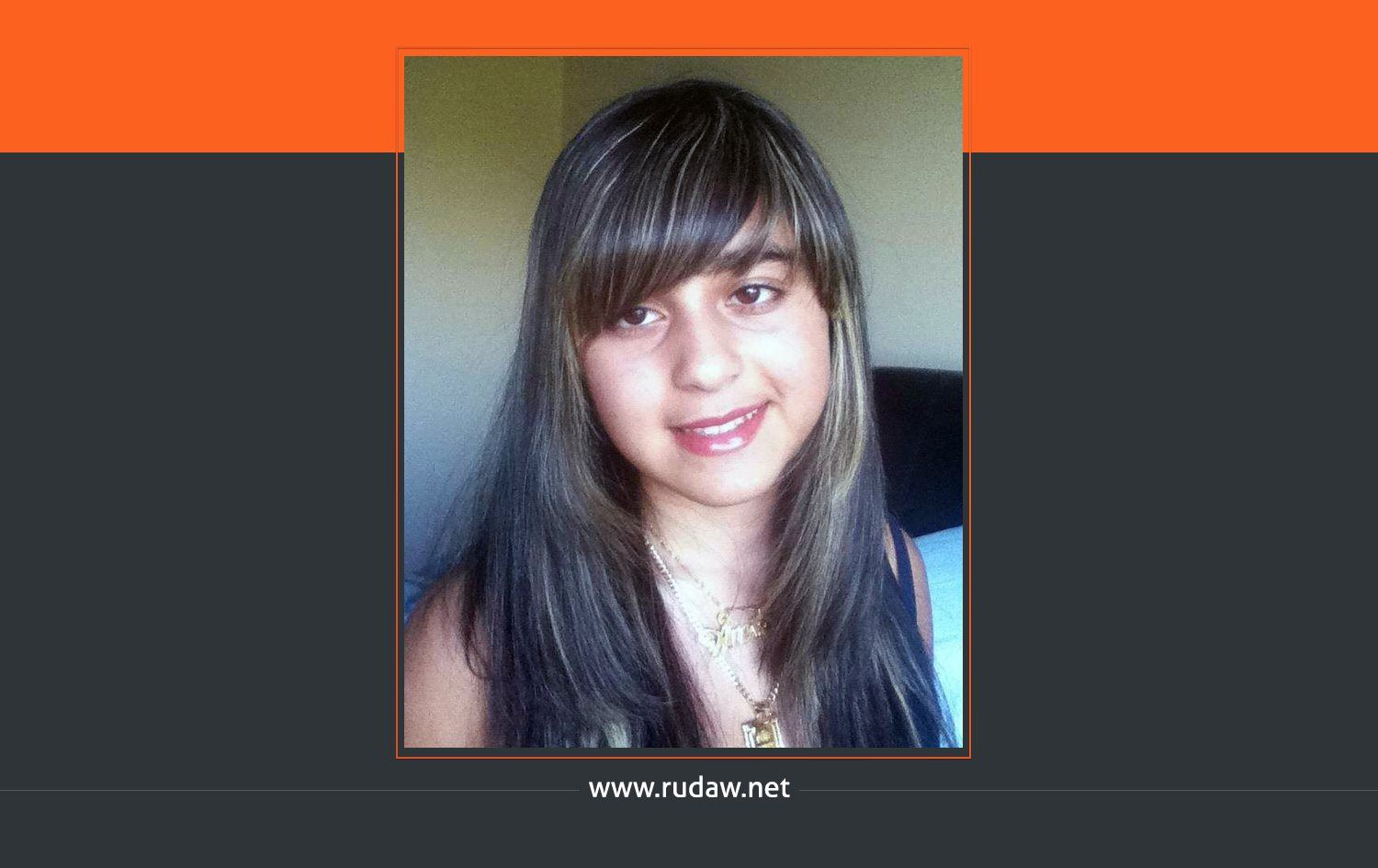
Avesta Alani, a Canadian-Kurdish woman, is legally blind but rejects the term “disability”, believing the word defines a person by their limitations.
In her new book, Diffability: The Liberation of Potential, published in April, Alani instead calls for a new terminology, replacing “disability” with “diffability” – different and able.
Born in the Kurdistan Region of Iraq in 1995 and fleeing with her family to Canada in ‘98, Alani was diagnosed with cone-rod dystrophy (CRD) when she was just eight years old.
“Essentially that leaves me with very low vision. My vision is 20/350,” Alani told Rudaw last week.
She refused to be held back by the condition, however, going on to become an advocate for young blind people.
“I found myself doing things just like any other, just a little differently,” she said.
Alani’s book has been well received in Canada and among Kurdish readers worldwide.
“The goal of this book is to attempt to begin a discussion and a movement to reform the conception of disability through language,” according to the book’s blurb on Amazon.com.
Interview by Rebwar Qassim
Rudaw: First of all thank you for this opportunity. We would like to hear more about you, like your early childhood, your family origin, and why your family decided to move to Canada.
Avesta Alani: My pleasure. My name is Avesta Alani, and I was born May, 1995, and I am from Kurdistan. My parents fled to Canada in 1998 because of the oppression of Saddam Hussein. In my younger years, I enjoyed reading, learning, and being active. It was at eight years old, after I had completed grade 2, that I had noticed some differences in my vision. I was diagnosed with cone-rod dystrophy before grade 3, and at the start of that school year I was legally blind. This was a big adjustment for me as a child because I did not know why suddenly I am not able to do the same things at school as I got used to the year before. My parents were new to Canada, and so I am sure it was a great adjustment for my father and mother as well.
If I said that I was always confident and an activist, that would not be the truth. For many years of my early experiences with vision loss, I was very timid talking about it, and would try to conceal it as much as I could, which is very hard to do, so it simply caused me a lot of grief. I also faced a lot of unfair treatment. I remember in grade 3 my teacher never made the standardized test accessible to me, and told me to mark whatever on the page because she didn’t care about my performance. I also never learned how to tell time with the other grade 3 students. I learned later on in high school where I taught myself. However, now, looking back, these early experiences are what give me the passion and motivation to be the best I can be.
Where in Kurdistan is your family from? Where do you live in Canada?
My mother’s side is from Kirkuk and my father’s side is from Qaladze. I have only one other lawyer in my family that I am aware of and it is my uncle from my mother’s side in Kirkuk. I am very excited to be a lawyer like him, and the first lawyer in my family with a law degree from another country. My family means the world to me, and so does my country. I was raised in Ottawa, Ontario, the capital city of Canada. That is where I completed my first university degree. Now I’ve grown and gone on my own to complete my law degree in Toronto, Ontario, the most populated city in Canada. I will remain in Toronto and will be practicing here. Toronto is a beautiful city for its multiculturalism. It is wonderful to me to learn from people all around the world, and to share my Kurdish culture with others from all around the world. Toronto is a testament that people of the world can live together, respect our origins, and learn from each other.
What is your “disability” (diffability)? How do you read and write?
I was diagnosed with cone-rod dystrophy. Essentially that leaves me with very low vision. My vision is 20/350, but it’s hard to understand from a number. Essentially, I cannot see distance well, I cannot see printed text because it’s almost always too small, and I cannot make out details. However, I most certainly read and write still. Together with today’s technology, and a strong will, I get things accomplished. I use technology on my laptop that zooms the screen several times larger, and it has the ability to read audio text when I need it to. I put labels on buttons in my home so that I can live independently. I use my other senses to compensate too; like smell when cooking, memory while learning directions, and hearing while reading. It’s made me a more adaptable, organized, thoughtful and driven person I think, and for that I am thankful.
“Diffability” has recently been published, in which you try to initiate a serious discussion concerning our conception of disability. From a personal perspective, how did you come up with the idea to tackle this issue?
My personal experiences really showed me that there were many things I was not given the opportunity to do due to the fact there was no faith that I could do them. My experience in grade 3 was my most profound memory, but it continued throughout my education. In grade 10 my French teacher had been very adamant about me not learning how to read and write French, and only speak it because of my vision. Granted, in Canada, you are mandated to take French throughout your education before that. I had been confident with my ability to perform well, so I had advocated this issue to the principal. I finished with a 98 percent, but more importantly, I think the teacher had learned from me as much as I learned from her. It was around then where I was finding myself advocating more and more for these issues. I adopted a personal philosophy that not only could I do something, but I could do it a lot better than would be expected. I found myself on the Chair of the National Youth Council for the Canadian National Institute for the Blind. I facilitated national talks, workshops, scholarship programs for young people, and fundraising. The principle of “diffability” was always there, growing as I was. Growing with my confidence. I found myself doing things just like any other, just a little differently. In my first post-secondary degree, I took a minor in philosophy with my honours program. Though we talked of the philosophy of women and race, “disability” was never a topic of discussion. So I asked myself, why do we take the notion of “disability” as such a given? Why do we not take a step back and ask, why do we lump all those who are different? And are we not all somewhat different? Why is there not an opportunity for individuality in the term “disability”? It was there where I began to nurture the idea.
When did you write “Diffability”? When did the first spark happen?
The idea crystallized during the last year of my honours degree. I was reading material by prominent philosophers and started pushing their ideas to places they had not gone before. Particularly “disability” issues. I had run it by my professor at the time who had encouraged me with my ideas. The summer after graduation and before law school I disciplined myself to write the first transcript of the book. I knew that law school and legal practice would not leave much room for my other passions, so I knew it was now or much later. After my first manuscript was completed, the process of the book took two years to complete. I started writing in 2017 and it was published in 2019.
From the title of the book, it is quite evident that you have issues with the way we name phenomena, as naming affects in the long run how we deal with them. Tell us more about how naming “disability” impacted our conception of it and how changing it would correct it?
“Disability” by definition means “no ability”. It does not leave room for degrees of ability. It does not leave room for individuality. For society, it gives the conception of a people who are defined by the things they are “not able” to do. For an individual, when they are told they are “disabled”, they are told they are “not able.” Now, we as “diffabled” can rise beyond it and prove to ourselves we can and prove to others we can. But why does every person with a “diffability” need to face that struggle from the bottom all over again for themselves? “Diffability” is not the be all and end all answer, but it gives room for individuality and by definition it just means “different” not “enabled”.
Apart from the linguistic barriers, what other obstacles do you see in the way of integrating people with diffabilties into society and how to tackle them?
Structurally, socially, economically, there are issues in play that make it more difficult to be different in ability. One topic I am passionate in is employment. In Canada, two thirds of people with vision loss do not have full-time employment. I don’t imagine there is a significant difference in many other countries towards improvement of that statistic. Personally, top it off with being a woman and a visible minority in Canada, and employment can become a potential threat. Nonetheless, I have found myself working for the largest law firm in Canada, living my dream, but I am not ignorant to the fact that two thirds of people with vision loss can’t even find a long-time job, let alone their dream one. I am the only person in my office, with over 500 employees, with a sensory diffability. I dedicate myself to being a mentor and leader in this field for making employers more accessible and more willing to give people of all abilities a fair opportunity.
What is your next major project?
For my professional career, I look forward to completing my articling to become a licensed lawyer of Ontario. I’m sure that would make my family very proud too. Beyond that, I also want to become a leader that law firms can access to help make their work more accessible for others. I would also love the opportunity to come back to Kurdistan. Maybe to share my experiences for anyone interested, but also to learn from others, as I am sure there is a wealth of incredible experiences to learn from.
What is your dream, both personally and for all “diffabled” people around the world?
They are essentially the same. For me and all those with all abilities to be treated with dignity and respect. To be given equal opportunity as everyone else to reach our potential. The direction of our lives should be governed by the efforts and merit we put into it, not by presupposed presumptions and social barriers. I think at the end of the day, everyone’s dream is similar, to be the masters of our own lives and identity.
You have many projects and workshops. Do you intend to limit them to Canada, or is your ambition to move beyond Canada’s borders?
The world is such a big and beautiful place with so many wonderful people; I would love to be able to interact with the world, sharing my story and hearing from others. I have an honours in international development and I have a legal specialization in international, comparative and transnational law. I would hope to one day find value in those on a global platform.
You are from a Kurdish family. Do you have any contact with Kurdistan and Kurdish people, especially “diffabled” people in Kurdistan?
I most certainly keep in touch with my family in Kurdistan. I very much follow the events and politics of the region, and try to involve myself as much as I can with the issues from Canada. I have not yet had the opportunity to do any projects or have direct contract with anyone diffabled from Kurdistan, but hope to. I was in Kurdistan around ten years ago, and I will never forget a blind young man who walked into a local pizza store, picked up a pizza and stumbled his way out. It was clear he was completely blind, and I wish I was more courageous and called out to him. He walked with no cane or assistance. What strikes me so much from that event is the way he walked with broad shoulders confidently. There are clearly many inspiring people in Kurdistan as well that I look forward to meeting.
How is the book being received?
It has been getting very good attention. For much of it I thank my Kurdish community around the world. In Canada it reached #1 in Medical Dictionaries, and has been in the top 3 for over a week now. One reader commented: “Diffability: The Liberation of Potential embodies a movement. The fundamental alteration of the conception of disability that Ms. Alani eloquently advocates for leaves one inspired to do more to push for the possibility of self-actualization for everyone. How the book is broken down into linguistic, philosophic, and sociological understandings of what disability entails bolsters the message incredibly. A must read!”
Do you have any projects in your mind that you might one day do in Kurdistan?
I think it would be wonderful for “Diffability: The Liberation of Potential” to be translated into Kurdish one day. I would love to facilitate a conference or workshop in Kurdistan for academics and those with diffabilities. Give people a forum to learn from one another and gain more perspective. I would also love to assist in creating a stronger bond between Canada and Kurdistan. As a Kurd, I know that Canada’s values of multiculturalism, equality, and tolerance are invaluable. As a Canadian, know the strength, perseverance, and passion of Kurds makes for Kurds to be a strong and loyal friend.
How do you feel about Kurdistan and your Kurdish roots?
We are the most driven, passionate, persevering, and warm hearted people. I try to personify many of the Kurdish values of what makes us a community in my everyday life. Being given a bad hand does not mean you must yield to it; Kurds do not, I am also a Kurd, so I will not either. The men and women of Kurdistan are my heroes and role models. The children of Kurdistan are my motivation. I hope to one day become an asset to Kurdistan and the Kurdish community. Long live Kurds, long live Kurdistan.


Comments
Rudaw moderates all comments submitted on our website. We welcome comments which are relevant to the article and encourage further discussion about the issues that matter to you. We also welcome constructive criticism about Rudaw.
To be approved for publication, however, your comments must meet our community guidelines.
We will not tolerate the following: profanity, threats, personal attacks, vulgarity, abuse (such as sexism, racism, homophobia or xenophobia), or commercial or personal promotion.
Comments that do not meet our guidelines will be rejected. Comments are not edited – they are either approved or rejected.
Post a comment