


Interview

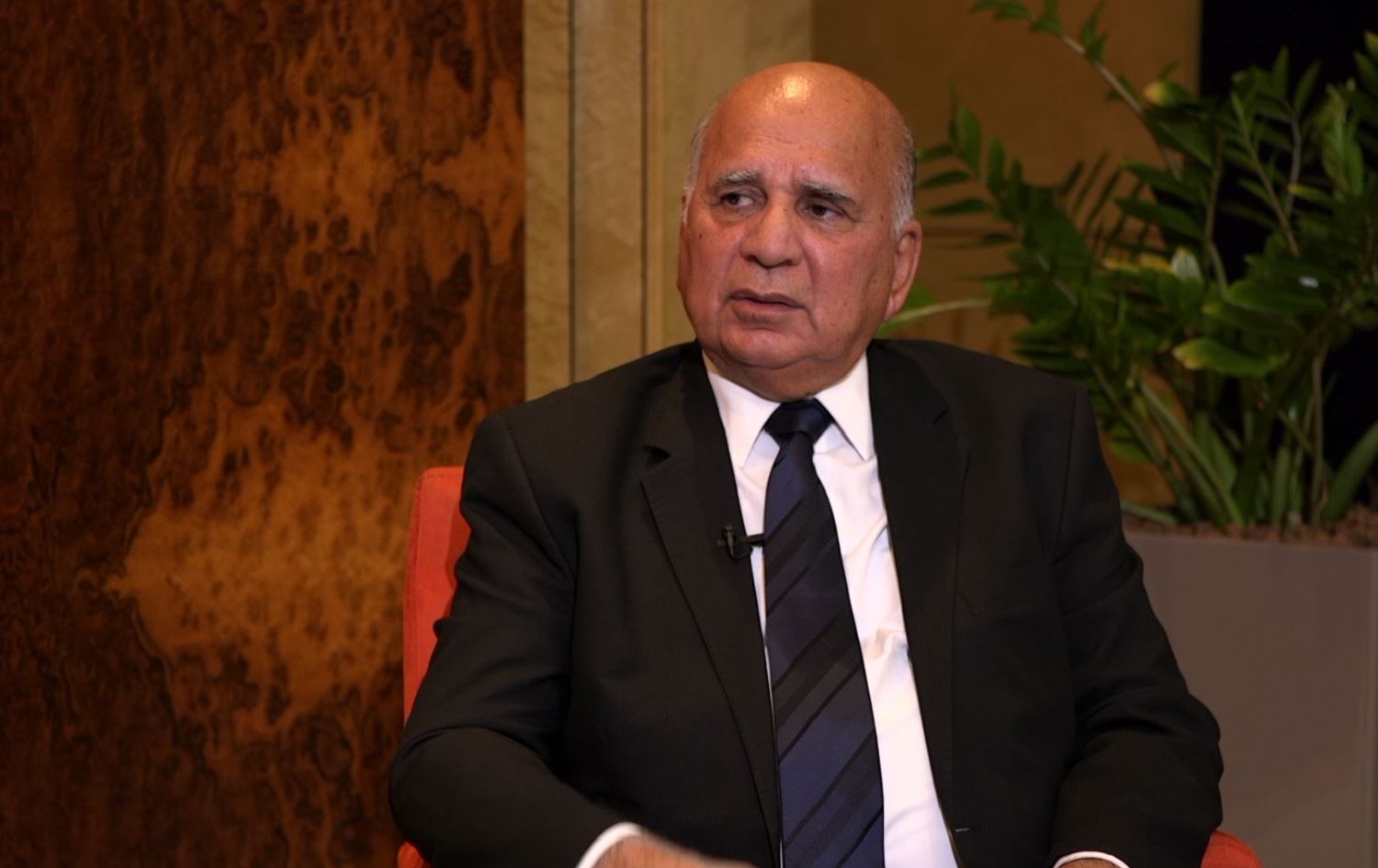
Iraqi Foreign Minister Fuad Hussein speaks to Rudaw in an interview in Luxembourg on June 20, 2021. Photo: Rudaw
Iraq’s foreign relations are at a new stage with Baghdad playing a mediatory role in the Middle East, Foreign Minister Fuad Hussein told Rudaw in an interview in Luxembourg on June 20, 2021, where he was attending a meeting of European Union foreign ministers.
Iraq’s neighbors are turning to dialogue instead of talk of war, “and Baghdad played a role in that. Baghdad brought these countries together,” said Hussein.
“We tried to mediate between a lot of the neighboring countries and great work has been done recently. We were successful in that process,” he said.
The mediatory role came about by necessity since external issues play a significant role in Iraq’s domestic affairs. Using the example of tensions between Iran and the United States, Hussein noted the problems between those states found their way onto Iraqi soil and into Iraq’s parliament.
“It’s very hard to solve Iraq’s problems if those of neighboring countries are not solved,” he said.
With respect to Turkey and its military operations against the Kurdistan Workers’ Party (PKK), Hussein said Baghdad must have dialogue with Ankara. “We have no other way,” he said, noting important economic ties.
Iraq is also looking to strengthen its relations with China. “Most of Iraq’s oil goes into the Chinese and Indian markets,” said Hussein. “Iraq can’t concentrate all of its foreign ties with the Americans and ignore China, Russia, or other states.”
The following is a translation of Rudaw’s interview with Fuad Hussein.
Alla Shally: Let’s start in Turkey. You had a meeting with the foreign ministers of Libya and Azerbaijan, telling them about Iraq’s readiness to help those countries and solve their issues. Why do you want to play this new role?
Fuad Hussein: It’s true I was in Turkey at the Diplomacy Forum, but I met a lot of people, ministers from a number of countries who we held meetings with, among them Iran and neighboring countries, the Gulf States as well. Generally, the diplomatic role of Iraq is at a new stage. One – they are trying to create better ties with neighboring countries. The first aim is to have good ties with Iraq’s neighboring countries. And those relations with a neighboring country are not at the expense of another country, but a balance should be created, because if there is balance, it’s in Iraq’s advantage and to the benefit of the people of Iraq.
The second point is, Iraq and its surroundings have scores of problems, internal problems, the problems of their surroundings. Work needs to be done on those issues in a diplomatic way. The only way is dialogue. That’s why we have made movement on this principle. We started with our neighboring countries first and we discussed the problems within that neighboring country. In our opinion, we’ve reached another stage, because the countries that had internal problems and are Iraq’s neighbors, they would often times bring up war, now they are turning to dialogue. And Baghdad played a role in that. Baghdad brought these countries together. Some might ask, what does solving these issues have to do with you?
I wanted to ask that. Why do you want to play this new role?
After looking into Iraq’s internal situation, we saw a lot of Iraq’s internal problems were related to the issues of its neighboring countries. It’s very hard to solve Iraq’s problems if those of neighboring countries are not solved. I will perform my duties as a foreign minister, I have started from the outside, but other friends have also started from within, and we can see that there is an external influence on the internal affairs.
Let me give you an example. There were big problems between Tehran and Washington during Trump’s era. The war and conflict was on Iraq’s land. Those two states were fighting, but the war was brought into Iraq, and the issue went into the Iraqi parliament, into Iraq’s society. This means the war between other states is not only in their countries, but it also becomes a part of our problem. This is the Foreign Ministry’s new policy. And we will make moves in light of this policy.
It was said that you played an important role in bringing Saudi Arabia and Iran together. How did that happen? What was the result?
Iraq tried. When Adil Abdul Mahdi was the prime minister, he mediated between Saudi and Iran, but in fact, these efforts did not succeed. The problems, on the contrary, were increasing. When we started this job, we went to Tehran. We met with Iranian officials and had lengthy talks about this. Then we went to Saudi’s Riyadh and we talked with them too. There was naturally a change and that change had to do with America. Trump was not in power anymore. In my opinion that was an asset. That’s why both sides decided to meet and, at the beginning, they were meeting in secret in Baghdad with intelligence work, but the process is still ongoing – the process of meeting and dialogue. But it’s not just those two countries. We tried to mediate between a lot of the neighboring countries and great work has been done recently. We were successful in that process, praise be to God, and the prime minister was aware of every step of the process.
As the foreign minister of Iraq, did you deliver any message to Turkey regarding Turkey’s latest attacks on the Kurdistan Region? What is the Iraqi government’s position on this?
When I went to Turkey, I went to a congress, I didn’t go for a bilateral relation meeting. I did see Turkey’s prime minister, but not in a meeting because I was busy with the congress and I was busy with meeting other state ministers. I was also a part of a panel.
Iraq’s position on the problem between Turkey and Iraq is: one – we have told the Turks everything needs to be solved with dialogue, because the Iraqis and the people of Iraq of all sides have been at war for 50 years, either civil war or war of their neighbors. Iraq was either fighting with itself or fighting its neighbors. Iraqis need peace, they need tranquility. This situation needs to be dealt with differently with neighboring countries. Even if there are some problems, and there are problems on all sides, there needs to be a place for dialogue. And it won’t be solved today. It might be postponed for tomorrow. Some things you talk about today, some you let simmer down.
After 2003, when the Saddam regime fell and other states came in and stayed in Iraq, both world states and neighboring states have made space for their influence in Iraq and that will not be removed easily. This needs work. It needs internal work, but it also needs work with neighboring countries. These are being discussed with Turkey. We have a constitution and we are committed to the Iraqi constitution. Attacks on another country from Iraq’s land, any country, this is part of the constitution, but also another country can’t, in a unilateral decision, enter Iraq. We are using this equation in our talks with neighboring countries, among them Turkey. We are using this equation.
What is Turkey’s response? Because Turkey’s attacks are ongoing.
I am saying, we also have internal problems. There is an organization inside Iraq that attacks another state. The constitution doesn’t allow that. But anyways, whatever their response is, we need to continue talks, because we have no other way. How are you going to solve it? How will you solve this problem? Our ties with Turkey are not only military and security ties, we have a broad relationship. Now, our commercial ties with Turkey are above $17 billion. This is huge, it’s a lot.
Let’s look at Iraq and Iran relations. As the foreign minister of Iraq, what do you expect from Iran’s new president?
The election process is an internal process and we congratulate the Iranian people that the process finished smoothly. Now there’s a new president of the republic and this is their choice, it’s the Iranian people’s choice. Let’s see as the government forms, the new government will be formed at the beginning of August, see how their new policies are in light of that. But to mention briefly, the relationship between Iraq and Iran is old. The ties, like with all our other neighbors, have two basic principles, one is geography and the other is history. You can’t change geography. They’re your neighbors. History, whatever happened, happened. There is good and bad in it. There are also other matters as well – there is culture, economy, assistance. These are accounted for in ties between two states.
Iraq has the longest border with Iran. There are also deep and a lot of connections with Iran, but there are also some things that are being discussed with the Iranian side all the time. The fundamental thing is that political and strategic decisions should be in Iraqi hands. Decisions for Iraq should be made in Baghdad, not in another country. This is fundamental to our diplomatic work. We have talked about this the Iranian side. We wish the new government success in its new program. We are now waiting for his program to see what his plan is, internally and externally.
Do you believe Iran will let Iraq make its internal decisions independently?
Iraq is a state and when we talk about a state, it means Iraq needs to be independent and its decisions should be in its hands. This is a fact. Neighboring countries should deal with Iraq as a country, not as a small garden in their house. Iraq is no country’s garden. Iraq is the garden of its own people and Iraq is an independent state and should make its decisions in its independent framework.
But in relations with neighboring countries and governments, you take other people into account in your decisions. When you make a decision, you should take your neighbor into account. The current Iraq cares a lot for its neighbors and wants to have good ties with its neighbors. The security of this region should be protected by the people of this region. In the end, you don’t bring in calm and security from elsewhere, you don’t go buy it at the bazaar. It should be with you. The people of Iraq, Iran, Turkey, Kuwait, Saudi, Jordan, those regions, Iraq’s neighbors should protect the security of the region.
There is news that Iraq played a role in reviving the Iranian nuclear deal. Does Iraq have a role in that? And what is the role?
No. When the government and the new administration came to power in Washington, we both had ties with Washington, with the persons who are now in power. Most of them were in Baghdad for years. When Biden was the vice president, Iraq’s file was in his hands for eight years. So all of them are aware of Iraq’s situation and they have close friendships with Iraqi officials. When they came to power, there naturally were contacts with the American side and one of the topics discussed with the American side was how to do a deal with Iran.
At the same time, we visited Tehran a number of times and we discussed this with Iranian officials – how do they deal with America. Why? As I mentioned, the problem between Washington and Tehran became Baghdad’s problem, the fight was partly in Iraq. Why? It was in our advantage that those two sides will start talks. Naturally there are points of contention on both sides. But we relayed some of the messages between the two sides before the meeting. I will not say this was why they met, but to a point, we have relayed some important messages between both sides.
If we look at world politics, we can see the world is moving into two to three camps. They say there is America’s side and its allies, there is China’s side and its counterparts, they say there is also a middle ground. On which side does Iraq see itself in the future?
It’s important for Iraq to have good ties with neighboring countries. But on the world level – like how I mentioned balanced relations with neighboring countries – on the global level it should also have a balance. Iraq can’t concentrate all of its foreign ties with the Americans and ignore China, Russia, or other states. For your information, China at times has been the biggest state buying Iraq’s oil, meaning Iraq’s oil will enter China’s market. Most of Iraq’s oil goes into the Chinese and Indian markets. China is important for Iraq and commercial ties between Iraq and China, before corona, reached up to $20 billion. Chinese companies have roles in Iraq.
Ties with China are important for Iraq, but ties with America are also important. Iraq does not stick to one side against the other, but looks wherever benefits lie. And it’s in Iraq’s advantage to have good ties with Russia, with China, but also with America.
What is the importance of Europe and its member states for Iraq? Your Excellency will participate in the foreign ministers’ meeting of the European Union. Why is it important for them that you are present in Luxemburg?
The first question is why is Europe important to us, to Iraq. First, geographically Europe is close to Iraq. Second, Europe has a lot of what they call industrial, commercial, intellectual knowledge, and Europe’s security is close to Iraq’s security, because it’s close to the area. And Europe has a history in the region, if we talk about the European Union and before when Britain was a member of the European Union. Iraq was under British power for a period of time. France was in Syria. The Europeans understand, generally, the situation of the Middle East more, because of the history, because of geography, because of the benefits. So Europe is very important.
Why is Iraq important for the Europeans? You should ask them that. But, in my opinion, it’s for the other reasons I talked about. There are other points as well, they are strategic, oil, the case of Iraq if it goes towards democracy and becomes more open. It has become a model in the region and Europeans like that. If Iraq is to become a model, that means it needs help and it needs to gain help from democratic states so that it becomes that model. The democratic states that have experience and are close are the Europeans.
In the technological field, Europe’s technology is important. Iraq’s economy has been torn down, its infrastructure is all gone. If you want to rebuild, you need companies, you need technology. Europeans have that. Other states too, but Europeans have that. Hence, Iraq is also important for Europe.
As you know, the EU gives Iraq a lot of humanitarian support and they have many projects inside Iraq.
Yes, yes. There is an agreement, an assistance and cooperation agreement between Iraq and the European Union. They invited me to their meeting. This is an important thing, to tell you the truth, because 27 foreign ministers will sit down tomorrow. A part of their agenda is about Iraq. They have asked me to talk about that situation. We will also talk about relations between Iraq and the European Union.
If we look into the Iraqi diaspora, it’s a big thing. What is the Iraqi government’s agenda for the diaspora?
The role of the diaspora is very important to be honest. Because Iraq has been busy with internal problems, it hasn’t paid much attention to the situation of the diaspora in the western countries. They can do a lot. Some of the lobbying in western societies, the members and leaders of the diaspora can do that, or their organizations.
There is a distance between the Iraqi government and – and it’s not just today, it goes back to 2003 until now – with the diaspora. This is unfortunate. I hope in the future we can look into this matter more, how we can help each other. The Iraqi diaspora can play a role both in Iraq and it can also become a bridge between the country that they live in – because they know the language, they know the culture of the language, they might have capital, they have received their knowledge and education there – they can play a big role in the Iraqi community in building both the economy as well as a democratic system, because they are experiencing democracy in practice in Europe.
Kurds have frequently complained that in Iraqi embassies and consulates, they are not receiving assistance. Are you aware of these problems? If it exists, what do Kurds need to do?
I don’t know about the complaints, because generally there are complaints. But what are the complaints? Does it have to do with documents, or does it has to do other things? If I know what the matter is, it needs to be solved and we will solve it.
If they complain, write out your complaints so that we are aware. For example, in which country is that complaint, where, what is the matter, so that we can be aware. I have been abroad before. I know what the diaspora’s problems are, but not everything that is being said is true. Let them write it us so that we know what is going on. If we receive it, I will thank them. We will do everything in our ability to solve it. If we were incapable of solving it, we will answer them and tell them we could not solve it.
Should they write to you?
Write it to the foreign ministry, to the embassies. Write to the embassies. Also, aren’t there Regional representatives in those countries? Write to the Regional representatives. Turn it into a report so that it goes back to the foreign ministry through the Region.
That is my next question. According to the constitution, there should be a Kurdistan Region representative in all Iraqi embassies, but there aren’t any. Why?
That article is in the constitution, but says it should be organized by law. The law hasn’t been organized yet. The law does not exist yet.
Why? Most of Iraq’s foreign ministers so far have been Kurds.
There is an article in the constitution that links the Region to the other provinces and back in the day I think that was a problem, as in if you have one for the Region you need to have it for every other province, the interpretation was like that. It’s not a necessarily correct interpretation. In the future, the Region and the Kurdish parties should work on that, because this is the parliament’s job, not the foreign ministry. It’s the parliament’s job to propose a law in the parliament. When there is a law, it will be implemented. If there is no law, there is no implementation. A law is needed.
Your Excellency is a diaspora Kurd and Dutch.
We were. We were a diaspora Kurd. I used to live in the Netherlands.
How do you see the Kurdish diaspora? What should diaspora Kurds do?
You know, diaspora has negative sides and positive sides. The negative side is you will be away from the country, family, its mentality. But on the positive side, you learn a lot of things, whether its studying in those countries – I am talking about diaspora in Europe – studying, work, language, you will learn all of these. Besides all that, you will make broad connections. If you are active in the diaspora, you will make broad connections, whether it’s economic connections, political connections, social connections, with organizations. This is all something you can use for your nation and your country. The diaspora can play a huge role.
But how do you see the diaspora movement these days?
It’s hard for me to evaluate the diaspora, because in our time it was different. We were all political and we went there and immediately started political activism and we continued it. Now, the diaspora doesn’t have a political background. Besides, back then, the first generation diaspora moved from the country, but the second and third generation didn’t move from the country, they were born there. The diaspora matters, their issues and their qualities are different. There is a difference between those who came from the country, political refugees, those who went there to make a living, those who were born there are different, those who are intellectuals and non-intellectuals. This all exists.
With all that, I am saying if there is organization between the diaspora, Iraqis and Kurds, if they can work, they can serve themselves, serve their people in Iraq and serve their families as well. The diaspora is important. They will bring in new ideas, various educations, various languages, various mindsets. This is important. I have a lot of respect for those in the diaspora and I have more respect for those who are always trying to both build themselves and their lives, and be of service to their countries and their nations.
Last time you nominated yourself for the position of Iraqi president. Do you still have that ambition?
No. You know, I am almost 72 years old now. It’s time to rest. There are other people, God willing.
So you don’t want to nominate yourself this time?
The decision-makers in this matter are the parties at the end of the day and I am always a person ready to fight. If they tell me this is good for the people, for the nation, for the country, for parties, then okay. But if you ask me, I would say it’s enough, because I am at an age when I need rest. There are other people. Let other people come forward.
Do you want to stay in Baghdad or do you want to return to Kurdistan after the elections?
No. You know what, Baghdad is very important. Baghdad is important as the capital of Iraq. But if we talk from Kurdistan’s standpoint, Baghdad is important for Kurdistan. The Kurdish political parties should send most of their cadres and the best of their cadres to Baghdad. Baghdad is not just ministers and the president. You can play a massively important role in parliament. Baghdad is the economy, it’s the social matter, the intellectual matter, and it’s the media. That’s why if I stay in Baghdad – if I leave my post I won’t stop fighting. If I leave my post, I won’t leave politics. If I leave my post, I won’t leave the ideology. If I leave my post, I won’t leave writing. And if I can do all of those, I will do them in Baghdad.
Iraq’s neighbors are turning to dialogue instead of talk of war, “and Baghdad played a role in that. Baghdad brought these countries together,” said Hussein.
“We tried to mediate between a lot of the neighboring countries and great work has been done recently. We were successful in that process,” he said.
The mediatory role came about by necessity since external issues play a significant role in Iraq’s domestic affairs. Using the example of tensions between Iran and the United States, Hussein noted the problems between those states found their way onto Iraqi soil and into Iraq’s parliament.
“It’s very hard to solve Iraq’s problems if those of neighboring countries are not solved,” he said.
With respect to Turkey and its military operations against the Kurdistan Workers’ Party (PKK), Hussein said Baghdad must have dialogue with Ankara. “We have no other way,” he said, noting important economic ties.
Iraq is also looking to strengthen its relations with China. “Most of Iraq’s oil goes into the Chinese and Indian markets,” said Hussein. “Iraq can’t concentrate all of its foreign ties with the Americans and ignore China, Russia, or other states.”
The following is a translation of Rudaw’s interview with Fuad Hussein.
Alla Shally: Let’s start in Turkey. You had a meeting with the foreign ministers of Libya and Azerbaijan, telling them about Iraq’s readiness to help those countries and solve their issues. Why do you want to play this new role?
Fuad Hussein: It’s true I was in Turkey at the Diplomacy Forum, but I met a lot of people, ministers from a number of countries who we held meetings with, among them Iran and neighboring countries, the Gulf States as well. Generally, the diplomatic role of Iraq is at a new stage. One – they are trying to create better ties with neighboring countries. The first aim is to have good ties with Iraq’s neighboring countries. And those relations with a neighboring country are not at the expense of another country, but a balance should be created, because if there is balance, it’s in Iraq’s advantage and to the benefit of the people of Iraq.
The second point is, Iraq and its surroundings have scores of problems, internal problems, the problems of their surroundings. Work needs to be done on those issues in a diplomatic way. The only way is dialogue. That’s why we have made movement on this principle. We started with our neighboring countries first and we discussed the problems within that neighboring country. In our opinion, we’ve reached another stage, because the countries that had internal problems and are Iraq’s neighbors, they would often times bring up war, now they are turning to dialogue. And Baghdad played a role in that. Baghdad brought these countries together. Some might ask, what does solving these issues have to do with you?
I wanted to ask that. Why do you want to play this new role?
After looking into Iraq’s internal situation, we saw a lot of Iraq’s internal problems were related to the issues of its neighboring countries. It’s very hard to solve Iraq’s problems if those of neighboring countries are not solved. I will perform my duties as a foreign minister, I have started from the outside, but other friends have also started from within, and we can see that there is an external influence on the internal affairs.
Let me give you an example. There were big problems between Tehran and Washington during Trump’s era. The war and conflict was on Iraq’s land. Those two states were fighting, but the war was brought into Iraq, and the issue went into the Iraqi parliament, into Iraq’s society. This means the war between other states is not only in their countries, but it also becomes a part of our problem. This is the Foreign Ministry’s new policy. And we will make moves in light of this policy.
It was said that you played an important role in bringing Saudi Arabia and Iran together. How did that happen? What was the result?
Iraq tried. When Adil Abdul Mahdi was the prime minister, he mediated between Saudi and Iran, but in fact, these efforts did not succeed. The problems, on the contrary, were increasing. When we started this job, we went to Tehran. We met with Iranian officials and had lengthy talks about this. Then we went to Saudi’s Riyadh and we talked with them too. There was naturally a change and that change had to do with America. Trump was not in power anymore. In my opinion that was an asset. That’s why both sides decided to meet and, at the beginning, they were meeting in secret in Baghdad with intelligence work, but the process is still ongoing – the process of meeting and dialogue. But it’s not just those two countries. We tried to mediate between a lot of the neighboring countries and great work has been done recently. We were successful in that process, praise be to God, and the prime minister was aware of every step of the process.
As the foreign minister of Iraq, did you deliver any message to Turkey regarding Turkey’s latest attacks on the Kurdistan Region? What is the Iraqi government’s position on this?
When I went to Turkey, I went to a congress, I didn’t go for a bilateral relation meeting. I did see Turkey’s prime minister, but not in a meeting because I was busy with the congress and I was busy with meeting other state ministers. I was also a part of a panel.
Iraq’s position on the problem between Turkey and Iraq is: one – we have told the Turks everything needs to be solved with dialogue, because the Iraqis and the people of Iraq of all sides have been at war for 50 years, either civil war or war of their neighbors. Iraq was either fighting with itself or fighting its neighbors. Iraqis need peace, they need tranquility. This situation needs to be dealt with differently with neighboring countries. Even if there are some problems, and there are problems on all sides, there needs to be a place for dialogue. And it won’t be solved today. It might be postponed for tomorrow. Some things you talk about today, some you let simmer down.
After 2003, when the Saddam regime fell and other states came in and stayed in Iraq, both world states and neighboring states have made space for their influence in Iraq and that will not be removed easily. This needs work. It needs internal work, but it also needs work with neighboring countries. These are being discussed with Turkey. We have a constitution and we are committed to the Iraqi constitution. Attacks on another country from Iraq’s land, any country, this is part of the constitution, but also another country can’t, in a unilateral decision, enter Iraq. We are using this equation in our talks with neighboring countries, among them Turkey. We are using this equation.
What is Turkey’s response? Because Turkey’s attacks are ongoing.
I am saying, we also have internal problems. There is an organization inside Iraq that attacks another state. The constitution doesn’t allow that. But anyways, whatever their response is, we need to continue talks, because we have no other way. How are you going to solve it? How will you solve this problem? Our ties with Turkey are not only military and security ties, we have a broad relationship. Now, our commercial ties with Turkey are above $17 billion. This is huge, it’s a lot.
Let’s look at Iraq and Iran relations. As the foreign minister of Iraq, what do you expect from Iran’s new president?
The election process is an internal process and we congratulate the Iranian people that the process finished smoothly. Now there’s a new president of the republic and this is their choice, it’s the Iranian people’s choice. Let’s see as the government forms, the new government will be formed at the beginning of August, see how their new policies are in light of that. But to mention briefly, the relationship between Iraq and Iran is old. The ties, like with all our other neighbors, have two basic principles, one is geography and the other is history. You can’t change geography. They’re your neighbors. History, whatever happened, happened. There is good and bad in it. There are also other matters as well – there is culture, economy, assistance. These are accounted for in ties between two states.
Iraq has the longest border with Iran. There are also deep and a lot of connections with Iran, but there are also some things that are being discussed with the Iranian side all the time. The fundamental thing is that political and strategic decisions should be in Iraqi hands. Decisions for Iraq should be made in Baghdad, not in another country. This is fundamental to our diplomatic work. We have talked about this the Iranian side. We wish the new government success in its new program. We are now waiting for his program to see what his plan is, internally and externally.
Do you believe Iran will let Iraq make its internal decisions independently?
Iraq is a state and when we talk about a state, it means Iraq needs to be independent and its decisions should be in its hands. This is a fact. Neighboring countries should deal with Iraq as a country, not as a small garden in their house. Iraq is no country’s garden. Iraq is the garden of its own people and Iraq is an independent state and should make its decisions in its independent framework.
But in relations with neighboring countries and governments, you take other people into account in your decisions. When you make a decision, you should take your neighbor into account. The current Iraq cares a lot for its neighbors and wants to have good ties with its neighbors. The security of this region should be protected by the people of this region. In the end, you don’t bring in calm and security from elsewhere, you don’t go buy it at the bazaar. It should be with you. The people of Iraq, Iran, Turkey, Kuwait, Saudi, Jordan, those regions, Iraq’s neighbors should protect the security of the region.
There is news that Iraq played a role in reviving the Iranian nuclear deal. Does Iraq have a role in that? And what is the role?
No. When the government and the new administration came to power in Washington, we both had ties with Washington, with the persons who are now in power. Most of them were in Baghdad for years. When Biden was the vice president, Iraq’s file was in his hands for eight years. So all of them are aware of Iraq’s situation and they have close friendships with Iraqi officials. When they came to power, there naturally were contacts with the American side and one of the topics discussed with the American side was how to do a deal with Iran.
At the same time, we visited Tehran a number of times and we discussed this with Iranian officials – how do they deal with America. Why? As I mentioned, the problem between Washington and Tehran became Baghdad’s problem, the fight was partly in Iraq. Why? It was in our advantage that those two sides will start talks. Naturally there are points of contention on both sides. But we relayed some of the messages between the two sides before the meeting. I will not say this was why they met, but to a point, we have relayed some important messages between both sides.
If we look at world politics, we can see the world is moving into two to three camps. They say there is America’s side and its allies, there is China’s side and its counterparts, they say there is also a middle ground. On which side does Iraq see itself in the future?
It’s important for Iraq to have good ties with neighboring countries. But on the world level – like how I mentioned balanced relations with neighboring countries – on the global level it should also have a balance. Iraq can’t concentrate all of its foreign ties with the Americans and ignore China, Russia, or other states. For your information, China at times has been the biggest state buying Iraq’s oil, meaning Iraq’s oil will enter China’s market. Most of Iraq’s oil goes into the Chinese and Indian markets. China is important for Iraq and commercial ties between Iraq and China, before corona, reached up to $20 billion. Chinese companies have roles in Iraq.
Ties with China are important for Iraq, but ties with America are also important. Iraq does not stick to one side against the other, but looks wherever benefits lie. And it’s in Iraq’s advantage to have good ties with Russia, with China, but also with America.
What is the importance of Europe and its member states for Iraq? Your Excellency will participate in the foreign ministers’ meeting of the European Union. Why is it important for them that you are present in Luxemburg?
The first question is why is Europe important to us, to Iraq. First, geographically Europe is close to Iraq. Second, Europe has a lot of what they call industrial, commercial, intellectual knowledge, and Europe’s security is close to Iraq’s security, because it’s close to the area. And Europe has a history in the region, if we talk about the European Union and before when Britain was a member of the European Union. Iraq was under British power for a period of time. France was in Syria. The Europeans understand, generally, the situation of the Middle East more, because of the history, because of geography, because of the benefits. So Europe is very important.
Why is Iraq important for the Europeans? You should ask them that. But, in my opinion, it’s for the other reasons I talked about. There are other points as well, they are strategic, oil, the case of Iraq if it goes towards democracy and becomes more open. It has become a model in the region and Europeans like that. If Iraq is to become a model, that means it needs help and it needs to gain help from democratic states so that it becomes that model. The democratic states that have experience and are close are the Europeans.
In the technological field, Europe’s technology is important. Iraq’s economy has been torn down, its infrastructure is all gone. If you want to rebuild, you need companies, you need technology. Europeans have that. Other states too, but Europeans have that. Hence, Iraq is also important for Europe.
As you know, the EU gives Iraq a lot of humanitarian support and they have many projects inside Iraq.
Yes, yes. There is an agreement, an assistance and cooperation agreement between Iraq and the European Union. They invited me to their meeting. This is an important thing, to tell you the truth, because 27 foreign ministers will sit down tomorrow. A part of their agenda is about Iraq. They have asked me to talk about that situation. We will also talk about relations between Iraq and the European Union.
If we look into the Iraqi diaspora, it’s a big thing. What is the Iraqi government’s agenda for the diaspora?
The role of the diaspora is very important to be honest. Because Iraq has been busy with internal problems, it hasn’t paid much attention to the situation of the diaspora in the western countries. They can do a lot. Some of the lobbying in western societies, the members and leaders of the diaspora can do that, or their organizations.
There is a distance between the Iraqi government and – and it’s not just today, it goes back to 2003 until now – with the diaspora. This is unfortunate. I hope in the future we can look into this matter more, how we can help each other. The Iraqi diaspora can play a role both in Iraq and it can also become a bridge between the country that they live in – because they know the language, they know the culture of the language, they might have capital, they have received their knowledge and education there – they can play a big role in the Iraqi community in building both the economy as well as a democratic system, because they are experiencing democracy in practice in Europe.
Kurds have frequently complained that in Iraqi embassies and consulates, they are not receiving assistance. Are you aware of these problems? If it exists, what do Kurds need to do?
I don’t know about the complaints, because generally there are complaints. But what are the complaints? Does it have to do with documents, or does it has to do other things? If I know what the matter is, it needs to be solved and we will solve it.
If they complain, write out your complaints so that we are aware. For example, in which country is that complaint, where, what is the matter, so that we can be aware. I have been abroad before. I know what the diaspora’s problems are, but not everything that is being said is true. Let them write it us so that we know what is going on. If we receive it, I will thank them. We will do everything in our ability to solve it. If we were incapable of solving it, we will answer them and tell them we could not solve it.
Should they write to you?
Write it to the foreign ministry, to the embassies. Write to the embassies. Also, aren’t there Regional representatives in those countries? Write to the Regional representatives. Turn it into a report so that it goes back to the foreign ministry through the Region.
That is my next question. According to the constitution, there should be a Kurdistan Region representative in all Iraqi embassies, but there aren’t any. Why?
That article is in the constitution, but says it should be organized by law. The law hasn’t been organized yet. The law does not exist yet.
Why? Most of Iraq’s foreign ministers so far have been Kurds.
There is an article in the constitution that links the Region to the other provinces and back in the day I think that was a problem, as in if you have one for the Region you need to have it for every other province, the interpretation was like that. It’s not a necessarily correct interpretation. In the future, the Region and the Kurdish parties should work on that, because this is the parliament’s job, not the foreign ministry. It’s the parliament’s job to propose a law in the parliament. When there is a law, it will be implemented. If there is no law, there is no implementation. A law is needed.
Your Excellency is a diaspora Kurd and Dutch.
We were. We were a diaspora Kurd. I used to live in the Netherlands.
How do you see the Kurdish diaspora? What should diaspora Kurds do?
You know, diaspora has negative sides and positive sides. The negative side is you will be away from the country, family, its mentality. But on the positive side, you learn a lot of things, whether its studying in those countries – I am talking about diaspora in Europe – studying, work, language, you will learn all of these. Besides all that, you will make broad connections. If you are active in the diaspora, you will make broad connections, whether it’s economic connections, political connections, social connections, with organizations. This is all something you can use for your nation and your country. The diaspora can play a huge role.
But how do you see the diaspora movement these days?
It’s hard for me to evaluate the diaspora, because in our time it was different. We were all political and we went there and immediately started political activism and we continued it. Now, the diaspora doesn’t have a political background. Besides, back then, the first generation diaspora moved from the country, but the second and third generation didn’t move from the country, they were born there. The diaspora matters, their issues and their qualities are different. There is a difference between those who came from the country, political refugees, those who went there to make a living, those who were born there are different, those who are intellectuals and non-intellectuals. This all exists.
With all that, I am saying if there is organization between the diaspora, Iraqis and Kurds, if they can work, they can serve themselves, serve their people in Iraq and serve their families as well. The diaspora is important. They will bring in new ideas, various educations, various languages, various mindsets. This is important. I have a lot of respect for those in the diaspora and I have more respect for those who are always trying to both build themselves and their lives, and be of service to their countries and their nations.
Last time you nominated yourself for the position of Iraqi president. Do you still have that ambition?
No. You know, I am almost 72 years old now. It’s time to rest. There are other people, God willing.
So you don’t want to nominate yourself this time?
The decision-makers in this matter are the parties at the end of the day and I am always a person ready to fight. If they tell me this is good for the people, for the nation, for the country, for parties, then okay. But if you ask me, I would say it’s enough, because I am at an age when I need rest. There are other people. Let other people come forward.
Do you want to stay in Baghdad or do you want to return to Kurdistan after the elections?
No. You know what, Baghdad is very important. Baghdad is important as the capital of Iraq. But if we talk from Kurdistan’s standpoint, Baghdad is important for Kurdistan. The Kurdish political parties should send most of their cadres and the best of their cadres to Baghdad. Baghdad is not just ministers and the president. You can play a massively important role in parliament. Baghdad is the economy, it’s the social matter, the intellectual matter, and it’s the media. That’s why if I stay in Baghdad – if I leave my post I won’t stop fighting. If I leave my post, I won’t leave politics. If I leave my post, I won’t leave the ideology. If I leave my post, I won’t leave writing. And if I can do all of those, I will do them in Baghdad.


Comments
Rudaw moderates all comments submitted on our website. We welcome comments which are relevant to the article and encourage further discussion about the issues that matter to you. We also welcome constructive criticism about Rudaw.
To be approved for publication, however, your comments must meet our community guidelines.
We will not tolerate the following: profanity, threats, personal attacks, vulgarity, abuse (such as sexism, racism, homophobia or xenophobia), or commercial or personal promotion.
Comments that do not meet our guidelines will be rejected. Comments are not edited – they are either approved or rejected.
Post a comment