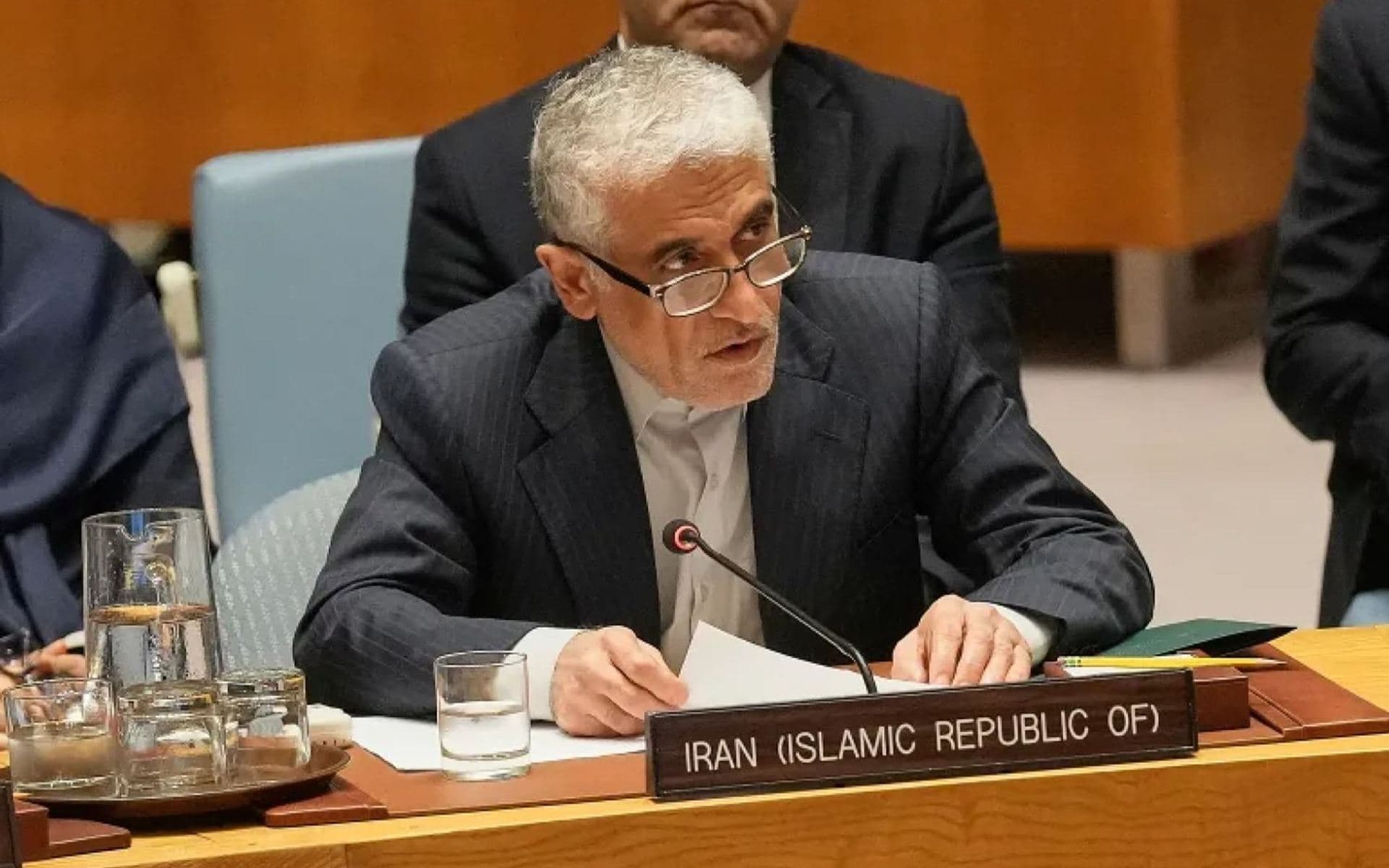
ERBIL, Kurdistan Region - Tehran’s ambassador to the United Nations warned that regional countries which have allowed bases on their territories, as well as their land, waters or airspace, to be used “to launch attacks” on Iran during the six-week war “must be held accountable,” media affiliated with the Iranian military reported on Friday.
The remarks reportedly came in response to a collective letter sent by six Gulf Arab states - Bahrain, Kuwait, Oman, Qatar, Saudi Arabia, and the United Arab Emirates (UAE) - to the UN in early March condemning Iranian attacks on their territories, including on civilian infrastructure and endangering civilian lives.
Amir Saeid Iravani, Iran’s Permanent Representative to the UN, stated that “by allowing military bases on their territory to be used for launching fire and airstrikes against Iran, they have participated in the aggression against Iran,” according to Fars News Agency, an affiliated of the Islamic Revolutionary Guard Corps (IRGC).
He added that “Iran has exercised its legitimate right to self-defense, as enshrined in the UN Charter” and “was not the initiator of the conflict or war,” warning that “countries which have participated in the aggression against Iran, or have allowed their bases, airspace, territorial waters, or land to be used for attacks against Iran, bear responsibility and must be held accountable.”
The United States and Israel launched a wide scale aerial campaign against Iran in late February, during which more than 17,000 sites were reportedly targeted over six weeks of hostilities.
In response, Iran carried out thousands of drone and missile strikes across the Middle East, targeting alleged US assets - particularly in Gulf Arab states - as well as launching retaliatory attacks against Israel.
The six member states of the Gulf Cooperation Council (GCC) on March 5 sent a joint letter to the UN Security Council formally condemning the series of Iranian ballistic missile and drone strikes that targeted their territories, accusing Tehran of striking vital civilian infrastructure, including international airports and energy facilities, while “endangering the lives of millions of innocent civilians.”
The GCC states previously rejected Iran’s justifications for the strikes, characterizing Tehran’s claims of targeting military assets as a “brazen deception.”
The Arab nations further invoked their own rights under Article 51 of the UN Charter, asserting an inherent right to collective self-defense and demanding full financial compensation for the destruction of infrastructure and loss of life.
The US and Iran later agreed to a Pakistan-mediated ceasefire on April 8, halting fighting to allow space for talks. While the first round of discussions concluded without a final agreement on April 11, a second round has yet to take place, as the war has yet to fully conclude.
In parallel with the talks, Iran and the US have engaged in reciprocal maritime restrictions. In Hormuz, Tehran has tightened controls on shipping in the key chokepoint which handles over 25 percent of global seaborne oil trade and around 20 percent of global liquefied natural gas (LNG) shipments.
Meanwhile Washington has, since April 13, enforced a naval blockade on Iranian ports, with the US Central Command (CENTCOM) reported on Thursday that it had redirected a total of 44 commercial vessels attempting to violate the embargo.