


Iran

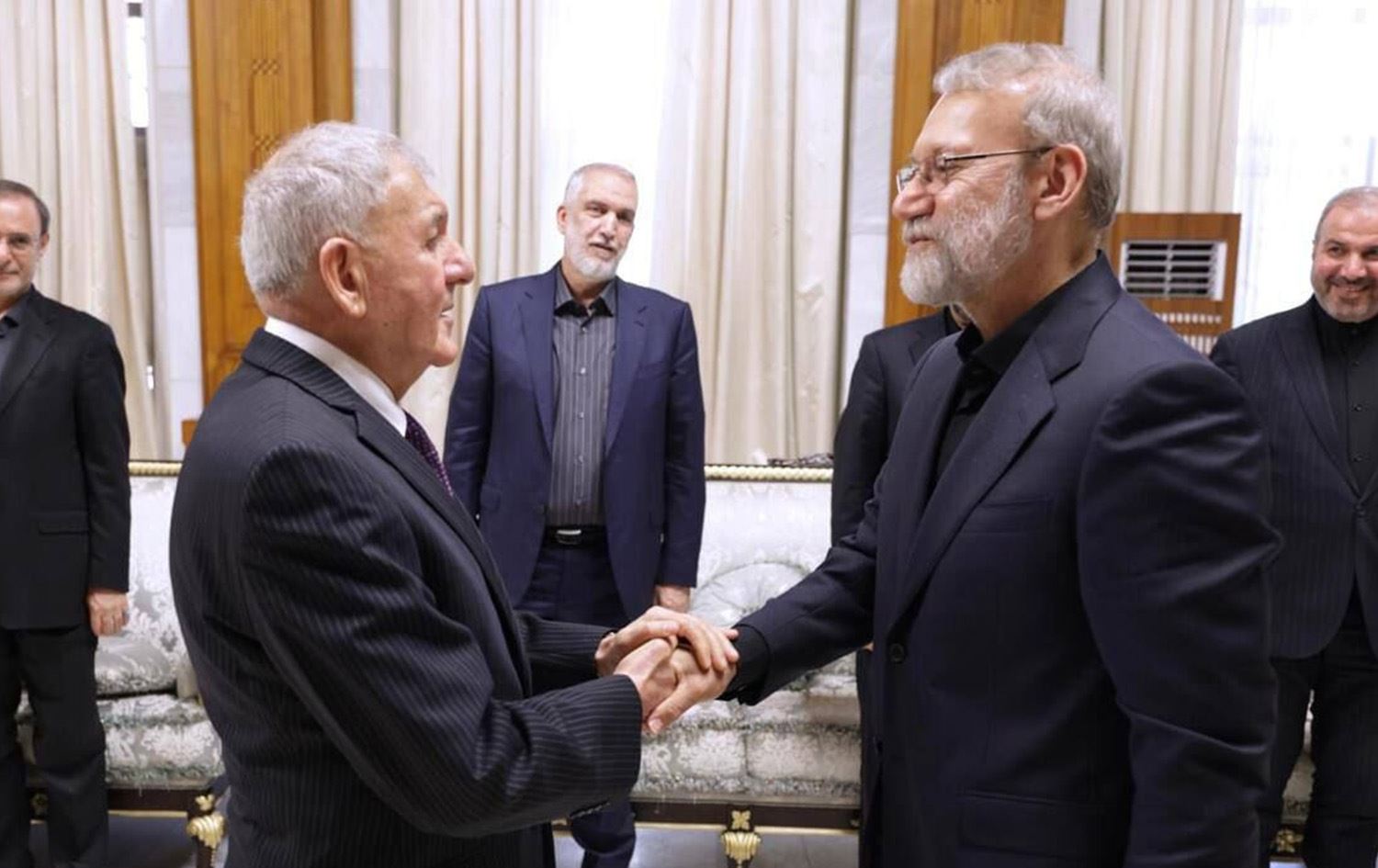
Iran’s Secretary of the Supreme National Security Council Ali Larijani (right) and Iraqi President Abdul Latif Rashid (left) meeting in Baghdad on August 11, 2025. Photo: IRIB
ERBIL, Kurdistan Region - Iran’s top security official on Saturday said that a newly signed border security agreement with Iraq seeks to curb foreign interference in the countries’ security affairs, with the deal having drawn the ire of Washington.
Iran’s Secretary of the Supreme National Security Council Ali Larijani and Iraqi National Security Advisor Qasim al-Araji signed a bilateral security memorandum of understanding (MoU) on Monday concerning “security coordination along the shared border between the two countries.”
“The key point of the agreement was that the two countries are committed to preventing individuals, groups, or third countries from disrupting the friendship, meaning that the territory of one country should not be used against the other,” Larijani said in response to a reporter's question, as quoted by Iran’s state broadcaster.
He asserted that the “central point” of the deal is that a “third country should not be allowed to penetrate” into Baghdad and Tehran’s security affairs.
In March 2023, Iran and Iraq signed a security pact under which Baghdad committed to disarming Kurdish opposition groups and tightening security along the shared border. Iran had threatened to use military action if Baghdad failed to fulfill the agreement.
Washington has opposed the agreement. On Tuesday, State Department spokesperson Tammy Bruce said that Washington “opposes any legislation that is inconsistent with the goals of our bilateral security assistance and partnership and runs counter to strengthening Iraq’s existing security institutions.”
“We support genuine Iraqi sovereignty, not legislation that would turn Iraq into an Iranian satellite state,” Bruce stated.
Her remarks drew condemnation from both Baghdad and Tehran. Iraq’s embassy in Washington issued a statement and stressed the country’s “inherent rights” to make deals with foreign countries, while Iran’s embassy in Baghdad slammed Washington’s “interfering position” in Iraqi and Iranian bilateral affairs.
Iran and Iraq have shared a strong relationship since the fall of Saddam Hussein in 2003. Tehran has since increased its influence over Baghdad, and the country has dozens of armed groups that are affiliated with the Shiite rule in Tehran.


Comments
Rudaw moderates all comments submitted on our website. We welcome comments which are relevant to the article and encourage further discussion about the issues that matter to you. We also welcome constructive criticism about Rudaw.
To be approved for publication, however, your comments must meet our community guidelines.
We will not tolerate the following: profanity, threats, personal attacks, vulgarity, abuse (such as sexism, racism, homophobia or xenophobia), or commercial or personal promotion.
Comments that do not meet our guidelines will be rejected. Comments are not edited – they are either approved or rejected.
Post a comment