


Iran

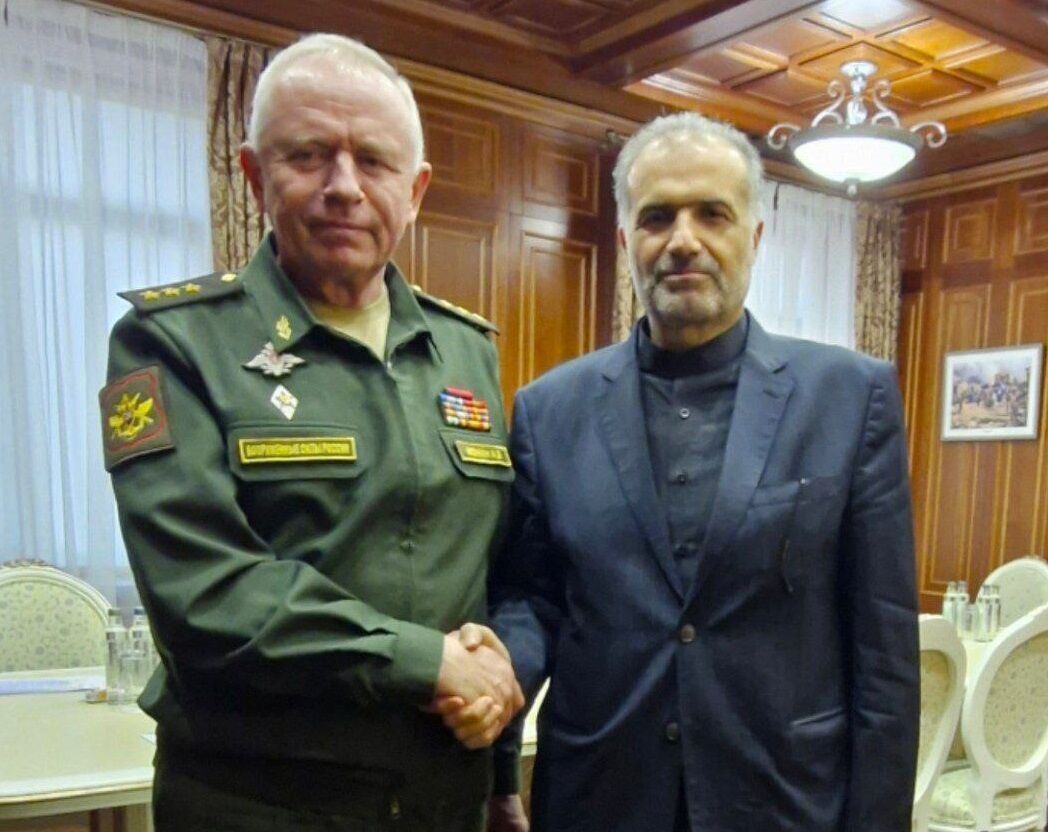
Iran’s Ambassador to Moscow Kazem Jalali meets with Russian Deputy Defense Minister Colonel General Alexander Fomin in Moscow on April 4, 2024. Photo: Iranian foreign ministry
ERBIL, Kurdistan Region - Iran and Russia held high-level discussions in Moscow on Tuesday about regional and international security issues, Russian state media reported. The talks notably touched on the “situation in the South Caucasus,” where both powers are struggling to preserve their influence amid the rapid geopolitical transformation, largely driven by the emerging Zangazur Corridor.
Iran’s ambassador to Moscow Kazem Jalali met with Russian Deputy Defense Minister Colonel General Alexander Fomin to discuss “a number of pertinent issues of bilateral military cooperation and the prospects of their implementation,” Russia’s Defense Ministry was quoted as saying by state-run TASS news agency.
The officials further “exchanged opinions on the key issues of international and regional security, including the situation in the South Caucasus,” the ministry added. It emphasized that the meeting was held in an “atmosphere of friendship and trust,” confirming both sides’ commitment to deepening strategic cooperation.
The backdrop
The timing of the meeting is significant, as a new geopolitical chessboard is seemingly taking shape in the South Caucasus, specifically driven by the proposed Zangazur Corridor.
Championed by Azerbaijan and Turkey, the Zangazur Corridor would connect mainland Azerbaijan to its Nakhchivan exclave and onward to Turkey via Armenia’s southern Syunik Province. While framed by proponents as a commercial and infrastructure initiative, the corridor is widely seen as a strategic project aimed at integrating the Turkic world and establishing an alternative to existing Eurasian trade routes.
The proposal has thus become a geopolitical flashpoint, drawing strong opposition from Iran and Armenia.
Tehran believes the corridor could sever its direct land access to Armenia and beyond and open the door for increased US or Israeli influence on Iran’s doorstep. Yerevan, for its part, has insisted that any transit through its territory must remain under its full sovereign control, rejecting any proposal that undermines its territorial integrity or autonomy.
For Russia, the Zangazur Corridor presents a direct challenge to its longstanding dominance in the South Caucasus. Although Moscow nominally supported the reopening of transport routes as part of the 2020 Nagorno-Karabakh ceasefire agreement, it remains wary that such a corridor could diminish its influence and serve as a vehicle for Western containment efforts.
Moscow is particularly alarmed by the possibility of US or European oversight of the route, which would bring Western military and economic presence closer to Russia’s southern border - potentially sidelining Moscow as the region’s primary power broker and elevating actors such as Turkey and the US.
The update
The Jalali-Fomin meeting comes shortly after a landmark agreement signed earlier this month between Armenian Prime Minister Nikol Pashinyan and Azerbaijani President Ilham Aliyev, brokered by US President Donald Trump. The deal includes the establishment of a strategic transit corridor officially dubbed the "Trump Route for International Peace and Prosperity" (TRIPP) - mirroring the proposed Zangazur Corridor.
Under the agreement, the US will have exclusive development rights to the corridor for 99 years. A consortium of American companies is expected to build rail, oil, gas, fiber-optic, and potentially electricity infrastructure along the 27-mile route.
While framed as a commercial venture, the TRIPP corridor directly competes with Russia’s International North-South Transport Corridor (INSTC), a long-standing initiative to connect Russia to India via Iran. The INSTC has taken on added importance for Moscow since the war in Ukraine, as it seeks to circumvent Western sanctions and reorient its trade links.
From the perspective of Moscow and Tehran, TRIPP is not just an economic project, but a strategic maneuver that could shift the regional power balance by undermining their influence and expanding Western presence in a critical geostrategic corridor.
In a sign of mounting concern, Iran’s President Masoud Pezeshkian visited Yerevan last week, where Armenian leaders sought to reassure him that the corridor would remain under Armenia’s exclusive jurisdiction and that no foreign military or security forces would be stationed along its path.
Iran’s ambassador to Moscow Kazem Jalali met with Russian Deputy Defense Minister Colonel General Alexander Fomin to discuss “a number of pertinent issues of bilateral military cooperation and the prospects of their implementation,” Russia’s Defense Ministry was quoted as saying by state-run TASS news agency.
The officials further “exchanged opinions on the key issues of international and regional security, including the situation in the South Caucasus,” the ministry added. It emphasized that the meeting was held in an “atmosphere of friendship and trust,” confirming both sides’ commitment to deepening strategic cooperation.
The backdrop
The timing of the meeting is significant, as a new geopolitical chessboard is seemingly taking shape in the South Caucasus, specifically driven by the proposed Zangazur Corridor.
Championed by Azerbaijan and Turkey, the Zangazur Corridor would connect mainland Azerbaijan to its Nakhchivan exclave and onward to Turkey via Armenia’s southern Syunik Province. While framed by proponents as a commercial and infrastructure initiative, the corridor is widely seen as a strategic project aimed at integrating the Turkic world and establishing an alternative to existing Eurasian trade routes.
The proposal has thus become a geopolitical flashpoint, drawing strong opposition from Iran and Armenia.
Tehran believes the corridor could sever its direct land access to Armenia and beyond and open the door for increased US or Israeli influence on Iran’s doorstep. Yerevan, for its part, has insisted that any transit through its territory must remain under its full sovereign control, rejecting any proposal that undermines its territorial integrity or autonomy.
For Russia, the Zangazur Corridor presents a direct challenge to its longstanding dominance in the South Caucasus. Although Moscow nominally supported the reopening of transport routes as part of the 2020 Nagorno-Karabakh ceasefire agreement, it remains wary that such a corridor could diminish its influence and serve as a vehicle for Western containment efforts.
Moscow is particularly alarmed by the possibility of US or European oversight of the route, which would bring Western military and economic presence closer to Russia’s southern border - potentially sidelining Moscow as the region’s primary power broker and elevating actors such as Turkey and the US.
The update
The Jalali-Fomin meeting comes shortly after a landmark agreement signed earlier this month between Armenian Prime Minister Nikol Pashinyan and Azerbaijani President Ilham Aliyev, brokered by US President Donald Trump. The deal includes the establishment of a strategic transit corridor officially dubbed the "Trump Route for International Peace and Prosperity" (TRIPP) - mirroring the proposed Zangazur Corridor.
Under the agreement, the US will have exclusive development rights to the corridor for 99 years. A consortium of American companies is expected to build rail, oil, gas, fiber-optic, and potentially electricity infrastructure along the 27-mile route.
While framed as a commercial venture, the TRIPP corridor directly competes with Russia’s International North-South Transport Corridor (INSTC), a long-standing initiative to connect Russia to India via Iran. The INSTC has taken on added importance for Moscow since the war in Ukraine, as it seeks to circumvent Western sanctions and reorient its trade links.
From the perspective of Moscow and Tehran, TRIPP is not just an economic project, but a strategic maneuver that could shift the regional power balance by undermining their influence and expanding Western presence in a critical geostrategic corridor.
In a sign of mounting concern, Iran’s President Masoud Pezeshkian visited Yerevan last week, where Armenian leaders sought to reassure him that the corridor would remain under Armenia’s exclusive jurisdiction and that no foreign military or security forces would be stationed along its path.


Comments
Rudaw moderates all comments submitted on our website. We welcome comments which are relevant to the article and encourage further discussion about the issues that matter to you. We also welcome constructive criticism about Rudaw.
To be approved for publication, however, your comments must meet our community guidelines.
We will not tolerate the following: profanity, threats, personal attacks, vulgarity, abuse (such as sexism, racism, homophobia or xenophobia), or commercial or personal promotion.
Comments that do not meet our guidelines will be rejected. Comments are not edited – they are either approved or rejected.
Post a comment