


Iraq

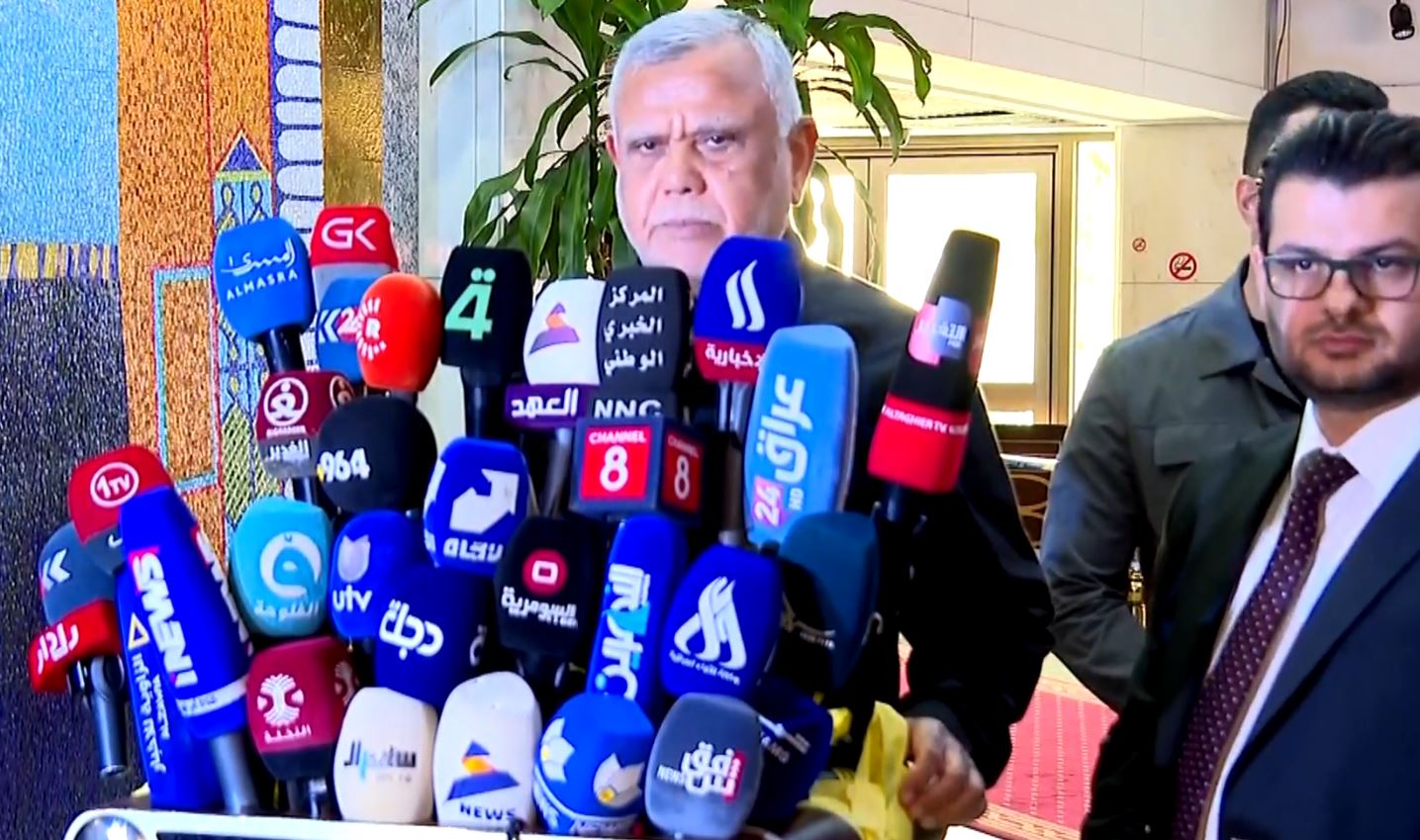
Hadi al-Ameri, head of Badr Organization, addresses reporters alongside Mohammad Raad, director of his media office, in Baghdad on November 11, 2025. Photo: Screengrab/Rudaw
ERBIL, Kurdistan Region - Badr Organization, widely known as Iran’s oldest ally in Iraq, told Rudaw it expects to secure “22 and 27 seats” in the upcoming parliament - including nine seats in Sunni-majority northern provinces. The anticipation comes a day after the group’s leader, Hadi al-Ameri, a senior figure in the ruling Shiite Coordination Framework, called for the formation of a “comprehensive and inclusive government” following the vote, firmly rejecting any form of “foreign interference.”
Mohammad Raad, Director of Ameri’s Media Office, told Rudaw that “Badr is set to secure 22 to 27 seats” in the 329-member legislature, attributing the projection to “wide participation by responsible and conscious voters whose turnout has raised the threshold of seats secured by Badr in most provinces.”
Raad added that nine of those seats are expected to come from Sunni-majority northern provinces - including Nineveh, Kirkuk, Salahaddin, and Diyala - while the organization anticipates winning at least 12 seats in Baghdad and Iraq’s predominantly Shiite southern provinces.
“In the coming hours, we will have many surprises,” he said.
The projection marks a significant improvement from the 2021 parliamentary elections, when the Badr-affiliated Fatah Alliance initially secured 17 seats, later expanding its share to 29 following the June 2022 withdrawal of the movement led by influential Shiite cleric Muqtada al-Sadr.
Sadr’s bloc won 73 seats in the 2021 vote, emerging as the largest political force in parliament, which traditionally nominates the prime minister. His bid to form a “national majority government” with Sunni and Kurdish allies was, however, blocked by the Coordination Framework, which sought to preserve Iraq’s post-2003 consensus model of governance.
Asked about thoughts on who could lead Iraq’s next cabinet, Raad noted that it is too soon to tell, adding, “Until this moment, there is no information.”
A day earlier, Ameri told reporters after casting his ballot, “We hope to participate in forming a new, comprehensive and inclusive government as soon as possible.”
Asked about the Coordination Framework’s stance vis-a-vis sitting Prime Minister Mohammed Shia’ al-Sudani’s push for another term as premier, Ameri remarked, “This issue will be sorted through the elections and is left to the political forces.”
He added, “I have never heard that brother Mohammed al-Sudani is eyeing another term as prime minister. After the results are announced, anyone who sees themselves as qualified can come forward, and the decision will be in the hands of the political forces.”
Although Ameri is considered one of Iran’s closest allies in Iraq, neither he nor the Badr Organization are listed on any international blacklists.
Addressing concerns over external influence, the head of Badr Organization stressed, “We have never and will never allow any foreign interference in forming the new government.”
“The time of foreign interventions is long gone, and it will not return to Iraq,” he concluded.


Comments
Rudaw moderates all comments submitted on our website. We welcome comments which are relevant to the article and encourage further discussion about the issues that matter to you. We also welcome constructive criticism about Rudaw.
To be approved for publication, however, your comments must meet our community guidelines.
We will not tolerate the following: profanity, threats, personal attacks, vulgarity, abuse (such as sexism, racism, homophobia or xenophobia), or commercial or personal promotion.
Comments that do not meet our guidelines will be rejected. Comments are not edited – they are either approved or rejected.
Post a comment