Iraq
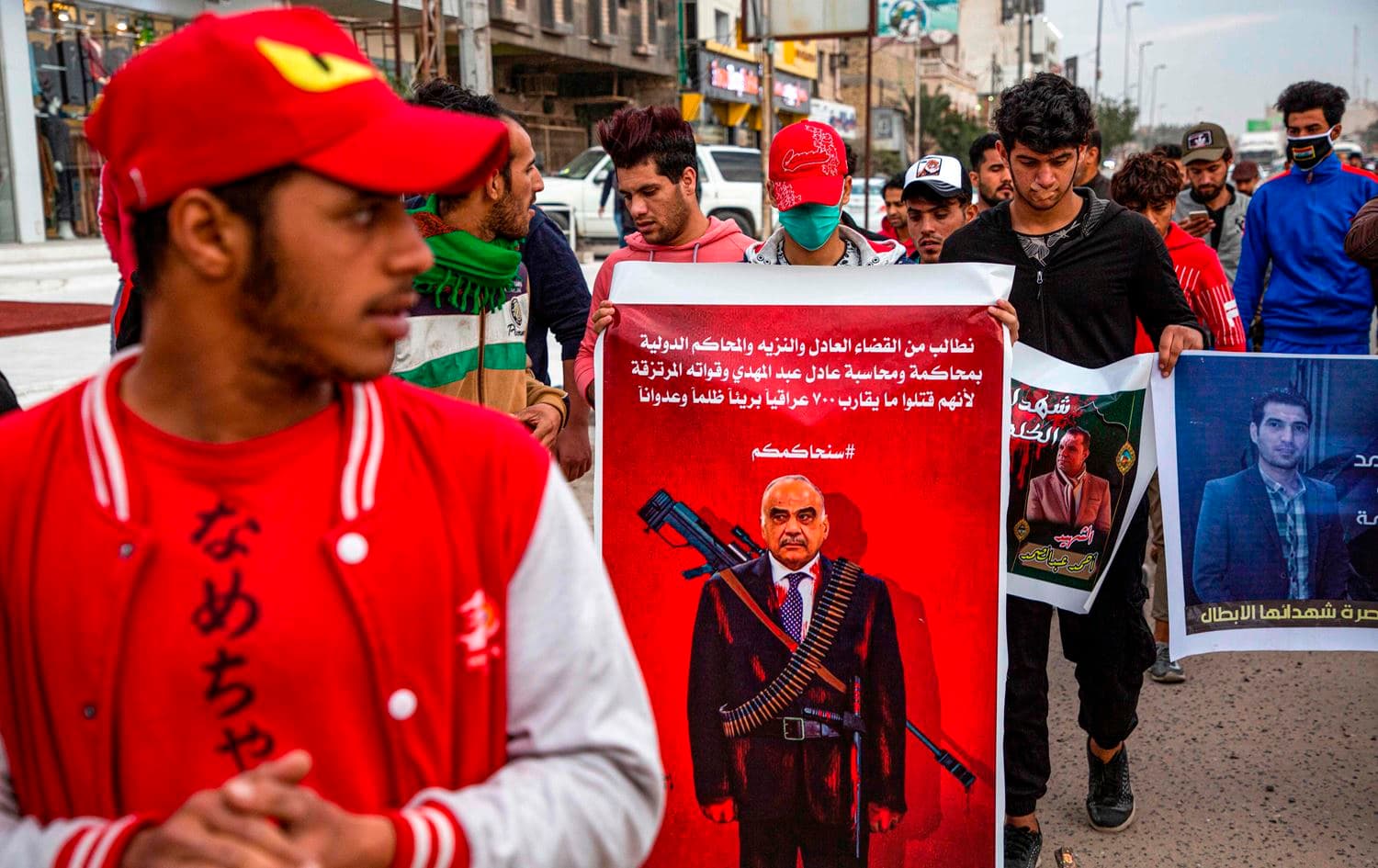
'We demand the fair and honest judiciary and the international courts to try and hold accountable Mr. Adil Abdul-Mahdi and his mercenary forces for unjustly killing almost 700 innocent Iraqis,' reads a banner depicting the prime minister as a sniper at a protest in Basra on January 17, 2020. Photo: Hussein Faleh/AFP
BAGHDAD – An Iraqi demonstrator was killed during a protest in Baghdad on Friday as protesters in the southern city of Basra marched to condemn the murder of two journalists a week ago.
Security forces fired tear gas at protesters trying to cross al-Sinek bridge in Baghdad on Friday evening. One demonstrator was hit in the chest with a tear gas canister and died, AFP reported. Medical sources told the news agency that another 24 people were also injured or suffered problems breathing.

In the southern city of Basra on Friday, protesters marched carrying images of journalist Ahmed Abdul Samad and his cameraman Safaa al-Ghali. The two, who had covered nearly four months of anti-government protests, were shot in their car by unknown gunmen on January 10. Samad was a vocal critic of the Iraqi government and Iranian influence. The Interior Ministry ordered an investigation into their deaths.
Since October, protesters have demanded real changes in Iraq – condemning the endemic corruption, demanding major political reforms, and calling for an end to both Iranian and American influence. The movement has been overshadowed by a spike in hostilities between Iran and the US increased after the US killed Iranian Gen. Qasem Soleimani and Iraqi militia leader Abu Mahdi al-Muhandis in a drone strike in Baghdad on January 3. Iran retaliated by firing missiles at Iraqi bases housing US forces.

Influential Shiite cleric Muqtada al-Sadr has called for a “million-strong march” on January 24 against the presence of US troops in Iraq. Protesters who have occupied Baghdad’s Tahrir Square since late October said they won’t participate in Sadr’s anti-US march, saying Iraq’s Iranian-backed militias are a more destructive force that must be dealt with first.

More than 511 protesters and members of security forces have been killed and around 17,000 wounded since demonstrations began on October 1, according to Human Rights Watch.

They have scored two partial victories: Prime Minister Adil Abdul-Mahdi resigned, though he remains in place as a caretaker, and parliament passed a bill amending the election law, though the changes failed to meet the protesters’ demands.
Security forces fired tear gas at protesters trying to cross al-Sinek bridge in Baghdad on Friday evening. One demonstrator was hit in the chest with a tear gas canister and died, AFP reported. Medical sources told the news agency that another 24 people were also injured or suffered problems breathing.

In the southern city of Basra on Friday, protesters marched carrying images of journalist Ahmed Abdul Samad and his cameraman Safaa al-Ghali. The two, who had covered nearly four months of anti-government protests, were shot in their car by unknown gunmen on January 10. Samad was a vocal critic of the Iraqi government and Iranian influence. The Interior Ministry ordered an investigation into their deaths.
Since October, protesters have demanded real changes in Iraq – condemning the endemic corruption, demanding major political reforms, and calling for an end to both Iranian and American influence. The movement has been overshadowed by a spike in hostilities between Iran and the US increased after the US killed Iranian Gen. Qasem Soleimani and Iraqi militia leader Abu Mahdi al-Muhandis in a drone strike in Baghdad on January 3. Iran retaliated by firing missiles at Iraqi bases housing US forces.

Influential Shiite cleric Muqtada al-Sadr has called for a “million-strong march” on January 24 against the presence of US troops in Iraq. Protesters who have occupied Baghdad’s Tahrir Square since late October said they won’t participate in Sadr’s anti-US march, saying Iraq’s Iranian-backed militias are a more destructive force that must be dealt with first.

More than 511 protesters and members of security forces have been killed and around 17,000 wounded since demonstrations began on October 1, according to Human Rights Watch.

They have scored two partial victories: Prime Minister Adil Abdul-Mahdi resigned, though he remains in place as a caretaker, and parliament passed a bill amending the election law, though the changes failed to meet the protesters’ demands.
Comments
Rudaw moderates all comments submitted on our website. We welcome comments which are relevant to the article and encourage further discussion about the issues that matter to you. We also welcome constructive criticism about Rudaw.
To be approved for publication, however, your comments must meet our community guidelines.
We will not tolerate the following: profanity, threats, personal attacks, vulgarity, abuse (such as sexism, racism, homophobia or xenophobia), or commercial or personal promotion.
Comments that do not meet our guidelines will be rejected. Comments are not edited – they are either approved or rejected.
Post a comment