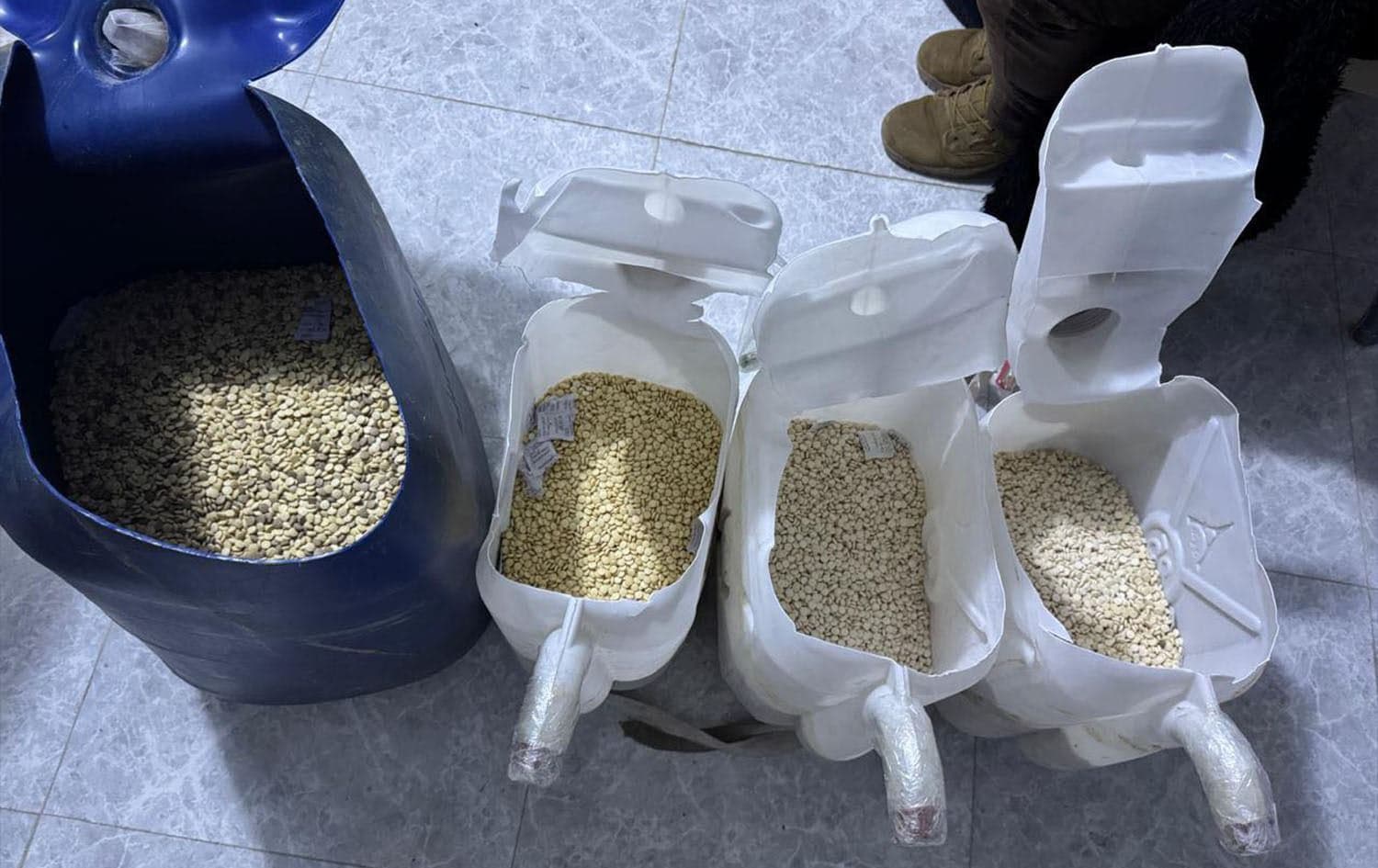

ERBIL, Kurdistan Region - Iraqi authorities announced on Wednesday that they had successfully seized hundreds of kilograms of narcotics in a major security operation conducted “inside Syrian territory” in direct coordination with their counterparts in Damascus.
In a statement, the ministry noted that its affiliate, the Directorate-General for Narcotic Drugs and Psychotropic Substances Affairs, “conducted a qualitative operation in direct coordination” with Syria’s Anti-Narcotics Administration. Through “joint fieldwork and intelligence coordination,” the two sides managed to seize “370 kilograms of narcotics.”
The operation also led to “the arrest of a number of internationally wanted suspects who are part of cross-border smuggling networks,” the ministry added, affirming that the operation falls within the framework of ongoing security cooperation between Baghdad and Damascus to combat drug trafficking.
For its part, the Syrian interior ministry announced on Monday the seizure of around 12 million Captagon pills in the possession of a drug smuggling network in the Damascus countryside, along with the arrest of the individual responsible.
It is highly likely that the statements from the Iraqi and Syrian Interior Ministries refer to the same cache.
The production and trafficking of Captagon - a powerful amphetamine - is a decades-old concern across the Middle East, where consumption and smuggling cases have risen sharply in recent years.
Syria, under the regime of the now-deposed dictator Bashar al-Assad, was widely recognized as a primary source of Captagon production and distribution. The trade became a political and economic tool for the Assad regime, with many analysts identifying Maher al-Assad, the president’s brother, as a key figure behind the industry.
Since the overthrow of Assad, the new authorities in Damascus have announced the seizure of millions of Captagon pills in various parts of the country. However, smuggling has yet to be curbed, as Syria’s regional neighbors - including Iraq - continue to report the seizure of large quantities of the narcotic substance from time to time.
.jpg&w=3840&q=75)