


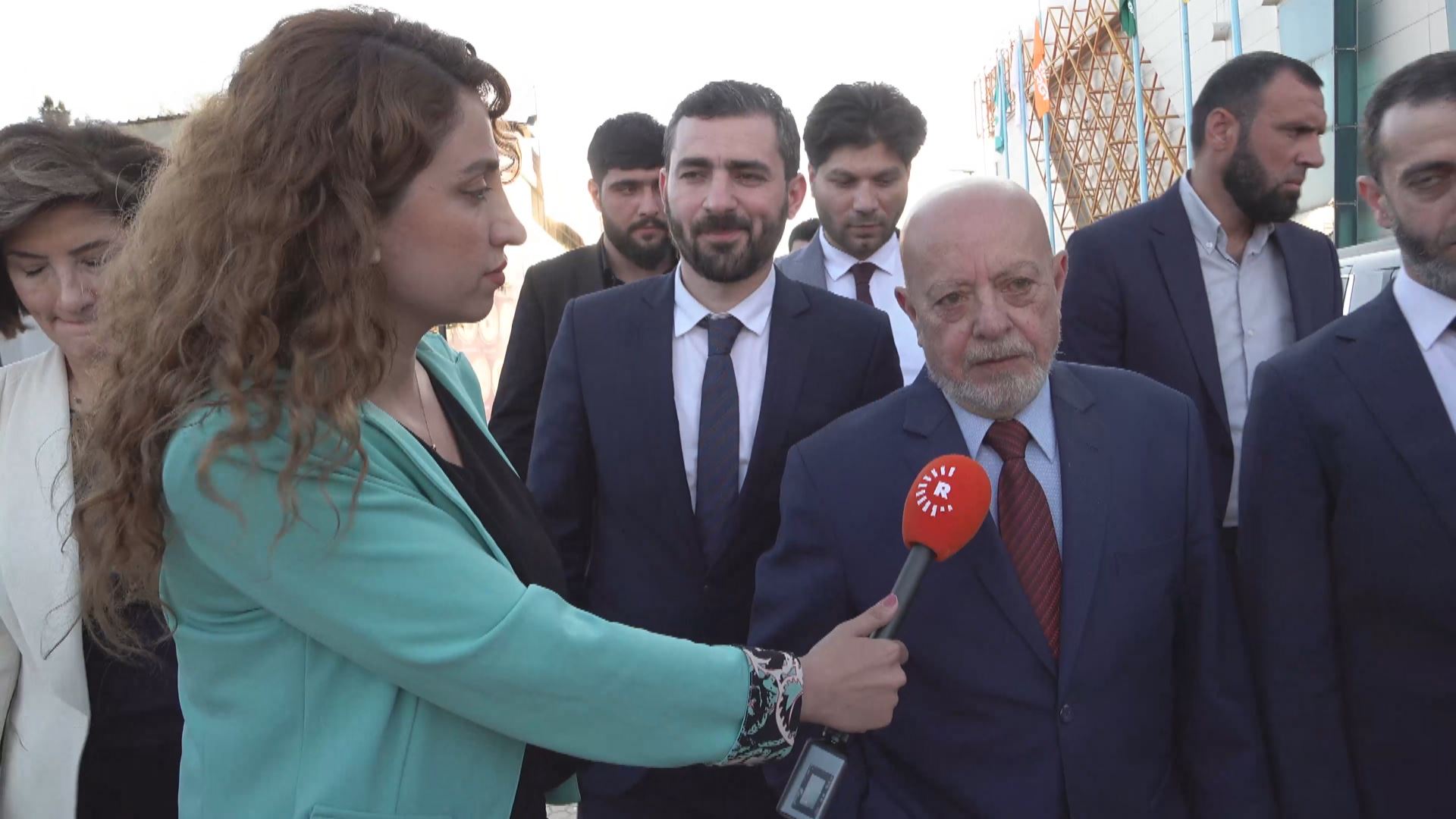
ERBIL, Kurdistan Region - Syrian Minister of Economy and Industry Mohammed Nidal al-Shaar said on Friday that he expects international sanctions on his country will be lifted soon.
“Sanctions are a temporary issue, and these matters will be resolved in the near future,” he told Rudaw on the sidelines of an exhibition in Damascus.
Since taking power, the new authorities in Damascus have demanded that the international community lift the sanctions that have been imposed on major sectors and institutions since the outbreak of the conflict in 2011. They argue that removing the sanctions is an essential step for economic recovery and starting reconstruction.
A former United Nations under-secretary general and advisor on Syria, Volker Perthes, told Rudaw last month that sanctions should be lifted so they do not hinder the country’s economic recovery after years of conflict.
Several European countries have removed some sanctions.
In April, the United Kingdom lifted sanctions it had imposed on Syrian ministries, intelligence agencies, and state-affiliated media outlets during the rule of toppled Syrian dictator Bashar al-Assad.
While nations like France and Germany have actively engaged with the interim Syrian government, they have warned that the lifting of sanctions is conditional on forming an inclusive government.
Syrian interim President Ahmad al-Sharaa said on Wednesday during a press conference with French President Emmanuel Macron in Paris that the continuation of European economic sanctions is not "justified."
The French leader said that the European Union will “gradually” lift sanctions on Syria.
The United States gave Syria some temporary sanctions relief in order to facilitate humanitarian aid, but its sanctions regime remains largely intact.
Regarding Syrian funds frozen abroad, the economy minister indicated that they have taken legal measures within the global monetary system, adding, "It is a right, and it will return, God willing."
Solin Mohammedamin contributed to this article.


Comments
Rudaw moderates all comments submitted on our website. We welcome comments which are relevant to the article and encourage further discussion about the issues that matter to you. We also welcome constructive criticism about Rudaw.
To be approved for publication, however, your comments must meet our community guidelines.
We will not tolerate the following: profanity, threats, personal attacks, vulgarity, abuse (such as sexism, racism, homophobia or xenophobia), or commercial or personal promotion.
Comments that do not meet our guidelines will be rejected. Comments are not edited – they are either approved or rejected.
Post a comment