

QAMISHLI, Syria - The United States’ decision to abandon its long-term ally, the Kurdish-led Syrian Democratic Forces (SDF), in northeast Syria threatens to unravel the fragile social fabric of a region already battered by years of war and deepening poverty. The move has heightened fears of renewed conflict and possible sectarian violence among Kurds and Arabs.
US Special Envoy for Syria Tom Barrack said on Wednesday that while the SDF had been “the most effective ground partner” in defeating ISIS, its original mission had now “expired.” He added that a post-Bashar al-Assad Syria offered Kurds “a pathway to full integration into a unified Syrian state with citizenship rights, cultural protections, and political participation.”
Across Kurdish-majority areas of northeast Syria, anxiety over an uncertain future is pervasive. Among dozens of Kurds and Arabs interviewed for this report, the most frequently used word was “fear.” Although the region has remained relatively stable compared to other parts of Syria, Washington’s apparent support for efforts to force Kurdish integration into the central state has shattered that sense of security.
“I am scared of a sectarian war,” said a middle-aged Kurdish woman in the village of Tannuriya, east of Qamishli, speaking on Wednesday, two days into a fragile ceasefire between the central government and the SDF. “We are the only Kurdish village here, and we are surrounded by Arab villages.”
Kurdish areas in northeast Syria are interspersed with tribal Arab communities settled there in the latter half of the 20th century under the Baath regime’s so-called “Arab Belt” policy. The initiative aimed to dilute the Kurdish population, rendering many Kurds stateless and positioning Arab communities as a buffer against Kurdish political aspirations.
“It is dangerous to speak now,” said an elderly Arab man in a village neighbouring Tannuriya, reflecting a palpable shift in the atmosphere.
Since the outbreak of the Syrian civil war in 2011, Kurds in the northeast have administered their own affairs, establishing a semi-autonomous system of governance. In 2015, the United States began arming Kurdish forces as its primary counterterrorism partner against ISIS, following several failed attempts to recruit moderate Arab groups to fight the extremists and Ahmad al-Sharaa’s former organisation, the Nusra Front.
Now, amid Sharaa’s US-backed offensive, Kurds have closed ranks, holding large rallies worldwide in solidarity with the SDF.
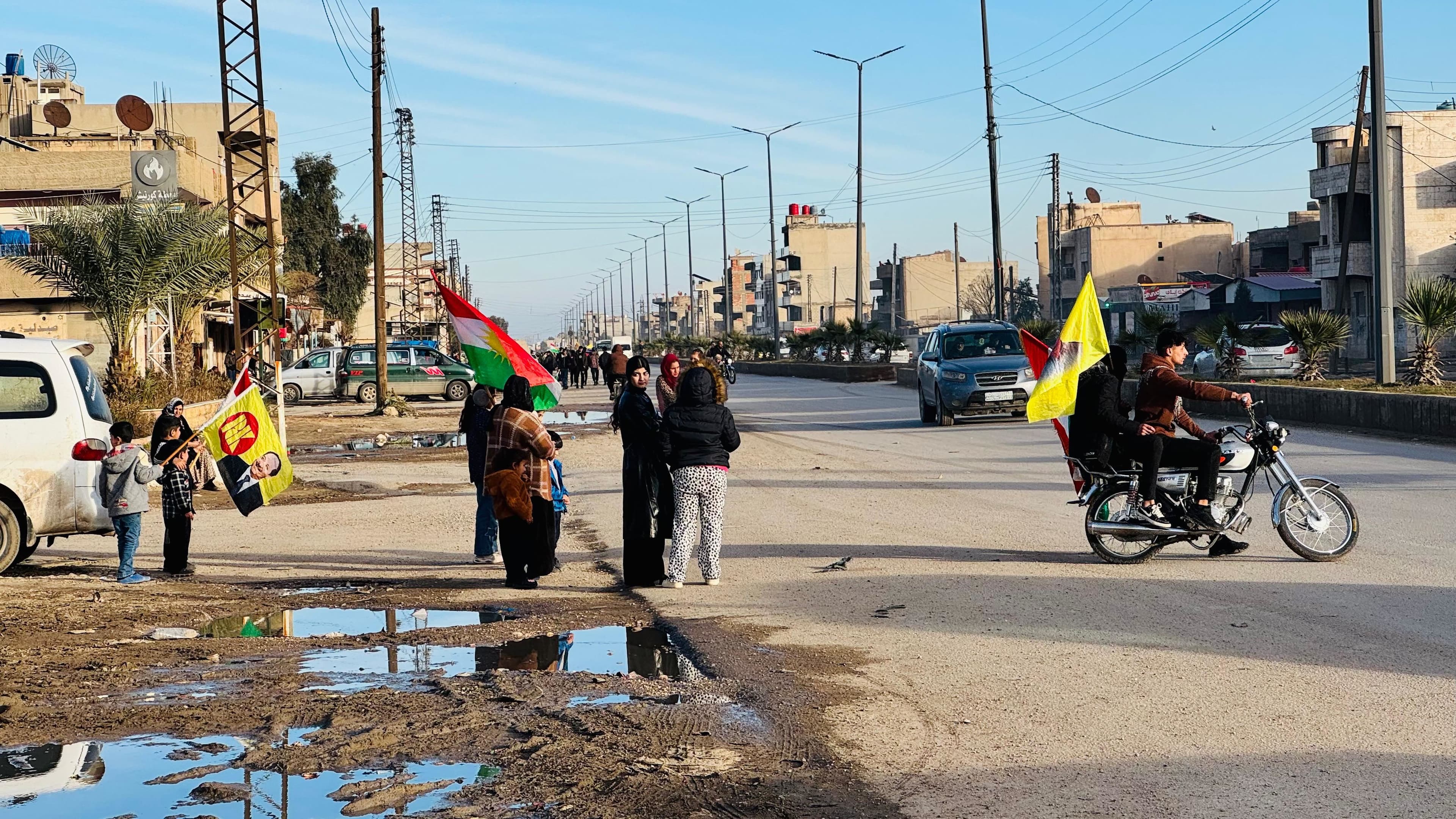
This mobilization has been visible at the entrances to Qamishli in recent days. Dozens of armed men and women, carrying AK-47s, race toward frontlines in pickup trucks, while groups of children line the streets waving Kurdistan flags.
At the same time, simmering tensions with clear sectarian undertones have begun to surface following the central government’s attacks on Kurdish forces.
“I was attacked by two Arab men - look at my hand,” said Pela, a 16-year-old Kurdish girl from Hasaka, pointing to a scar on her left hand. She has taken refuge in a Qamishli hotel with her mother and older sister. “This is going to get worse. I don’t dare go back to Hasaka.”
Her sister, Ilina, interjected: “I don’t want a sectarian war. I don’t want Kurds and Arabs to fight each other.”
The sisters said many Kurdish families fear for their lives in Hasaka, where they believe sections of the Arab population have become more aggressive amid government bombardments and calls for Arab communities to rise up against Kurdish control.
Hasaka, home to around half a million people, is evenly divided between Kurds and Arabs. In the city’s Ghewiran neighbourhood, an Arab man gestured toward piles of rubbish littering the streets.
“We have no jobs - look at our situation,” he lamented.
Another resident added that schools were no longer functioning properly, as many were filled with displaced families. “These people are poor,” the first man said, pointing to a group of men and children gathered nearby.
The neighbourhood still bears the scars of fierce fighting from several years ago, when ISIS militants attempted to storm a prison housing their fighters, clashing with Kurdish security forces.
The SDF was formed in 2015 after Kurdish leaders convinced the Obama administration that the force would be non-sectarian, securing US backing in the fight against ISIS.
While many Arab components of the SDF have since defected to government forces, some Arab fighters remain on the frontlines alongside their Kurdish counterparts.
“Two of my cousins were killed not far from here two days ago,” said Saad, a 22-year-old Arab SDF fighter standing atop a newly supplied American Humvee on the road between Hasaka and Raqqa. Asked how he expected to be treated if captured by the Syrian Arab Army under President Sharaa, he pulled a single AK-47 bullet from his pocket. “I saved this for that moment,” he said. “I will not be taken prisoner.”
SDF commanders express anger over the defections.
“We were betrayed. We trusted the Arabs, and we were mistaken,” said Heval Baran, a commander on the Shadadi frontline, noting that some Arab fighters still remain with the SDF. He became visibly agitated when the United States was mentioned.
“The Americans acted dishonourably toward us,” he said, while absolving US soldiers on the ground. “They were just carrying out orders.”
On Wednesday, US Central Command (CENTCOM) announced the transfer of 150 ISIS detainees from a Hasaka detention facility to a secure location in Iraq, adding that up to 7,000 ISIS prisoners could eventually be moved to Iraqi-controlled sites.
Rudaw understands that US forces stationed in northeast Syria are preparing for a potential withdrawal, further complicating an already volatile situation.
In Hasaka, around 150 women queued for hours to buy bread.
“I’ve been waiting six hours,” said one elderly woman. Nearby, some 400 displaced Arab civilians were sheltering in Ahmad Yasin Primary School. Many declined to speak.
American fighter jets, Apache helicopters, and A-10 Thunderbolts patrolled the skies over Hasaka, monitoring a fragile ceasefire between the rival forces. Heval Baran, the commander on the Shadadi frontline, warned that a larger confrontation could be imminent, with grave consequences for Kurdish areas and Syria as a whole.
“I don’t know what will happen to us,” said Ismail, 25, as dozens of young children played outside the school.
“I am afraid for their future.”
Hevidar Ahmed contributed to this article from Qamishli, Syria
.png&w=3840&q=75)