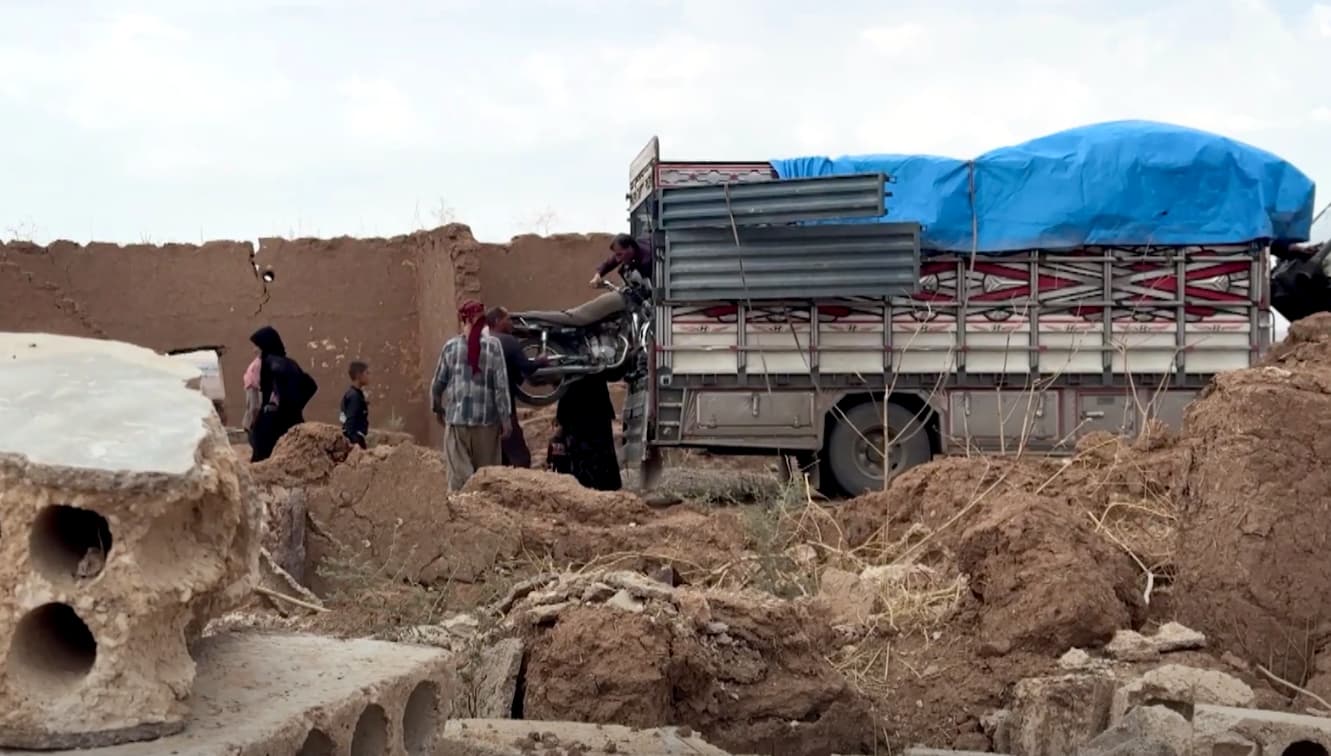
ERBIL, Kurdistan Region - In northeastern Syria's Qamishli city, a school has become a refuge for thousands of Kurdish families fleeing the latest wave of violence at the hands of armed factions affiliated with the transitional government of Damascus, a stark reminder of the human cost of the ongoing conflict in Rojava.
The displacement follows renewed clashes between forces loyal to Syria’s transitional government, led by President Ahmed al-Sharaa, and the Kurdish-led Syrian Democratic Forces (SDF).
The International Organization for Migration (IOM) reported Thursday that the number of internally displaced people in Hasaka province has surged past 134,000 - a staggering increase from just 5,725 on Sunday. The sudden exodus reflects fears of escalating violence near SDF-held areas, military bases, and detention facilities holding ISIS suspects and their families.
A fragile four-day ceasefire announced Tuesday aims to open talks on integrating SDF structures into state institutions and transferring control of key facilities. Yet reports of violations by both sides continue, leaving civilians gripped by uncertainty.
Inside the overcrowded school, Rudaw’s cameras captured heartbreaking scenes: mothers weeping beside infants, families huddled on thin mattresses, and children shivering in the biting winter cold.
Eighty-five-year-old Khalil Blo from Afrin’s Bilbil sub-district sat beside a kerosene heater, his scarf tightly wrapped around his neck, murmuring prayers.
“May God take our right from them. May God restore our rights,” he said. Displaced multiple times - first to Raqqa, then Tabqa, now Qamishli - Khalil spoke with a voice heavy with longing: “I kiss the soil of that land. I always tell these children: If I die, take me back to that area. Don’t leave me here. Take me back to our own soil.”
Rukan Hamid, a mother sheltering with her two daughters in a large classroom, described the harsh conditions: a few thin mattresses and blankets scattered across a cold, bare floor. She recalled seven years of repeated displacement: “We stayed in Tal Rifaat for seven years, hoping to return to Afrin. But the enemy came and pushed us here.”
Tears in her eyes, she asked, “What does the enemy want from us? No country supports us. Our children are hungry. We want nothing - only to return to our homeland. Let us know that we have a land too.”
Nasrin Bakr, another displaced woman from Afrin, spoke of enduring the harshest winter conditions during each displacement.
“We face frost and snow. Even here, rain poured on us for two nights,” she said. “We pray so much, but our prayers turn into curses.”
The IOM warns that the displacement is largely fueled by fears of potential fighting between the SDF and government forces, particularly among residents near detention centers and SDF military sites. From Kobane alone, 1,647 people have fled due to severe shortages of food, water, and electricity.
More than 2,500 Kurdish families from Aleppo, rural Hasaka, and other regions have sought refuge in Qamishli. Teams from the Barzani Charity Foundation are distributing food, water, and winter essentials to families sheltering in schools and mosques.
Currently, over 41,000 people live in collective shelters across Hasakah province, urgently needing food, mattresses, blankets, and other basic supplies. One elderly displaced man from Afrin echoed the pain of countless others: “If I die, don’t leave me here - take me back to Afrin.”
As the ceasefire hangs by a thread and talks continue, displaced Kurds in Qamishli cling to prayers for peace, a return to their lands, and an end to years of repeated uprooting.
With winter deepening, the humanitarian crisis intensifies, demanding urgent international attention.
Ghareeb Majid contributed to this article from Qamishli