


Syria

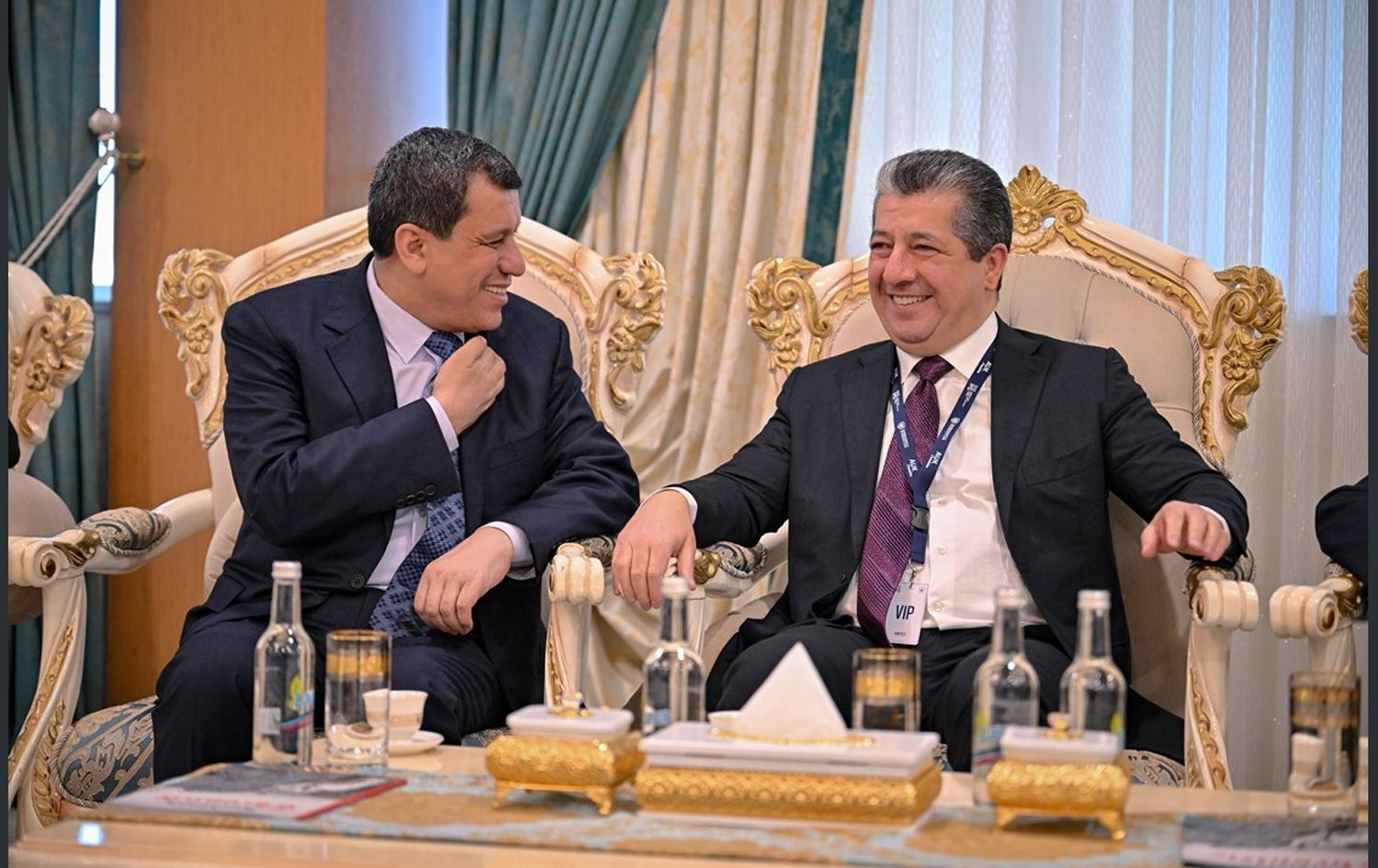
Kurdish-led Syrian Democratic Forces (SDF) chief Mazloum Abdi (left) and Kurdistan Region Prime Minister Masrour Barzani (right) pictured during a meeting in the Region's northern Duhok province on November 19, 2025. Photo: KRG
ERBIL, Kurdistan Region - Kurdistan Region Prime Minister Masrour Barzani on Monday held a call with Mazloum Abdi, chief of the Kurdish-led Syrian Democratic Forces (SDF), to discuss de-escalation in northeast Syria (Rojava) and the transfer of Islamic State (ISIS) detainees to Iraq. This comes as a prominent US diplomat warned of a potential resurgence of the extremist group amid escalating violence.
In a statement on X, Abdi quoted the Kurdish premier as reaffirming “the efforts exerted by the Kurdistan Regional Government [KRG] to support us [Rojava].”
“For our part, we expressed our deep appreciation for the continued support his government has provided to our people, reflecting the spirit of partnership and shared responsibility under these difficult circumstances,” Abdi added.
Since mid-January, the Syrian Arab Army and affiliated armed groups launched a large-scale offensive to retake areas in eastern Aleppo, Deir ez-Zor, Raqqa, and Hasaka that the SDF held for nearly a decade.
The SDF, the de facto military force in Rojava and a key US-led Coalition ally, played a crucial role in defeating ISIS territorially in 2019. Since then, the Kurdish-led forces maintained control over the areas they liberated, much of which has now been recaptured by Damascus and its allied forces.
The US Central Command (CENTCOM) announced on Wednesday the transfer of 150 Islamic State (ISIS) detainees from a detention facility in Rojava’s eastern Hasaka province to a secure location in Iraq, noting that up to 7,000 ISIS prisoners could eventually be moved.
Importantly, veteran American diplomat Zalmay Khalilzad, former US ambassador to Iraq and Afghanistan, on Monday raised concerns over a potential resurgence of ISIS amid the developments in Rojava.
In a post on X, Khalilzad referred to what he described as “a very disturbing report” by Hamid al-Shatri, head of Iraq’s National Intelligence Service (INIS), warning of ISIS’s growing empowerment in Syria.
Khalilzad stressed that urgent steps are needed to “contain and reverse the recent hostility between the Syrian government and the SDF,” cautioning that continued tensions would “only fuel regional instability and strengthen ISIS.” He added that Syria’s security forces - composed of diverse elements - must undergo reform, emphasizing that a “modernized and strengthened security service is essential.”
He also called for enhanced coordination between Baghdad and Damascus, stating, “We must assist and oversee greater cooperation between Iraqi and Syrian security forces.”
Of note, in addition to his call with the Kurdish Prime Minister, SDF Commander Abdi also reported on Monday that he had recently spoken with Bafel Talabani, leader of the Patriotic Union of Kurdistan (PUK), who “expressed his support and backing for the resistance of our people and our forces.”
Of note, in addition to his call with the Kurdish Premier, SDF Commander Abdi also reported on Monday that he also held a call with Bafel Talabani, leader of the Patriotic Union of Kurdistan (PUK), who “expressed his support and backing for the resistance of our people and our forces.”
“It also fills us with pride to see our people in Sulaymaniyah taking to the streets in massive demonstrations to express their continued support for us,” Abdi said.
Last week, hundreds of people from Sulaimani province - a stronghold of the PUK - boarded buses bound for Rojava, as the Kurdistan Region’s eastern province also witnessed large demonstrations in solidarity with the Kurds in northeast Syria.


Comments
Rudaw moderates all comments submitted on our website. We welcome comments which are relevant to the article and encourage further discussion about the issues that matter to you. We also welcome constructive criticism about Rudaw.
To be approved for publication, however, your comments must meet our community guidelines.
We will not tolerate the following: profanity, threats, personal attacks, vulgarity, abuse (such as sexism, racism, homophobia or xenophobia), or commercial or personal promotion.
Comments that do not meet our guidelines will be rejected. Comments are not edited – they are either approved or rejected.
Post a comment