
ERBIL, Kurdistan Region - Several Arab and Islamic countries have expressed willingness to repatriate their nationals held in Iraqi prisons for affiliation with the Islamic State (ISIS), who were recently transferred from Syria, Iraq’s foreign minister said on Saturday.
US army said on Thursday that it had completed the transfer of 5,700 ISIS male prisoners from the Kurdish-held areas to Iraq during a 23-day mission.
Iraq has launched initial investigations into the prisoners.
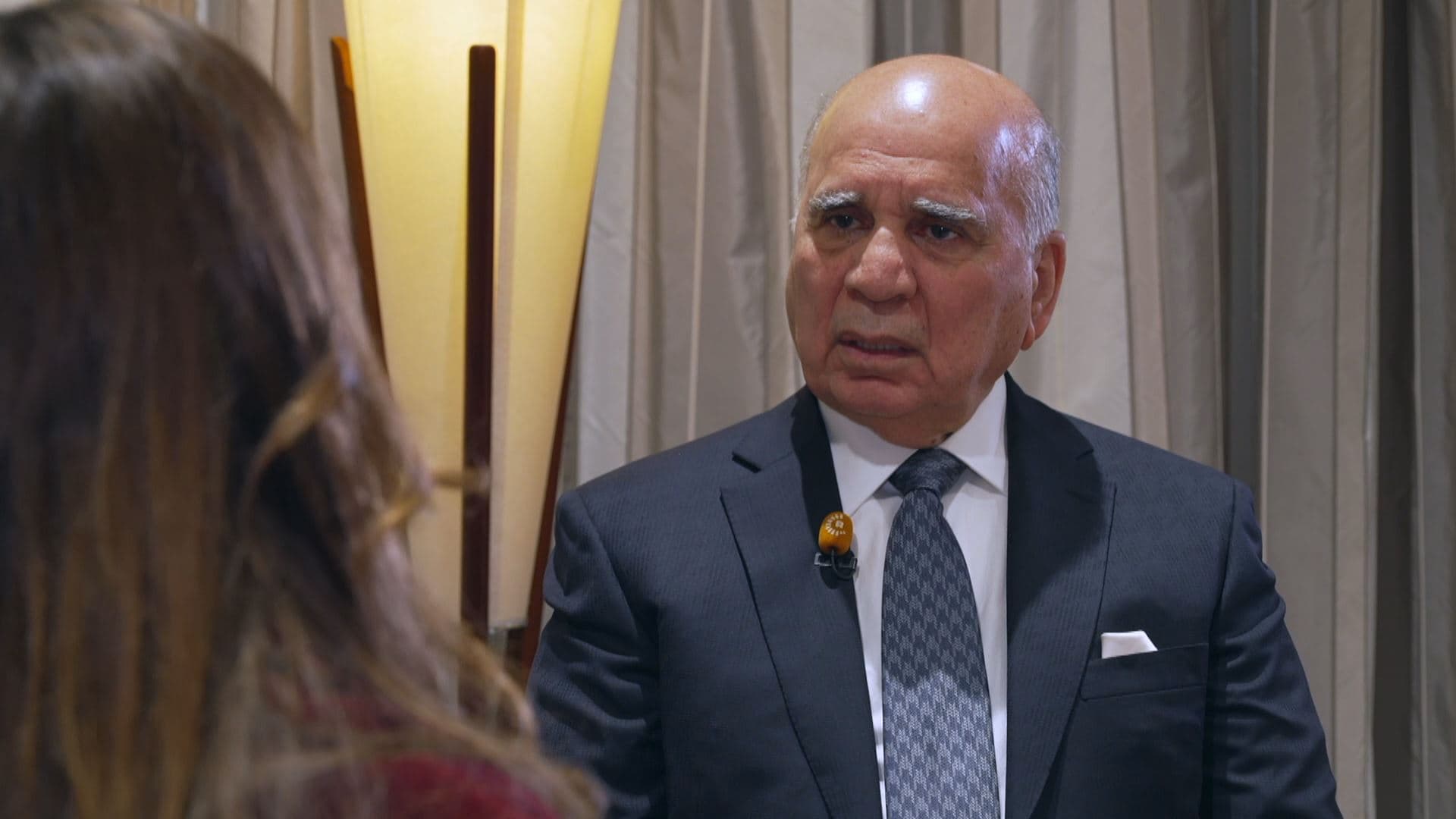
"We have started investigations. They already have legal cases, but their files were handled by SDF courts, which are not internationally recognized since they are not a state. We want to collect information and investigate them again. Most are foreigners, only about 470 are Iraqi," Iraqi Foreign Minister Fuad Hussein told Rudaw's Alla Shally on Saturday on the sidelines of the Munich Security Conference.
"We have contacted other countries, especially Arab and Islamic countries, and some promised to take back their citizens. We have also contacted Western countries, but this is a long and difficult process," he added.
The following is the full transcript of the interview with Hussein:
Rudaw: What is Iraq’s message to the world from Munich?
Fuad Hussein: Certainly, our message in these meetings is that Iraq is stable, but the region’s situation is dangerous. Iraq is part of this region, and we hope no fire reaches Iraq, because, as I said, the region’s situation is dangerous.
Are you referring specifically to Syria and Iran?
The situation is clear—these are Iraq’s neighbors.
ISIS remains a threat in Syria. Is that also a threat to Iraq?
Yes, it is a threat. We have experience with ISIS. ISIS was a very small organization that attacked Mosul in June 2014, but quickly took control. This shows that ISIS ideology has roots in our society. ISIS is dangerous not only as an armed group but because it has an ideology. ISIS activity still exists in Syria now.
The UN says there have been five assassination attempts against Ahmed al-Sharaa, but the world doesn’t seem concerned about ISIS strengthening. Why?
I don’t know. But the countries we speak with consider it very important. One reason we transferred ISIS prisoners from SDF prisons to Iraq was our fear they would escape. Most of them are experienced ISIS members and terrorist leaders, and they are now imprisoned in Iraq.
The world did not take them back, and now nearly 5,700 ISIS members have been transferred to Iraq?
Fuad Hussein: 5,714 ISIS prisoners.
Do you think countries will take them back?
We have started investigations. They already have legal cases, but their files were handled by SDF courts, which are not internationally recognized since they are not a state. We want to collect information and investigate them again. Most are foreigners, only about 470 are Iraqi. We have contacted other countries, especially Arab and Islamic countries, and some promised to take back their citizens. We have also contacted Western countries, but this is a long and difficult process.
Have you raised regional threats in your Munich meetings?
Yes. Some discussions were about ISIS and its activities, while others focused on Iraq and its bilateral relations. Most of the people I met were from Western and Gulf countries. We discussed bilateral relations and the regional situation.
Kurdistan’s people want Iraq to protect Syrian Kurds. How did you convey that to Damascus?
We have diplomatic and security relations with Damascus. Iraq’s position has been clear, and we strongly supported dialogue between the SDF leadership, Mazloum Abdi, and the Syrian government. I will meet them tomorrow and continue supporting this process.
Do you think that after Trump responded to Rudaw, his position toward Nouri al-Maliki has now changed?
Honestly, I don’t know. That response given to Rudaw was certainly a major thing Rudaw did, but the response can be interpreted in different ways. Therefore, we need to receive that response through diplomatic channels and understand its meaning, because the interpretation of the answer he gave to Rudaw varies.
Is there hope that his position will change?
I don’t know. I cannot speak on that, but we are in contact with the Americans, and this issue is being discussed extensively.
When will Iraq elect its president?
The presidency will be resolved once the prime minister issue is resolved. Either we agree as KDP and PUK on a candidate, or we compete in parliament and parliament decides. I hope it happens before or after Ramadan, but it must happen soon because without a president, a prime minister cannot be appointed, and the government cannot be formed. The situation of the region is complicated, therefore the government has to be formed as soon as possible.
Have KDP and PUK agreed on a candidate?
No. I don’t know where those reports came from. I think the news was first published by Rudaw. That is unfortunate.
Rudaw always reports accurate news.
That report was incorrect. The presidency was not discussed in that meeting at all. They talked about cooperation between parties, including KDP and PUK… There was no agreement [on presidency].
Will KDP and PUK meet next week?
I hope so. It is important to reach a result. If we do not agree, we will compete in parliament, which is not good for Kurds. The more united we are, the stronger we will be in Baghdad.
Are you waiting for the Coordination Framework, or are they waiting for you regarding the upcoming parliament session?
No, look, most members of the Iraqi parliament are Shia. If they want, they are the majority and can convene. However, for a session to be held, at least 220 members must be present, because legally that number is required for the election of the president. I’m not saying the problem is on their side, but there is an issue among them. Once a president is elected, they must designate and assign a prime minister within 15 days. I say within 15 days, though sometimes the prime minister is designated in the same session in which the president is elected. Right now, the issue concerns Mr. Nouri al-Maliki and President Trump’s tweet. We will see how the Shiites will resolve it, because this is the responsibility of the Shiite forces.
Are you personally ready to become president?
In what sense am I ready? If it is a matter of experience, thank God, I have experience in various fields. In addition to my long struggle in opposition and politics, after we returned to Iraq following the regime change in 2003, I served in Baghdad as one of the supervisors at the Ministry of Education. Later, I became a member of the Governing Council. After that, I served as head of the Presidency Office of the Kurdistan Region, with ministerial rank, and participated in Council of Ministers meetings. Then I became Deputy Prime Minister and Minister of Finance. I have also served twice as Foreign Minister and Deputy Prime Minister. If the matter is about record and personal qualifications, I believe I am ready. However, it is up to the members of parliament to decide whom they want as president. This is their responsibility, and I hope they choose someone capable. The presidency is a major position—it is one pillar of executive authority, alongside the Council of Ministers. It requires experience, expertise, and strong relationships, both domestically and internationally. Certainly, all of this is ultimately in the service of the people.
Mazloum Abdi met the US secretary of state and Syrian foreign minister. How does Iraq view this?
I am happy to see this. I will meet them tomorrow. We welcome agreements between the Syrian government and SDF. We also welcome their joint participation in Munich and their meeting with the US secretary of state. The alternative was war, which would have been very dangerous for Syrian Kurds, Syria, and Iraq. It could have caused refugee flows and risks related to ISIS prisoners.
Are you confident Kurdish rights will be protected in Syria’s constitution?
I cannot speak on behalf of Mazloum Abdi or the Syrian government, but from our observation, the Americans are involved, and they are friends with both sides. That is important.