


Middle East

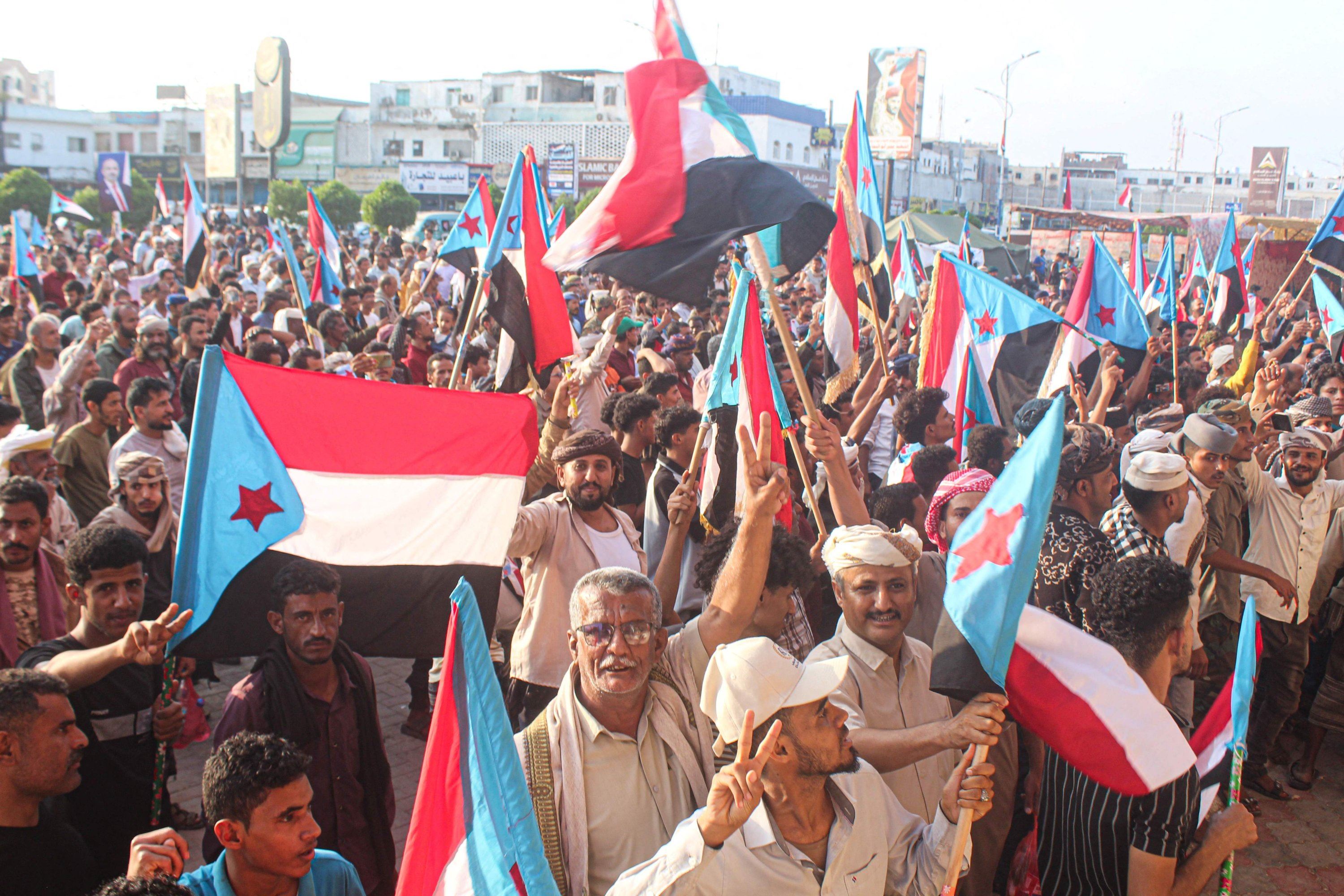
Supporters of the Southern Transitional Council (STC), which wants to revive an independent South Yemen, wave the old South Yemen flag in the port city of Aden, Yemen, Dec. 8, 2025. Photo: AFP
ERBIL, Kurdistan Region - The Southern Transitional Council (STC) has consolidated control over southern Yemen and is stepping up its international outreach to advance what it describes as the South’s “legitimate right to self-determination,” a well-placed source in Aden told Rudaw on Tuesday.
“Southern forces have secured control over all southern territories,” the source said on condition of anonymity, adding that the Council is “intensifying efforts to raise international awareness about the legitimate rights of the people of the South, foremost among them the right to self-determination.”
Earlier this month, the Council launched a two-year transitional period aimed at restoring an independent southern state.
In a televised address on Friday, STC President Aidarous al-Zubaidi announced a “Constitutional Declaration” for the State of South Arabia, to be followed by a referendum on self-determination by January 2028. “Achieving the aspirations of the people of the South to restore their state must proceed through a safe, responsible, and phased process,” he added.
The declaration defines the proposed state’s borders along the pre-1990 boundaries of the former People’s Democratic Republic of Yemen and outlines plans to establish state institutions and draft a permanent constitution. The STC warned however that the constitutional declaration would take immediate effect if “the people of the South, their land, or their forces are subjected to any military attack.”
For his part, the source in Aden told Rudaw that the STC is maintaining ongoing communication with “influential states and international organizations” to advance a peaceful political settlement that ensures southern rights and stability.
He described ties with Saudi Arabia as “strong and positive,” highlighting Riyadh’s “pivotal role” in “supporting security efforts and countering destabilizing projects in the South.” The source noted that Saudi Arabia sees stability in the South as “a key Arab achievement against the Iranian-backed project [led by the Ansarullah Movement, otherwise known as the Houthis].”
Asked about prospects of engagement with the Houthis, the source said “I do not see any possibility for reconciliation,” the source said, describing the Houthis as “not merely an adversary of the South,” but “a serious threat to regional security and to humanity at large.”
“Any form of negotiation remains impossible as long as their hostile policies toward the southern people and the wider region persist,” he concluded.
Below is the full transcript of remarks provided to Rudaw by a well-placed source within the Southern Transitional Council (STC) in Aden.
Rudaw: What steps is the STC taking at the international level to advance the South’s push towards self-determination?
STC source: Southern forces have secured control over all southern territories [in Yemen]. At the same time, we are intensifying efforts to raise international awareness about the legitimate rights of the people of the South, foremost among them the right to self-determination. Ongoing communication is taking place with influential states and international organizations to clarify the southern cause and to work toward a peaceful political solution that ensures stability and protects the rights of southern citizens.
How would you characterize the current relationship between the STC and the Kingdom of Saudi Arabia, as well as with other regional and international players?
Our relations with the Kingdom of Saudi Arabia are strong and positive. We highly appreciate the pivotal role Saudi Arabia has played since the beginning, particularly in supporting security efforts and confronting destructive projects targeting the South. The Kingdom is keen on preserving stability in the South, as it represents a key Arab achievement against the Iranian-backed project [led by the Ansarullah Movement, otherwise known as the Houthis, in Sana’a] and serves as a pillar of Arab national security.
As for the broader international community, relations are gradually taking shape. We continue to engage diplomatically to clarify the southern position, emphasize our right to defend our land, and underline our role in promoting long-term stability in the region.
Is there any realistic prospect for political dialogue or reconciliation with the Houthis, or do you consider such engagement improbable under the current circumstances?
I do not see any possibility for such reconciliation. The Houthis are not merely an adversary of the South; they pose a serious threat to regional security and to humanity at large. Any form of negotiation remains impossible as long as their hostile policies toward the southern people and the wider region persist.
What is the current status of al-Qaeda in the Arabian Peninsula (AQAP) and other extremist groups in southern Yemen, and how sustainable are the security gains achieved by southern forces?
Thank God the sustained security efforts, southern forces have successfully cleared most southern areas of terrorist elements. There are currently no safe havens for these groups in the South, and operations continue to ensure that terrorism does not regain a foothold.
How are the living conditions in Aden and other areas under STC control, and what are the most urgent humanitarian and service-related challenges that still require international support?
Living conditions have begun to improve gradually following the restoration of security and the takeover of key institutions and facilities. Humanitarian assistance continues to arrive on a regular basis; however, there remains an urgent need for expanded international support to fully meet essential humanitarian and service requirements.
How is the STC addressing the issue of African migrants in the South?
The South has historically been open and welcoming to all people. We are working to regulate the presence of migrants in a manner that preserves their dignity and basic rights, while also maintaining public order and security. Coordination with relevant international organizations is ongoing to minimize challenges and address humanitarian concerns responsibly.
To what extent do climate change and environmental degradation pose a threat to the South, and what policies or initiatives are being pursued to mitigate their impact?
The South is increasingly affected by severe climate challenges, including rising temperatures and water scarcity. Efforts are underway to improve the management of natural and agricultural resources, raise public awareness about climate adaptation, and promote environmentally friendly initiatives aimed at reducing the long-term impact of climate change.
Niyaz Mustafa contributed to this report from Erbil, Kurdistan Region.


Comments
Rudaw moderates all comments submitted on our website. We welcome comments which are relevant to the article and encourage further discussion about the issues that matter to you. We also welcome constructive criticism about Rudaw.
To be approved for publication, however, your comments must meet our community guidelines.
We will not tolerate the following: profanity, threats, personal attacks, vulgarity, abuse (such as sexism, racism, homophobia or xenophobia), or commercial or personal promotion.
Comments that do not meet our guidelines will be rejected. Comments are not edited – they are either approved or rejected.
Post a comment