


Middle East

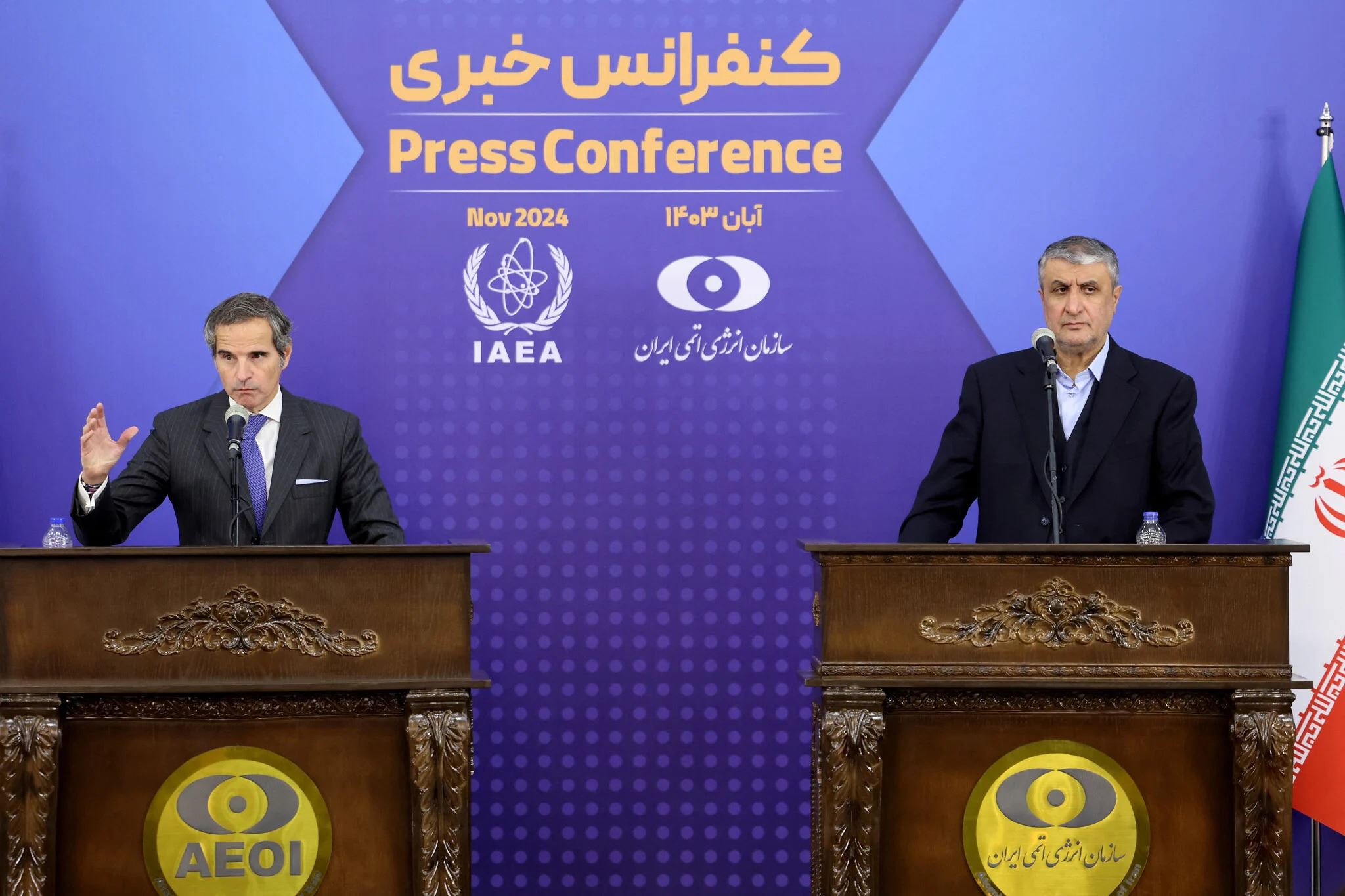
Iran's nuclear chief Mohammad Eslami (R) and the United Nations nuclear chief Rafael Grossi give a joint press conference in Tehran on November 14, 2024. Photo: AFP
ERBIL, Kurdistan Region – Iran’s nuclear chief Mohammad Eslami on Wednesday accused Rafael Grossi, head of the United Nations’ nuclear watchdog, of playing a “destructive role” in what Tehran insists is a “peaceful” nuclear program. The remarks come as the Israel-Iran conflict rages on amid growing speculation that Tehran may withdraw from the Treaty on the Non-Proliferation of Nuclear Weapons (NPT).
Eslami, who heads the Atomic Energy Organization of Iran (AEOI) and also serves as a vice president, stated that Grossi, Director General of the International Atomic Energy Agency (IAEA), “failed to carry out his duties regarding Iran’s peaceful nuclear program,” claiming his actions “will be recorded in history” as harmful to Iran.
“Grossi’s procrastination paved the way for the Israeli regime to advance its illegal objectives,” Eslami said, adding that “Iranians will not bow to any pressure and oppression.”
Eslami’s statements follow a series of Israeli strikes on key Iranian nuclear sites - Natanz, Isfahan, and Fordow - launched last Friday under the “Rising Lion” military operation. Israel has also killed several top Iranian nuclear scientists and military commanders since.
Eslami’s criticism of Grossi notably came hours after the IAEA director-general had told CNN that the Agency did not find “have any proof of a systematic effort to move into a nuclear weapon” by Iran.
“If there was some clandestine or hidden activity, we would know,” he said, adding that the agency has “no proof” of an Iranian nuclear weapons program.
At the backdrop of Israel’s attacks on Tehran’s nuclear facilities, Grossi had on Friday warned that “nuclear facilities must never be attacked” and that such actions violate international law and the IAEA Statute. He stressed that such strikes pose “serious implications for nuclear safety, security, and safeguards,” and threaten both regional and global stability.
Despite this, Israeli Foreign Minister Gideon Sa’ar reaffirmed on Wednesday that Israel’s military actions are primarily focused on neutralizing Iran’s nuclear, missile, and strategic weapons programs.
Speaking to Fox News, Sa’ar said that Israel’s assessment is that Iran is “maybe half a year or less from [developing] an atomic bomb,” noting that “they have enough [fissile] materials for nine atomic bombs.”
“Tehran’s nuclear issue cannot be delayed and should be solved now,” he warned.
The backdrop
Israel’s “Rising Lion” operation came less than a day after the IAEA’s Board of Governors passed a resolution declaring Iran in violation of its non-proliferation obligations.
Drafted by France, Germany, and the UK (the E3) and backed by the United States, the resolution stated that Iran had not fully cooperated with the IAEA under its Safeguards Agreement with the Agency, hindering verification efforts.
It accused Tehran of “repeatedly failing to offer technically credible explanations for uranium particles found at undeclared locations or the whereabouts of nuclear material and contaminated equipment.”
The resolution added that Iran “did not declare nuclear material and nuclear-related activities” at three undeclared sites - Lavisan-Shian, Varamin, and Turquzabad - noting that these actions represent “a significant impediment to the Agency's ability to clarify and verify Iran's declarations and the exclusively peaceful nature of Iran's nuclear programme.”
The agency also said it was “not able to verify that there has been no diversion of nuclear material” to “nuclear weapons or other nuclear explosive devices,” adding that its inability “to provide assurance that Iran's nuclear programme is exclusively peaceful gives rise to questions that are within the competence of the United Nations Security Council (UNSC)” as the body responsible for international peace and security.
Tehran swiftly condemned the IAEA Board of Governors’ resolution as politically-motivated.
In a joint statement, the Iranian Foreign Ministry and the AEOI stressed that “Iran has always adhered to its safeguard obligations,” adding that “none of the Agency's reports have mentioned Iran's failure to adhere to its obligations or any deviation in Iran's nuclear materials and activities.”
Iran accused the E3 and the U.S. of reviving long-settled issues - some more than 25 years old - that were resolved in a 2015 IAEA resolution. Tehran also criticized the IAEA’s approach as politically biased.
In response to the resolution, AEOI chief Eslami ordered the establishment of “a new enrichment center in a secure location and the replacement of first-generation centrifuges at the Fordow enrichment site with advanced sixth-generation machines.”
Importantly, the IAEA Board of Governors resolution was based on an early June comprehensive report by the UN’s nuclear watchdog, which accused Iran of continuing undeclared nuclear activities and significantly increasing its stockpile of uranium enriched up to 60 percent. As of May 17, Iran’s enriched uranium stockpile stood at 408.6 kilograms - a 133.8-kilogram increase since February - raising fresh proliferation concerns.
Iran dismissed the report as biased and claimed it relied on “forged” Israeli documents. The AEOI called the report an overreach by Grossi and said it violated the principles of impartiality required of international institutions.
“The Islamic Republic of Iran, while expressing regret over the publication of this report, which was prepared for political purposes through pressure on the Agency, expresses its clear objection to its content,” a statement by the AEOI read.
The statement further stated that the report “goes beyond the scope of the duties assigned to the Director General,” Grossi, and “is in conflict with the professional requirements governing international institutions, including the principle of impartiality.”
Iran's foreign ministry and the Iranian nuclear agency then-warned Tehran will take "appropriate measures" in response to any effort to take action against the country at the IAEA Board of Governors meeting.
Next steps
As the Israel-Iran conflict continues to rage on, Tehran has been pressing ahead with its strikes against Israeli targets. One option reportedly under serious consideration is withdrawing from the Treaty on the Non-Proliferation of Nuclear Weapons (NPT), which Iranian officials argue has failed to deter Israeli attacks or protect Iran’s nuclear infrastructure.
While some voices within Iran’s political corridors advocate for developing a nuclear deterrent, any such move would face a significant obstacle: the religious edict (fatwa) issued by Iranian Supreme Leader Ayatollah Ali Khamenei that explicitly forbids the production of nuclear weapons.
Another drastic measure being debated is the closure of the Strait of Hormuz through which around 20 percent of global oil and a large volume of liquefied natural gas pass.
Such a move would send shockwaves through global energy markets, triggering sharp price hikes and supply chain disruptions that would impact both exporters and importers across the Middle East, Europe, and Asia.
However, this option also carries serious risks. Iran itself relies heavily on the Strait for imports, and closure would damage relations with key partners such as China. It could also provoke direct military confrontation with the United States and its allies, raising the specter of a broader regional war.
Despite these consequences, Tehran may proceed with more drastic measures if domestic political and public pressure mounts - and if it concludes that diplomatic engagement offers diminishing returns.


Comments
Rudaw moderates all comments submitted on our website. We welcome comments which are relevant to the article and encourage further discussion about the issues that matter to you. We also welcome constructive criticism about Rudaw.
To be approved for publication, however, your comments must meet our community guidelines.
We will not tolerate the following: profanity, threats, personal attacks, vulgarity, abuse (such as sexism, racism, homophobia or xenophobia), or commercial or personal promotion.
Comments that do not meet our guidelines will be rejected. Comments are not edited – they are either approved or rejected.
Post a comment