


Middle East

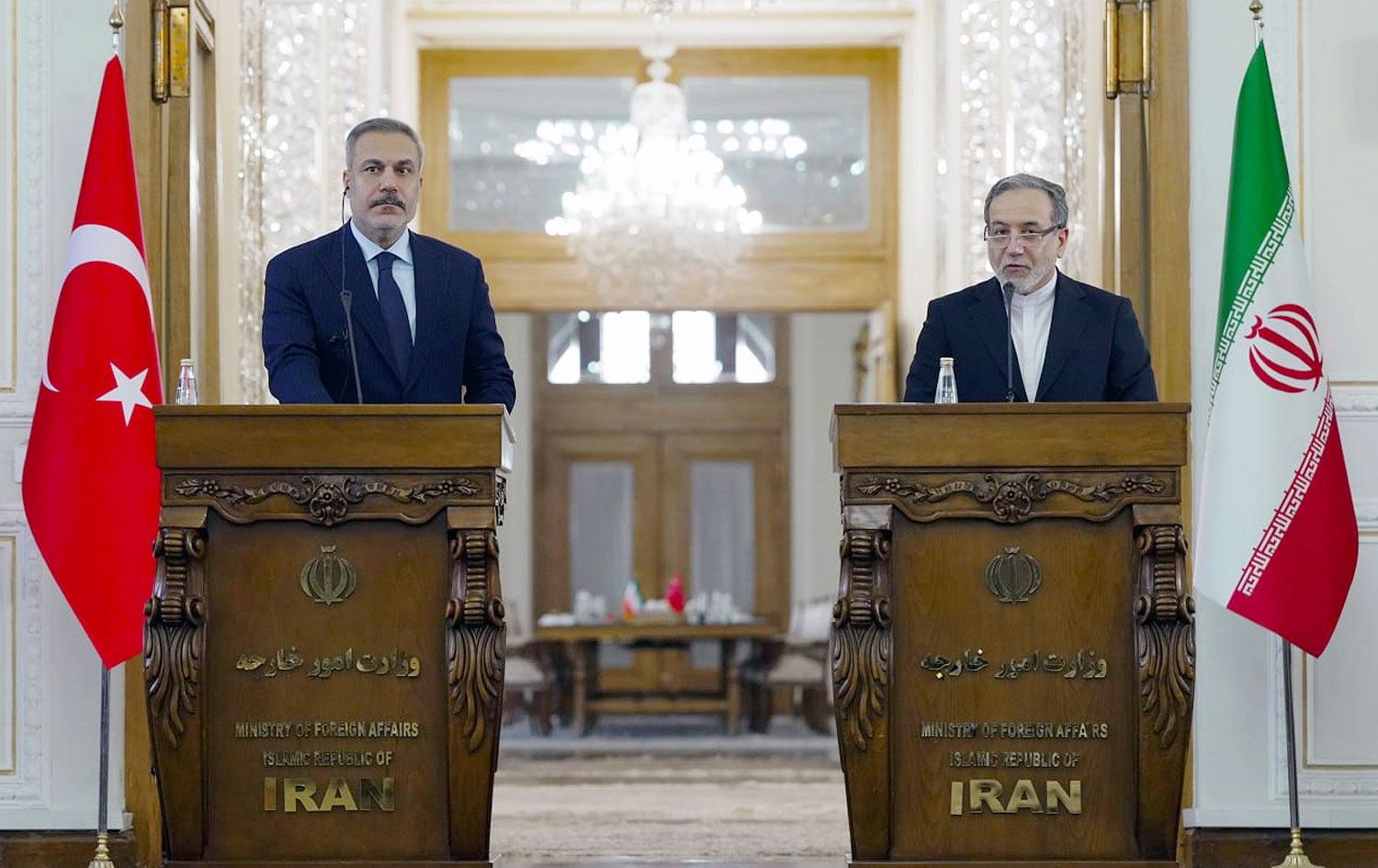
Turkish Foreign Minister Hakan Fidan (left) holds a joint press conference with Iranian Foreign Minister Abbas Araghchi in Tehran on November 30, 2025. Photo: Iranian Foreign Ministry/Telegram
ERBIL, Kurdistan Region - Iranian Foreign Minister Abbas Araghchi on Sunday received his Turkish counterpart Hakan Fidan in Tehran, reiterating Iran’s support for the disarmament of the Kurdistan Workers’ Party (PKK) and placing security and counterterrorism cooperation at the center of their talks.
“Iran, while supporting the process of disarming the PKK and achieving a Turkey free of terrorism, stresses the need to dismantle all terrorist groups to build a region entirely free of terrorism,” Araghchi said at a joint press conference with Fidan.
Founded in 1978, the PKK initially sought an independent Kurdish state but later shifted its focus toward greater cultural and political rights for Kurds in Turkey. Ankara designates the group a terrorist organization.
In February, jailed PKK leader Abdullah Ocalan called for the group’s disarmament and dissolution, with the PKK beginning compliance by May. In the following months, the group took further steps to advance the peace process.
Most recently, the PKK withdrew its fighters from Mount Zap in the Kurdistan Region’s northern Duhok province - a long-contested by Turkish forces.
On Sunday, PKK commander Amed Malazgirt told AFP that the group had “completed all the necessary steps” in the peace process and would take no further actions. “From now on, we will be waiting for the Turkish state,” he said, again demanding the release of Ocalan.
For its part, Iran has also been locked down in armed conflicts with Kurdish opposition groups, which - like Turkey - it designates as terrorist organizations.
Those groups notably include the Free Life Party of Kurdistan (PJAK) - an Iran-based armed group widely considered an offshoot of the PKK. Founded in 2003, PJAK has recently stated that Ocalan’s disarmament call does not apply to them.
Importantly, Araghchi stressed on Sunday that “the scourge of terrorism poses a serious and shared threat to both Iran and Turkey, as well as the region,” emphasizing Tehran’s commitment to counterterrorism cooperation with Ankara.
Beyond the PKK
Tehran’s foreign minister announced Sunday that Iran plans to open a new consulate general in Turkey’s Kurdish-majority Van province “in the near future.”
Van borders Iran’s West Azerbaijan province for over 200 kilometers, forming Turkey’s longest provincial border with Iran.
The new mission “will bring about a new capacity for relations,” he said, also highlighting an agreement to “link the two countries’ railway networks” at their border.
For his part, Fidan said the two sides acknowledged they were “lagging behind” in border and transport utilization, stressing the need to expand crossings.
At the level of trade, both diplomats underscored the importance of boosting trade and investment by "removing obstacles to bilateral trade and investment.”
Iran supplies Turkey with around 10 billion cubic meters of natural gas annually under a 25-year deal set to expire mid next year.
Amid rising household and industrial energy demand, Ankara has been pushing for higher gas volumes. In 2022, the two countries agreed to begin negotiations on a new 25-year export deal that would increase Iran’s supply to Turkey starting in 2026.
Araghchi on Sunday underlined Tehran's "readiness to extend the gas agreement” with Ankara.
Iran and Turkey held the eighth meeting of the High Council of Cooperation in Ankara in January 2024. Preparations are ongoing for the ninth meeting, to be held in Tehran with both presidents in attendance, Fidan said.
Despite often describing their relationship as friendly, the two countries have backed opposing sides in several regional conflicts, including the Armenia-Azerbaijan war and developments in Syria.


Comments
Rudaw moderates all comments submitted on our website. We welcome comments which are relevant to the article and encourage further discussion about the issues that matter to you. We also welcome constructive criticism about Rudaw.
To be approved for publication, however, your comments must meet our community guidelines.
We will not tolerate the following: profanity, threats, personal attacks, vulgarity, abuse (such as sexism, racism, homophobia or xenophobia), or commercial or personal promotion.
Comments that do not meet our guidelines will be rejected. Comments are not edited – they are either approved or rejected.
Post a comment