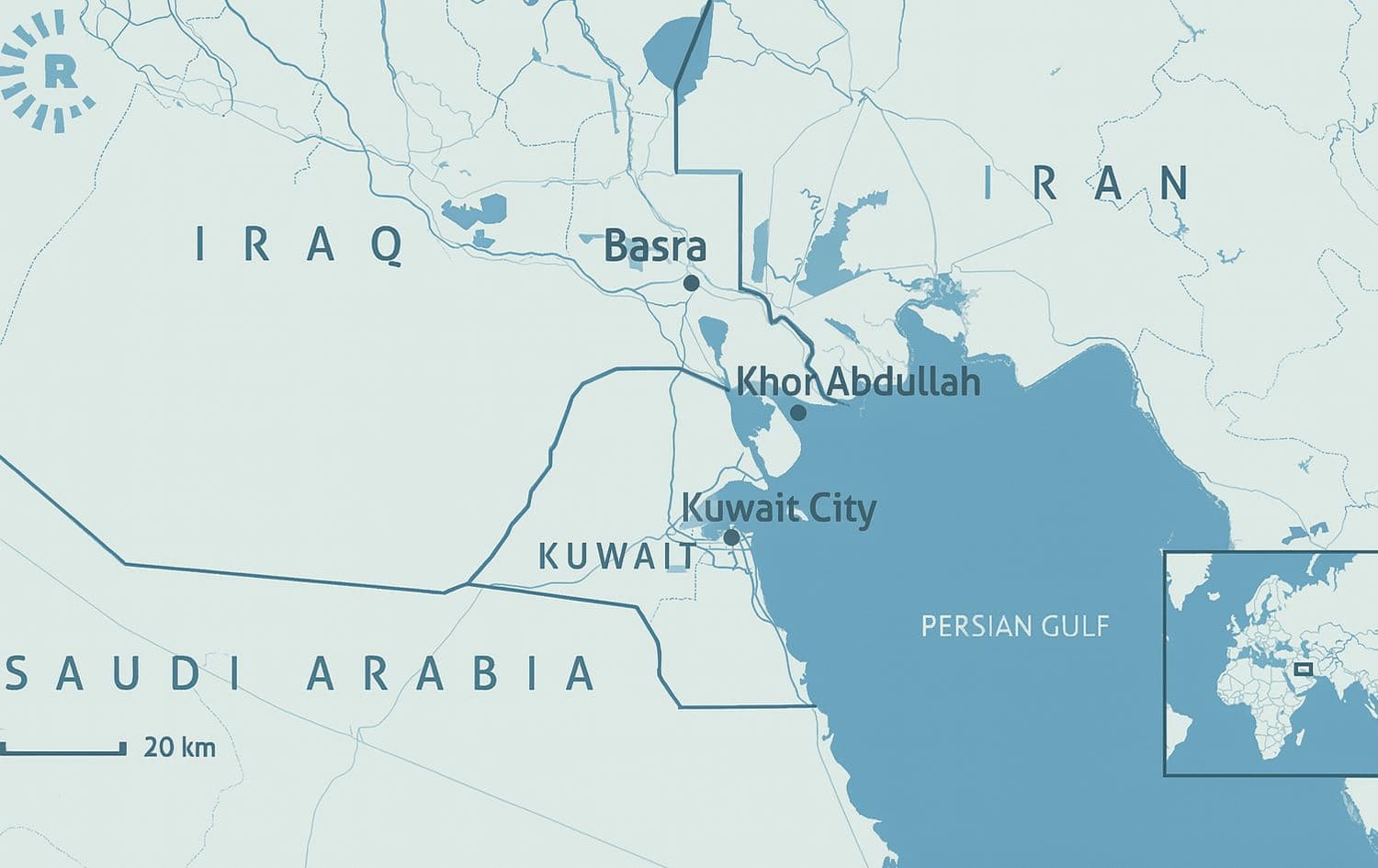

ERBIL, Kurdistan Region - With protests taking place in Basra condemning regulation of maritime navigation in the Khor Abdullah waterway shared with Kuwait, a member of parliament said Iraq can withdraw from the agreement that he argues impacts the Development Road project.
"The Iraqi parliament can request cancellation of the agreement and the government can also withdraw from it, especially since there is a Federal Court decision. This gives the government an opportunity to tell the Kuwaitis that we do not accept this agreement," Musanna Amin, a member of the Foreign Relations Committee in the Iraqi parliament, told Rudaw on Saturday.
"The Iraqi government can negotiate a new agreement in a way that protects the interests of both sides. If it doesn't do that, then it becomes responsible for the loss of Iraq's rights," he added.
The Khor Abdullah agreement - signed between Iraq and Kuwait in 2012 - regulates navigation rights in a narrow waterway shared by Iraq and Kuwait that is Iraq’s only direct maritime access to the Persian Gulf. Al-Faw port, the southern end of Iraq’s ambitious Development Road project, sits at the head of Khor Abdullah.
The agreement delineates the maritime boundary that was not covered by the United Nations when it defined the land border in 1993 after Iraq’s invasion of Kuwait. It has always been a sore point from some politicians who say it infringes on Iraq’s sovereignty.
In September 2023, Iraq’s Federal Supreme Court ruled the agreement was unconstitutional, arguing that parliament ratified it with a simple majority rather than the required two-thirds majority.
That decision was welcomed by some political factions within Iraq, but drew condemnation from Kuwait, which called on Baghdad to take urgent and decisive steps to correct what it described as historical inaccuracies in the court ruling.
Iraq’s Prime Minister Mohammed Shia’ al-Sudani Sudani and President Abdul Latif Rashid, under diplomatic pressure from Kuwait, its Gulf allies, and the United States, have individually appealed to the Federal Supreme Court to reverse its annulment of the agreement.
The head of Iraq’s Supreme Judicial Council, Faiq Zaidan, on Wednesday confirmed the legality of the 2012 agreement. He said that the court’s 2023 reversal had no constitutional basis and could invalidate over 400 treaties, exposing Iraq to international legal risks. He said the court had overstepped its authority.
MP Amin described Khor Abdullah as a “very sensitive and strategic” issue, and warned that the disputed waterway directly impacts the Development Road project.
"Iraq is interested in canceling any agreement that becomes an obstacle to the Development Road project. This agreement is registered with the United Nations, but that doesn't necessarily mean it can never be canceled," he said.
“The Development Road, compared to routes like the Suez Canal and Gibraltar, can shorten international trade by 10 days,” he added. “This makes Iraq one of the largest sources and routes of international trade.”
Dr. Wael Abdul-Latif, a former governor of Basra, a judge, and one of the authors of Iraq's constitution, criticized Zaidan’s stance, saying it is not an official decision but rather a legal interpretation that “unfortunately... was disturbing, so it brought people to the streets.”
"It's decided that on Sunday, a large demonstration will be held in front of the Supreme Judicial Council, and tomorrow in Basra there will be demonstrations and a conference on this issue. Large demonstrations might also be held in other provinces,” he told Rudaw.
Malik Mohammed contributed to this report.