


Iraq

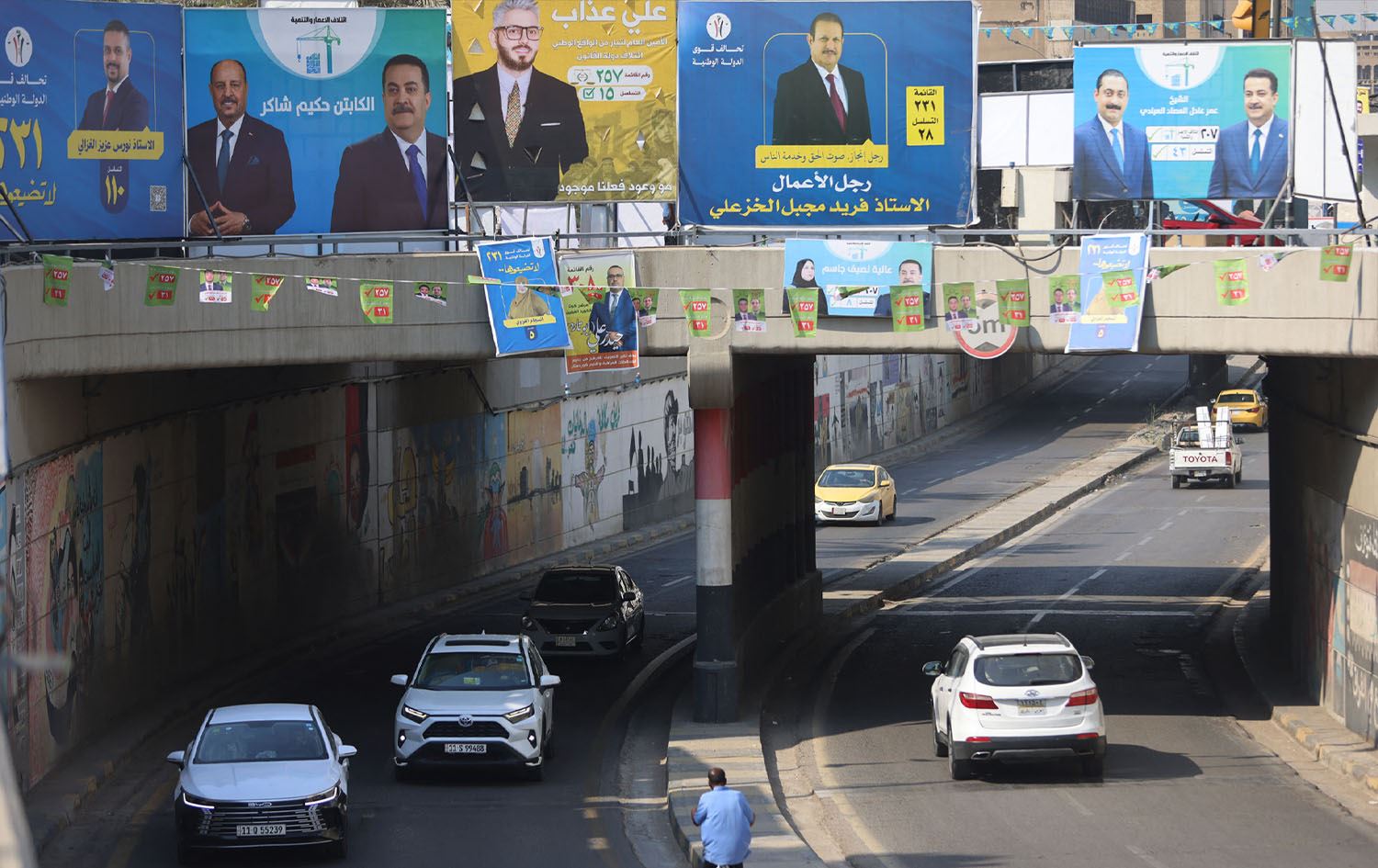
Traffic flows past electoral billboards in Baghdad on October 19, 2025. Photo: Ahmad al-Rubaye/AFP
ERBIL, Kurdistan Region - With Iraq’s legislative elections less than 15 days away, Kurdish and Iraqi contestants and officials are intensifying their campaigns and calls for voter participation.
Kurdistan Region President and first deputy president of the Kurdistan Democratic Party (KDP), Nechirvan Barzani, on Sunday called on supporters to strengthen the party’s position in the upcoming parliamentary elections scheduled for November 11.
“With your support, the KDP will emerge as Iraq's leading party - the party of one million [votes] and even more,” President Barzani told a large crowd at a campaign rally in Akre district, located in the Kurdistan Region’s northern Duhok province.
The KDP’s electoral list in Duhok includes 22 candidates competing for 11 of the province’s 12 parliamentary seats, with the remaining seat reserved for the Christian quota. The party “must succeed so that Kurdistan can move toward a better future, ensuring continued peace and reconstruction,” President Barzani said.
He further emphasized that the party’s mission extends beyond the Kurdistan Region, aiming to foster development across Iraq and to strengthen Kurdish-Arab brotherhood.
“Our lawmakers in the upcoming term have two main tasks,” the top KDP official pointed out, detailing, “First, to ensure that newly enacted laws are truly federal, reflecting the spirit of Iraq’s constitution - partnership and consensus. Second, to amend laws inherited from the previous regime so that Iraq’s system becomes a genuinely federal one.”
The Kurdistan Region President also highlighted the importance of relations between Erbil and Baghdad, describing them as a “central governance” partnership. He stressed that the upcoming elections are crucial for “implementing the constitution” and further defining the ties between the two sides.
Sudani seeks second term
For his part, Iraqi Prime Minister Mohammed Shia’ al-Sudani on Sunday warned against misinformation campaigns aimed at discouraging voter participation in the November ballot.
Addressing a gathering of tribal and community leaders from western Baghdad, Sudani said some parties “falsely campaign to fabricate facts and distort public opinion in order to hinder participation in elections.”
He urged political parties to ensure the “election competition is based on performance records and projects, and far from incitement rhetoric, regionalism and chaos.”
The Iraqi premier encouraged Iraqis to exercise their voting rights, describing their participation as a “constitutional right that determines the country's fate for the next four years.”
Sudani in early October reaffirmed his bid for a second term, pointing to his government's success in restoring “lost trust between the people, the political process, and state institutions.”
He then described the upcoming vote as “an important step in strengthening and consolidating the democratic system” in Iraq, especially as they are “not brought about by pressure from any internal or external factors.”
The Iraqi premier further expressed confidence in his Reconstruction and Development Coalition, which he says "enjoys popular acceptance" and is "qualified to win the largest number of seats" in Iraq’s 329-member legislature, due to its "clear vision, tangible achievements, and a proven national project."
"I aspire to form the next government to continue implementing this project," Sudani then confirmed.
Iraqi lawmaker and senior member of Sudani’s coalition, Mohammed al-Sayhoud, said the bloc’s main objective in the upcoming parliamentary elections is to complete the government’s ongoing projects if it secures a strong presence in Iraq’s next parliament.
Speaking during Rudaw’s election program Bestoon Talk, hosted by Bestoon Osman in Baghdad, Sayhoud explained that Sudani’s coalition brings together a range of parties and political leaders seeking to form a major parliamentary alliance.
“Our goal is to complete the reconstruction path we started during the current parliamentary term,” Sayhoud said during the program aired on Sunday, noting that numerous projects and challenges remain unresolved.
“Perhaps we have implemented only 20 percent of our plans - 80 percent remains. We need more time to address all the outstanding issues and problems,” he added.
Sayhoud emphasized that one of the coalition’s key priorities is to pass long-pending legislation, particularly the Oil and Gas Law, which has been stalled since 2007. The law aims to better regulate the management of Iraq’s energy resources and define the energy relationship between Erbil and Baghdad.
“Our genuine vision for building a constitutional and lawful relationship between the [Kurdistan] Region and the center requires enacting the Oil and Gas Law,” Sayhoud said. “In the future, God willing, it will be one of our top priorities.”
Addressing relations between Erbil and Baghdad, the lawmaker argued that the constitutional framework governing their ties has long been neglected. “Relations between the Region and the center have not been clearly defined by law,” he said, suggesting that passing the Oil and Gas Law could help resolve this issue.
Acknowledging the differing interpretations of the bill, Sayhoud stated that Iraq’s 2005 Constitution “has already defined the relationship between Erbil and Baghdad,” but added that “what remains is the differing constitutional interpretations.” He noted that such disputes are typically referred to Iraq’s highest judicial body, the Federal Supreme Court, lamenting that “our main problem lies in the lack of compliance with court decisions.”
Of note, Kurdish political leaders from the Kurdistan Region’s ruling KDP and Patriotic Union of Kurdistan (PUK) parties have repeatedly accused Baghdad of failing to uphold the constitution in its dealings with the Region - a central theme of their ongoing election campaigns.
President meets IHEC
Iraqi President Abdul Latif Rashid on Sunday met with Omar Ahmed, head of the Independent High Electoral Commission (IHEC), to discuss ongoing preparations for the upcoming parliamentary elections.
According to a statement from the presidency, President Rashid expressed his support for the commission’s efforts to ensure “clean and fair elections” that accurately reflect the will of the people.
For his part, Ahmed reaffirmed the IHEC’s commitment to implementing all necessary measures to guarantee transparent elections that meet public expectations and uphold citizens’ right to free participation.
On the same day, the electoral commission released updated statistics showing that 7,754 candidates will compete in Iraq’s sixth parliamentary elections - a slight decrease from the previous total of 7,769 after 15 candidates were removed since the start of the campaign period.
Election campaigning officially began on October 3 and will continue until November 8, ahead of the general vote scheduled for November 11.
Hastyar Qadir contributed to this report.


Comments
Rudaw moderates all comments submitted on our website. We welcome comments which are relevant to the article and encourage further discussion about the issues that matter to you. We also welcome constructive criticism about Rudaw.
To be approved for publication, however, your comments must meet our community guidelines.
We will not tolerate the following: profanity, threats, personal attacks, vulgarity, abuse (such as sexism, racism, homophobia or xenophobia), or commercial or personal promotion.
Comments that do not meet our guidelines will be rejected. Comments are not edited – they are either approved or rejected.
Post a comment