


Syria

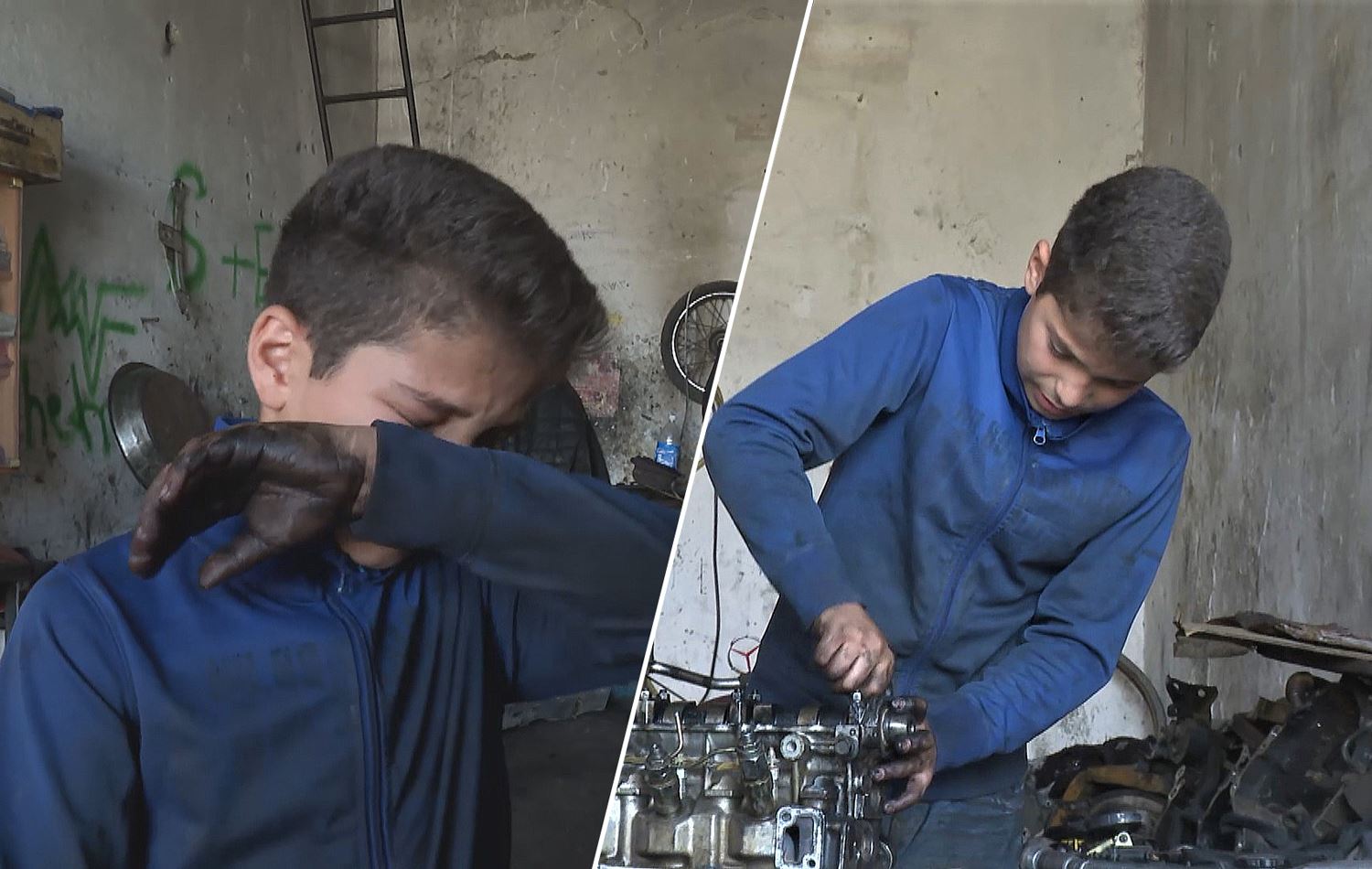
Eleven year old Muhammad Eziz works at a mechanical shop in Qamishli. June 5, 2021. Photo: Rudaw/screenshot
ERBIL, Kurdistan Region — An eleven-year-old Kurdish boy from the northern Syrian town of Sari Kani (Ras al-Ain) who was forced by poverty into hard labor at a mechanic shop after his family was displaced to Qamishli, longs to go home and see his friends.
“I only come to work and go to school,” Muhammad Eziz told Rudaw, while crying. “My legs and my back hurt … I’m really tired.” Eziz said he works eleven hours a day, from 8 am to 7pm, for only 12,000 Syrian pounds (less than $4) a week.
“I miss my friends, I miss my house, I miss everything,” he said.
The only son in his family of eight, he says he wants to help his father provide for the family.
“When I was in Sari Kani, I wouldn’t go to work, I just studied and played.”
Eziz says he now has nothing. When they fled from Sari Kani to Qamishli, “we didn’t bring anything with us, we just left.”
His father, Eziz Siddiq, says life in Qamishli is hard with the current economy, especially for displaced people.
“Rent is expensive. I am now in a house, he [the landlord] gave it to us for 100,000 ($32), he said he wanted to help us,” Siddiq says. “It’s hard, it’s very hard.”
Siddiq explained he hears from neighbors their house in Sari Kani is now occupied by “gunmen” and the car wash business they had back home is not operating anymore.
The Turkish invasion of Sari Kani and neighboring Gire Spi (Tal Abyad) as well as their surrounding areas – previously under Kurdish People’s Protection Units (YPG) – led to the displacement of hundreds of thousands of people – mostly Kurds – to other parts of Syria controlled by the Kurdish-led Syrian Democratic Forces (SDF).
Thousands of children who fled their hometown of Sari Kani due to the invasion in October 2019 have been missing out on schooling ever since.
The majority of Syrian children do not see a future in their home country, according to a Save the Children report from March.
Millions of Syrians have been displaced since the outbreak of civil war in 2011, either fleeing abroad or to elsewhere in the country. The total number of displaced people as a result of the war in Syria stands at 6.5 million, according to a report by Norwegian Refugee Council (NRC) published in March, known to be the darkest decade for the country.
According to the United Nations, nearly 90 percent of Syrians live below the poverty line and some 13.4 million people in the country need humanitarian aid.
The UN special envoy to Syria warned in May of a “growing humanitarian suffering” in Syria. “It is a tragic irony that this time of relative calm, compared with earlier years of the conflict, is also a period of immense and growing humanitarian suffering of the Syrian people,” he said.
“I want my voice to reach [international] countries, to return us back to Sari Kani,” said Eziz with tears in his eyes.
Additional reporting by Nalin Hassan and Dilbixwin Dara


Comments
Rudaw moderates all comments submitted on our website. We welcome comments which are relevant to the article and encourage further discussion about the issues that matter to you. We also welcome constructive criticism about Rudaw.
To be approved for publication, however, your comments must meet our community guidelines.
We will not tolerate the following: profanity, threats, personal attacks, vulgarity, abuse (such as sexism, racism, homophobia or xenophobia), or commercial or personal promotion.
Comments that do not meet our guidelines will be rejected. Comments are not edited – they are either approved or rejected.
Post a comment